31 July, 2014

Quill Sharpening and Other Useful Skills!

The other day I read an article relating (once again!) to Michael Gove who was, until last week, Secretary of State for Education in England. As anyone who has read my blogs before  will know this gentleman is not my favourite politician – I am not alone in that. His tenure in the post for the past 4 plus years has seen a continual war being fought between him, teachers, academics and many parents. He has been, to say the least a controversial figure. However, he has now been moved on to other spheres of influence so there will be fewer of my blogs devoted to him. You will, no doubt, cheer that fact! 
Just like the desks we sat in  when I was eleven - and the
inkwells are visible. Mr Gove would be proud!

The article that I read was a collection of memories and anecdotes by various people who had dealings with Gove over the past few years. With very few exceptions they were universally critical of the man. One item, however, caught my eye. It was written by a primary school music teacher who, over the past few years had on numerous occasions visited the Department of Education in London to attend meetings/courses etc. This is an extract from what she wrote:

I used to go to the Department for Education when it was the Department for Children, Schools and Families. Then, it was smothered in imagery of children and playgrounds. Wherever you were in the building you always knew where you were – it wasn't health or environment, it was education. After the election, Gove took this all down and put this 19th-century pupil writing desk in the foyer. It was such a clear sign of what was going to happen to schools.

As anyone who has lived through the past 4 years while the Department for Education has been under Gove’s stewardship will know the antique pupil writing desk was indeed a physical manifestation of what the man stands for - of Gove’s desire to turn the classroom clock back, for schools to be more “traditional”, to be more “academic”, to be more rigorous in their testing, to return to well tried and perhaps “old fashioned” teaching methods and discipline and to be more traditional in their values and curriculum. Well, all that is as maybe. As a teacher of forty years and at a personal level I often reflect that a bit of tradition is no bad thing. Having said that the displaying of a 19th century pupil’s desk and all that it implies about the Gove’s and government’s view of the nature of 21st century education is worrying. I also find it concerning that one man should be able to impose his own beliefs and prejudices on the nation’s education system - no matter how laudable, inspired or, in Gove’s case,  madcap they might be.
All my yesterdays - items that once ruled my world but soon became
obsolete and the knowledge redundant
But leaving all that aside let me move on. Later on the same day that I read the article I was  tidying a drawer in my office and came across one or two things from my past – things that were once very important to me and my life. Firstly, my old slide rule. Before entering teaching I worked as a design draughtsman in an engineering drawing office. In those far off days – the early 60s - a slide rule was a basic tool of every draughtsman or engineer. In those pre-computer/calculator  days it was vital in every calculation that you worked out – logarithms, sines, cosines, everyday calculations.  It was part of my daily professional world. Learning the skills to use the thing was one of the first things that I was taught when I started my career in that drawing office – John Newton, the chief draughtsman, took me into his office to guide me. When I attended college as part of my training time was devoted to ensuring that young trainees like me were fully conversant with this tool and its associated skills. And now it lies redundant and obsolete in my office drawer. As I held it in my hand the other morning I tried to remember what the numbers on each scale represented  and how I should use it to perform a simple calculation. True, its use was fairly specific, but it was of its time and has now been passed over in favour of electronic aids which, of course, require different skills. As I rummaged further through my office drawers I came across other items from my past. A set of French Curves which was also part of my everyday work in the drawing office – helping me to draw exact curves to meet certain criteria. These were not simply to make the design drawing look pretty but to ensure that the men on the workshop floor could make the required item exactly and accurately  so that it worked and fitted into its correct position to within thousands of an inch. Today, I would guess that sort of thing is all computer generated – the skills and the equipment that I practised, needed and used half a century ago have  disappeared and been replaced by others - and all my knowledge and skills in that area are now merely redundant and consigned to the waste basket of history. And finally, in my drawer, a bottle of ink. Not, perhaps, totally redundant today but still something that has been largely replaced for many people as ballpoint pens, felt tips, word processors, computers, e-mails and the like have made writing with an ink pen a marginalised activity. Just as the quill pen (and with it the skill of quill sharpening) was consigned to the waste bin when the “modern” fountain pen came along so, too, fountain pens in their turn – and all their associated writing skill requirements – are largely things of the past. As I looked at the bottle, which has probably not been opened for almost half a century, I thought how many hours I had spent in my early teaching career working with children to ensure that they could grip and successfully use an ink pen. I reflected, too, that although I have a fountain pen which I still use when appropriate, my modern pen is charged with pre-filled cartridge, and doesn’t require a bottle of ink. Times have changed. I recalled that when I was a eleven year old child at school, sitting in a desk not unlike that on display at Michael Gove’s Department for Education each desk had a little pot inkwell sitting in a whole in the desk. We boys would dip our stick pens into the inkwell as we blobbed and scrawled in our exercise books. Every Friday afternoon, my teacher, the much feared Mr Roberts, would choose one boy to be the inkwell monitor for the afternoon. We all desperately wanted to win Mr Roberts’ approval so worked diligently on Friday hoping that we would be the chosen one. If I was lucky one then late on Friday afternoon while other boys were still working I would proudly and silently creep around the classroom with the ink container carefully replenishing the ink in each of the little white pot inkwells so that all was ready for Monday morning. And, of course, inkwell refilling itself was, in its time an important skill - using the inkwell filler correctly so that no ink splashed onto the desks was crucial if one didn’t want to incur Mr Roberts’ wrath!. But no more, times have changed.

All these items and skills are now largely replaced by others. It’s the way of the world. That’s the problem with knowledge and much of what we learn – it has a massive obsolescence factor.  And it has always been thus. We cannot blame it on the modern world. A thousand years ago William the Conqueror’s knights practised their battle skills by riding at speed ducking and diving through dense forests to imitate battle conditions – but with the invention of the gun much of that became immediately redundant. Three hundred years ago, the skills of the home weavers producing cloth were major parts of life and everyday economics of every village and hamlet but the invention of the steam engine and the modern loom altered the industrial and employment landscape.  Great factories grew and the old home weavers’ skills and knowledge were no longer needed – different mind and skill sets were required. And today, it seems, knowledge is expanding and accelerating at a phenomenal rate – what is useful today will almost certainly have only a very short life span.  
Just like the inkwell filler we had in Mr Roberts' class -
the skill was to fill the little pots without makinjg a blob

My mother in law, who died in 2006 just a few years short of her century often remarked  how her generation had seen so much change. She was right and future generation will see even more – and schools have to be responsive to this. Mr Gove’s antique desk implicitly suggesting that “the good old days of education” were the best and something to return to could not be more wrong. Both in content and in approach education has to look forward and schools have to anticipate and continually change, evolve and respond to an ever changing world. I have absolutely no doubt that what is being taught to my grandchildren today in their respective schools (good though they are) will be less relevant and may, like my slide rule or French curves be redundant knowledge and skills by the time my grandchildren leave school to enter the world of work. Such is the nature of change, the world and education. Michael Gove’s desire to look back might be appealing but it is also very, very wrong and does children and society no favours at all.


18 July, 2014

"Dominus Fecit" - the Lord has made.

Fifty years on - standing on what remains of the steps to the
 main building. Flowers give a cosmetic tinge to what is now
 a graceless and tasteless educational factory farm.
Last week we had friends from Australia staying with us for a few days. Pat and I had been at teacher training college with Jacky in the mid sixties and soon after qualifying she emigrated to Australia. In the 40 plus  intervening years we have communicated regularly, visited each other in our respective countries and often relived our misspent youth in the heady days of the Beatle, Rolling Stone and Bob Dylan filled 60s! Jacky married Garry, an Australian, and they live in the wonderful city of Adelaide. While they were here, Jacky thought she might like to revisit the college we had attended all those years ago. It was a salutary reminder to all of us when we suddenly realised that it will be 50 years ago next year (2015) that we first met at what was then Nottingham teacher training college or Nottingham College of Education as it was called in those far off days. The college – now part of Nottingham Trent University – is only a couple of miles from where we live and over the past 49 years both Pat and I have visited many times to attend meetings and other local functions so we knew what to expect. We knew that it had changed mightily since our day.

Perhaps it was because on this occasion it was a nostalgic trip - a revisiting of a long past but well remembered part of our lives – this visit to the college with Jacky and Garry was, however,  different. As we drove up the entrance drive we were stopped 21st century style by security and given a day permit. We followed the myriad of roads and signs to find our way to the visitor parking – Jacky occasionally exclaiming “I’m lost.......it’s all changed”. Indeed it had – and, of course, that is what you would expect after almost half a century. In our day it was a much smaller institution catering only for the training of teachers. Today, it caters for a multitude of disciplines and faculties – the education  section is only one part – and indeed, is concentrated in only one building. The rest of the large campus is a complex web of modern buildings, sweeping roofs, vivid colours, shopping areas, traffic humps, commercially sponsored buildings, and continual  redevelopment as the University grows further. In a constant state of change it seems to have no tradition, no solid foundation. It is a learning place not a place of learning. As we left the car we came across the occasional remembered building – the “boiler house” where the old college’s central heating was run from, one or two of the old tutors’ houses now converted for other use. We approached the main building – the centre of the old college – to find it half demolished as further developments took place. In fact it was hardly at all the place we had enjoyed all those years ago. As we walked along one of the paths we followed a student – wearing shorts, vest and his arms covered in tattoos and as we walked I reflected that the college and indeed higher education in this country has changed (in my view) in more ways than simply new buildings – and maybe something has been lost.
As it was in our day - the "Great Divide" goes off to the
right in the distance

In the UK higher education is a bit of a political and educational battle ground – students now have to pay very significant amounts of money for their courses which usually means they leave university saddled with huge debts. Understandably, therefore, they question : Are we getting value for money, do we have enough lectures, are the lectures providing what we want, is the accommodation suitable for our needs, which is the best course to guarantee us a job at the end of it? In other words it has become a consumer driven market. On top of that the name of the game as far of the higher education institutions are concerned is “bums on seat” – making themselves as attractive as possible to win the affections of both clientele and government funding. Higher education is now exactly the same as the supermarket where customers demand what they want and the universities, like supermarkets, strive to outdo each other to gain the custom and the money of these young people. As I looked around the college I could not escape the feeling that this was an educational conveyor belt – the educational equivalent of factory farming where young people came and were fed their globules of knowledge and came out at the end with a bit of paper but not an education. The place had no soul, no heart beat. No longer did all the students come and for a year or two at least were part of the college community by living in halls of residence  before they spread their wings and went into “digs”.

Now instead of halls of residence  students, if they live on site, they live in en-suite rooms with their flat screen TV/computer/mobile. In the centre of Nottingham, near to the main building of Trent University there is a commercially owned tower block providing student accommodation. Each time I pass I sadly read the garish advertising on the outside of the building:  “Each flat  fully furnished, with leather recliner chairs and flat screen TV and  with en-suite facilities  and shared kitchen area. The accommodation has a gym and supermarket on-site and is next door to The Corner House – a complex offering a brilliant selection of restaurants, bars and entertainment venues. Across the road is the Victoria Centre, home to upmarket department stores and high-street shops”.  Sounds wonderful – clearly what students 21st century style want; but no mention of desks or library facilities or things to nurture the soul.  Just good access to designer shops, restaurants and bars! Why would you go into your college of university with all this available outside your front door. And if you don’t go into your university, except to attend the occasional lecture then in my world you would be missing a huge portion of what university is about – the social and intellectual life, the social and academic societies, involvement with like minded people, the opportunity for the institution and its members – both staff and fellow students  - to change you, in short to “educate” you. But instead, it seems today’s student all too often lives in their little en-suite world surrounded by all that they like and know – lap top, wi-fi, gym, designer shops, bars – and the university is just the learning place, not the place of learning.
As the campus is now - brazen and garish

I thought how in our day if one wanted to leave the college at weekend to visit parents, go on a trip somewhere we had to first obtain an exeat from our tutor giving us that permission.  I somehow think  that would be frowned upon by today’s youth – and definitely score against any university’s attractiveness if they tried to introduce it. As we stood outside what had, in our day, been the main college building I noticed that the steps leading up to it were now decorated with flowers – a cosmetic nicety to be sure. But maybe like so much in the modern world that was just what they were – cosmetic  froth hiding the basic tastelessness and gracelessness of the modern world. We stood in the foyer to the main building and peered through the glass doors into what in our day had been the college dining room -the place we ate breakfast, lunch and dinner. How it has changed. To be sure it is still a cafeteria  but now filled with garishly coloured plastic tables and along one wall banks of computers -  a far cry from the softly curtained and subdued  place that  we knew and  where one didn’t just go to eat – but to learn to be a person. Let me explain.

The college was opened in 1960. We went in 1965 and in those few short years it had  already established itself as one of the premier teacher training institutions of the country and a place highly thought of both academically and as a professional training centre for teachers. Without any doubt this was due to the efforts and skill of its first principal – Kenneth Baird, or “Yogi ” as we affectionately called him (after Yogi Bear who was a popular TV cartoon character at the time!). In the first  few years of the college’s life Mr Baird had established traditions, values and expectations that permeated the whole of college life and which made you very aware that your were at Nottingham College of Education and not just any college. When you arrived there you quickly got into the Baird way of doing things. Much of this we mocked – as teenagers that is what one does – but in our heart of hearts we all knew it was good. Mr Baird’s college didn’t just turn out academically good teachers it turned out mature professionals who within three years at college had turned from callow teenagers into young men and women who knew how to conduct themselves in any situation – personal, professional and social.

The students' common room 1960s style
I well remember the very first night at college. There was a “Formal Dinner” – yes, that was what they were called and attendance was compulsory. I sat there at a table with 7 or 8 other students and a tutor – I hadn’t a clue which knife and fork to use, or what I should say about the glass of wine that the tutor had provided. I watched others and learned. I learned over the next three years to feel at ease in this kind of social setting and to know the expectations and the mores. It was all so very new to me on that first night, and I know that was true about many of my peers – but we were on a learning curve which would give us skills and understandings that would serve us well for many years. Throughout our time at college every day of the week the dining room served not only as an eating place but as a social gathering place. It was not just a grab a tray and get your food place – the equivalent of McDonald’s which is what I thought of as I gazed through the glass doors of the place last week. No, it was a dining room where one “dined” chatted over a meal, said grace, largely spoke in whispers – and dressed for dinner. Each day one could have “cafeteria service” if one wanted an early meal because of some evening commitment. Or, you could opt for dinner service at 7 pm where one was expected to dress properly, sit in a pre-arranged group and maybe take a bottle of wine. At 7 pm Mr Baird and members of staff would file into the Dining Room, all we students would stand and when everyone was at their place Yogi would quietly say a short grace followed by “Dominus fecit” ("the Lord has made", the motto of the Baird family) or “Tempus fugit”. At the end of the dinner, as plates and dishes were being cleared Yogi would again stand and quietly say “Gentlemen, if you must you may” – the students were being given permission to smoke if they wished. Once a week – every Tuesday – there was a Formal Dinner. You didn’t have to go to Formal Dinner every week but had to attend a certain number – sometimes these would be times when you would meet with other members of your various teaching groups or celebrate some special occasion. At Formal Dinner evening dress was required and expected.

All very old fashioned, twee maybe, and some might say quite out of sync with the heady and revolutionary days of the swinging sixties but no, it was appreciated and respected by all. We all knew that we were being prepared to become teachers, maybe head teachers or even more. We were gaining experiences and know how that most of hadn’t had at home – it was widening our horizons. And that is after all the basic thing that any educational system must do. If it doesn’t do that it is not “education” it is simply training – sadly what schools and colleges have largely become in the modern UK – training institutions not educational establishments. The schools of Michael Gove and of the National Curriculum and of OFSTED are places to get a certificate of your competence in some form or other – be it a level 4 SAT at 11,  a clutch of GCSEs at 16 or a 2:1 degree at the end of your university – and you can do all these things and still be the same person, because all you have done is an academic course and learned to get the right answers. Education is more than that. I well remember when, a few years after leaving college as a young teacher I attended a number of residential courses in venues across  the country. These were organised by HMI (Her Majesty’s Inspector) – the highly regarded School Inspectorate. Places on these courses were like gold dust and those running the courses were often national or international figures. I still remember standing having pre-dinner sherry with the other members of the course and various senior HMI. I felt comfortable being able to converse with these people and to be in their company and, as I stood there, I remember  saying a silent “thank you” to Yogi Baird and what he established for preparing me for this.
Ready for formal dinner

Times have changed. In thinking about this blog I dug out a letter that I found in my mother’s items when she died. It wasn’t new to me I had seen it many years ago. It was a letter sent by Mr Baird to the parents of all new students who would be coming to Nottingham College. Today it looks very dated and I suspect any 18 year old today would be horrified to read it. It speaks of a bygone age and long forgotten beliefs and expectations. In my view it also speaks of a greater vision and understanding for what should be expected of and presented to young people. I was a little older than the average trainee teacher when I went to Nottingham College of Education – having trained as a draughtsman for a number of years I was already 20 when I went to college. But despite that my parents still got this letter and I know they appreciated it greatly. It is too long to quote in full – three pages of “foolscap” – remember that, how strange the dimensions of foolscap look today! All tightly typed – no rushed photocopying, no cosmetic logo or advertising and above all no impersonal computer template. It was a personal letter to my parents.  Mr Bird speaks of welcoming me and committing himself to “ensuring three years of hard work, interest, excitement and happiness” – well he certainly did that. He advises my parents about the financial arrangements and support I will require and about they should try to ensure that I am wise in my use of funds. He talks of the reading lists that I will be sent and how they should try to ensure that I fulfil the various tasks on them prior to arriving at College. He talks about the many games and entertainment opportunities that will be available and how he hopes I will play a full part in the sporting and cultural life of the college and he then goes on to mention sex! “Where a large number of attractive young people are together inevitably they will form friendships with members of the opposite sex. I do not regard this as a bad thing.......I will treat them as adults.....they are starting their independent lives  and I have no doubt that you will speak to them about the need for self control.....In three years’ time they will themselves be in charge of classes of young people. They must have achieved their own moral standards before they can teach them to others in their care ”  Mr Baird then goes on to discuss the various medical facilities at the college and how in an emergency situation he would act in loco parentis  should any crucial decision need to be made about my welfare and my parents might not be immediately available. Finally he talks about a number of other things - how any motor vehicles must be registered at the college and how my parents must provide a written consent to my riding pillion on a motor bike or where and when trunks might be stored and what parents should do if they have any concerns.

 The letter looks terribly dated today – but it strikes just the right note. I know that my mother was pleased to receive it and I’m sure today any parent would still be pleased to receive the information and advice that Yogi set to paper. And it wasn’t all talk. He was as good as his word. We all knew what the rules were and although as young people there was much “testing of the water” we were allowed to develop and grow and change within the context of what had been imposed and was expected.


As we stood at the front of the main college building we looked down what was, in our day, the main drive of the college – the “Great Divide” as it was called. In those far off days the halls of residence fell on either side of the drive – women’s blocks on one side men on the other. Members of the opposite sex had to be on their own side by 10 pm each night under peril of expulsion. If a party was to be arranged we could apply for an extension on that rule but, whatever, the main drive, the Great Divide, was patrolled from about 9.45 each night by one of the college’s wardens. Any parties were checked to make sure that the required permission had been granted (usually an extension on the time limit till 11 pm). Yogi’s word in action.  We were being treated like adults, given certain freedoms but expected to obey the rules – all of which seems a pretty basic rule of all societies to me. Sadly, I too often ponder that today we may have forgotten that.
Our three years at college gave us so much – and I suspect the least important part was the academic stuff. Yes we worked hard and I think it was true that such was the college’s reputation in those early days that all those who gained a place did so on merit. Yogi Baird’s institution turned out a stream of high quality young teachers who were grabbed by schools and I know quickly rose to senior positions in both schools and wider education. But, it also turned out young people who were ready as Mr Baird said in his letter “themselves ready to take charge of young people”  We were expected to and had been given the opportunity to develop the personal, social, cultural and moral skills to enable us to take our place in our chosen profession, we had not been trained to be a teacher but educated  in the widest possible sense for life. Nottingham College of Education under Kenneth Baird’s leadership wasn’t the hallowed corridors of Oxford or Cambridge but like these two institutions it gave me and many others a framework for life. His family motto, Dominus fecit - what the Lord has made - was almost a metaphor for him and what he created and which benefited so many.  And for that I will be eternally grateful – it broadened my horizons and allowed me to enter a different world. I didn’t just get a teachers’ certificate when I left, I got a passport for life.

I’m not sure that the quick fix training of today’s schools and campuses and the obsession with certificates and value for money education  as the marker of an “educated person” can or will provide the same opportunities and results. The en-suite flats, the access to designer shops and bars, the flat screens the leather recliners or the McDonalds like educational factory farm campuses merely, it seems to me, give the young students of today what they like and know – wine bars, the flat screens, Wi-Fi, gymnasiums, designer shops and the rest. They will attend the university, go to all the lectures, pass the exams and leave with their certificate - but little else. Like a visit to an educational  supermarket they will emerge with their value for money training and  with their degree tucked into their bags but  I fear they will  not have been changed.


13 July, 2014

Shocking!

Last week I read a report of some research done in the USA by psychologists at the Universities of Harvard and Virginia. Briefly, the research indicated that people find it very difficult to do nothing, that people seem consistently to hate being left alone with their thoughts - and this, it seems, is regardless of their age, education, income or the amount they used smartphones or social media. The researcher who led the work, said the findings were not necessarily a reflection of the pace of modern life or the spread of mobile devices and social media but might be based upon our constant urge to do something rather than nothing.

The first run of experiments began with students being put – alone, without phones, books or anything to write with – into an empty room and told to think. The only rules were they had to stay seated and not fall asleep. They were informed – specifically – that they would have six to fifteen minutes alone. The students were questioned when the time was up. On average, they did not enjoy the experience. They struggled to concentrate. Their minds wandered even with nothing to distract them. Even giving them time to think about what to think about did not help. And, in case the unfamiliar setting hampered the ability to think, the researchers then ran the experiment again with people at home. The results were the same except that people now found the experience even more miserable, and cheated by getting up from their chair or checking their phones! To see if the effect was found only in students, the scientists recruited hundreds of other people, aged 18-77. They, too, disliked being left to their thoughts.

But the most telling result was that to check whether people might actually prefer something bad to nothing at all, the students were given the option of administering a mild electric shock. They had been asked earlier to rate how unpleasant the shocks were, alongside other options, such as looking at pictures of cockroaches or hearing the sound of a knife rubbing against a bottle. All the students picked for the test said they would pay to avoid mild electric shocks after receiving a demonstration. But to the researchers' surprise, 12 of 18 men gave themselves up to four electric shocks, as did six of 24 women – each later confessed that they administered the shocks to ease the “boredom” or unpleasantness of being left completely to their own devices. "What is striking” confirmed the lead researcher, “is that simply being alone with their thoughts was apparently so aversive and unpleasant to people that it drove many participants to self harm and administer an electric shock which they had earlier said they would pay to avoid."

It is not unusual when I read reports such as this, of pieces of academic research being undertaken (usually at huge expense) for me to ruefully comment “Well, I could have told them that” but on this occasion, it really did not surprise me. I have long noted the reluctance (I think that this is an increasing phenomena) of people to be happy with their own company and thoughts. Almost five hundred years ago the French mathematician and philosopher Blaise Pascal commented upon the same human characteristic when he famously said: “All mankind’s miseries derive from him being able to sit in a quiet room alone and with only his thoughts”. He followed this up with other similar observations such as “So wretched is man that he would weary even without any cause for weariness... and so frivolous is he that, though full of a thousand reasons for weariness, the least thing, such as playing billiards or hitting a ball, is sufficient enough to amuse him”. In other words, man needs constant distractions or amusement and is unhappy with his own company and thoughts.
Blaise Pascal

I do not think that anyone could deny that Pascal’s words across the centuries or that the findings of the two US universities do not contain some elements of truth. Our inability to simply be content with our own thoughts and company manifests itself in a myriad of ways – both personal and in globally. In the modern world, people cannot simply walk down the street without constantly referring to their mobile phones – not always to make a call. So limited is their ability to be at ease with themselves and so limited their concentration span when alone that, I might argue, that viewing a social media site, the playing a game or the sending of a text for them breaks the boredom of a simple, silent walk. Joining a gym, going for a walk watching TV, writing a blog, going to the pub, reading a book and a million other things are other ways we “manage” our respective inability to be at ease with ourselves and our condition - so we need to “pass the time”. Many of these “pastimes” may be perfectly laudable and indeed ways of “self improvement” but I wonder how many are simply distractions from ourselves and our thoughts. Indeed, one of the commentators on the article made a point, that had, I believe, some merit: “I think this proves something we all greatly fear; when left alone we fall into a tumbling darkness. We are, in the majority, a desperately unhappy, Godless race. Not that I believe in God. Countless hours of our days are spent projecting an appearance, a persona, to the extent that we no longer have a central sense of self. Our Id is lost. Thus, when left with no one to project to, the realisation of the death of self is to some, unfathomable, unbearable even.”

The above observation can be seen often even with young children. Watch a young child in a room with a peer who is occupied with some activity or other and it often will not be long before he/she will “interfere” with what the other is involved in – not because he/she wants to play but simply to be involved, active – unable just to sit back, watch others and be themselves in silence. As the commentator above suggests the child is “projecting an appearance, a persona” and when we are left completely alone and with no one or nothing to project to it becomes quite “unfathomable” and “unbearable” for us. And, even at a national level, countries cannot bear to confront their own “self” – every vacuum has to be filled with action. Things must be done – we must keep busy, we must do something! Watch great nations (the UK and the USA?) – and see how they cannot bear the thought of non-interference in the affairs of others – Iraq, Afghanistan and the rest. The national persona has to be projected. It is not in the human psyche – certainly of the “developed” western world - to simply be content with our lot, to live in our own world. We have to keep “doing”, we have to constantly be “involved” and active. We have to project our persona.

I am reminded of the hymn that we used to sing at school half a life time away – some of the words implored the children to learn:

“.....When to speak and when be silent,
When to do and when forbear....”

Sadly, both individually and as great nations we find it difficult to distinguish between “.....When to speak and when be silent, When to do and when forbear....”!

One could, of course, argue that this is one of the essential characteristics that separates us from the animal kingdom – that we “do” and in “doing” improve ourselves to make us something that were not before. Clearly there is some truth in that – animals are not constantly ”doing”, entertaining themselves, keeping fit, communicating with others as we are. When he is hungry the lion may join with others to hunt down a gazelle but when his hunger is sated he will simply “chill out”, lie in the shade until the next hunger pang encourages him to spring into action, to do some “work”. He is not bored with himself or of “nothingness” but content to lie in the shade with his thoughts, whatever they might be.

And it is not just the animal kingdom that has no problem with solitude or lack of constantly doing. Most of the world’s what might term “primitive” societies are similar. They do what they need to do – get food or build a shelter – and with that they are largely content. Having eaten sufficient and ensured some kind of shelter then like the lion they “chill out”. But not so the more “advanced” societies – we continue to beaver away keeping occupied, being entertained, making items of desire rather than items of need. It is only these “developed” societies – often of the northern hemisphere or those adhering to the notion of the Christian work ethic - that see some virtue or need to constantly “do” or be involved or to create. And invariably, what they “do”, or are involved in or create are not life’s essentials – they are not concerned with keeping oneself alive or warm or fed but are rather concerned with making life pleasanter. That may be no bad thing but when one considers that all this hard work and effort is being expended largely to keep us entertained and to ensure that we pass our time on the planet pleasantly it might be questioned. Making a TV set in order that someone can watch that TV set, making a mobile phone to enable us to send messages of a largely inconsequential nature or to pass the time with as we sit in the doctor’s waiting room, growing more and more crops to fill our supermarkets with wider and more exotic choice – then it puts it all into a kind of perspective. It is not unusual, to read of some elderly person who has perhaps passed away and at their funeral or in their obituary they are applauded because they “never missed a day’s work in their life” or perhaps “carried on working right up to their death” when they absolutely no need to do so. All very inspiring and laudable – but is it necessary? Or, is it rather, that they could not face the thought of their own company and thoughts without the distraction of “work”.

In saying this I am reminded of the comment on a different theme in Evelyn Waugh’s “Brideshead Revisited.” As Lord Marchmain lay close to death Charles Ryder comments to the doctor that “Lord Marchmain has a wonderful will to live” . In response the doctor dryly observes, “Would you put it like that? I should rather say he has a great fear of death.” Similarly, we keep constantly busy in some way to create things and situations that prevent us being bored and which merely help us to “pass the time” because in reality we are so frightened of our own company. While writing this blog I have just read of a man who each day when he wakes he has, since his school days (he is now well into middle age), followed exactly the same ritual. On waking each morning he picks the first random subject that enters his mind as he opens his eyes. He then lies in silence and thinks about it for fifteen minutes. At the end of that period he then sits on the edge of the bed and talks for seven minutes on the subject – airing his views, clarifying his thoughts, explaining his opinions. And all this to an empty room! One might have mixed views about this and about him – but clearly he is at home with himself and his thoughts – he is a rare human.

For the rest of us, so dissatisfied with our own lives and minds are we that as the research suggested and as Pascal knew we cannot bear the thought of our own existence for as little as fifteen minutes. Instead we need to be distracted from the horror of ourselves, our condition and our thoughts by giving ourselves an electric shock. “Nothing is so intolerable to man as being fully at rest, without a passion, without business, without entertainment, without care” commented Pascal in the seventeenth century. He was right.


02 July, 2014

Accident & Emergency - self fulfilling problems?

As Pat and I left our house on Sunday morning we saw an elderly local lady who had missed her footing and fallen heavily onto the pavement whilst walking to church. She was sitting there looking dazed while another lady was trying to help her to her feet. The fall had obviously shaken her up – a badly cut lip, various other grazes and a particularly nasty sliced cut to her hand were the wounds we could see, but I suspect she would have also been rather shaky for a few days as a result of her fall. We helped her to her feet, gathered up her belongings – including her walking stick - and discussed what to do next. Fortunately, another neighbour came along who knew the lady and said he would make sure that she got home safely. “I’ll have to put a plaster on that cut on my hand” the lady said. Clearly something had to be done with it and although it wasn’t bleeding too much it was in desperate need of cleaning and I suspect needed a couple of stitches. “You might need to see a doctor” we agreed but her reply was “Well it’s Sunday, and the doctors aren’t open today”. It never occurred to her that it might be necessary to go to the local A&E department at the hospital – for older people that is often the case, they don’t want to bother emergency services with what they see as a trivial complaint.

Within that short conversation was highlighted one of the problematic  issues confronting our medical services in this country – the ability of the health service to meet demand and listening to the old lady made me think.

Sister Jen Du Prat whose humour and down to earth
way of managing patients have made her a
real celebrity. She comes over as the sort of person
you would want on your side when in difficulties!
A week never goes by without there being some media coverage in the UK about the health services available. It will be a brave government who considers abolishing the National Health Service – I have absolutely no doubts that it would bring any government down. It is widely praised and rightly revered. Equally, however, it can never meet demand and expectation – understandably when we or our loved ones are sick we want the very best treatment available – and instantly. In fact, the NHS is an almost no win situation; on the one hand revered and to virtually the whole population an almost sacred institution whilst at the same time vilified by those same people  when something goes wrong. When a hospital, nurse or doctor fails to respond in what the tabloids see as the way it should then the dogs of war are set loose. When a particular form of treatment is deemed too expensive or of dubious worth the “faceless bureaucrats” of hospital management are blamed. When necessary economies are suggested then “bureaucratic fat cats” are blamed for their salaries taking all the funds that should be put into patient care!

No system, I believe, can ever meet modern expectations, there will always be something else wanted. In our modern world, an ageing population, the costs of high tech medicine and drugs, the economic balancing of books, the availability and expense of highly qualified staff and all the rest mean that whatever system is used there are always going to be disappointed people and huge pressures built up. In the UK our “free” health service provides unquestioning care to all and in doing that is facing higher and higher costs as more and more people expect more and more. Because of my heart condition I visit the doctor occasionally for check-ups, blood tests and the like -  my every need taken care of. Each time I sit in the waiting room or pick up my repeat prescription I am amazed that all this comes “for free” – I would have no problem with making a regular donation towards the costs. I also sit there and reflect, when I read the notices in the waiting room, on the wide range of services that, in this modern day and age, are expected by the public and offered by the service.......... and I reflect, too, on  the necessary bureaucracy that this must cause.In short these things don’t just happen by magic!  I often think of the old village doctor we had for many years – Dr MacLaren.  He was of the “old school”. He ran his surgery with an iron rod,  no-one got past the dragon like receptionist unless they really were ill. The good doctor  was held in the highest esteem within the locality but, I have absolutely no doubts that he would not have survived today with the demands being put upon those involved in the modern service. And it all costs money.

 Many people take out private health insurance to help them access facilities quicker or to ensure what they perceive as better provision. There may be many ethical questions about that but even private companies face the same problems of too much demand – they however can resolve this by putting up fees or limiting the service unless people pay up front. In the end, it all comes down to money. There are as many views about what should be done to ensure the future of the NHS as there are people – we all have an opinion. Many politicians see some form of privatisation and outsourcing as a solution – others see greater investment as the way forward. Different involved parties have different viewpoints – doctors, nurses, patients, relatives, economists, politicians and the rest all argue their position and I am sure that all have some validity. But in the end these are only temporary solutions, in my view the pressures to some degree will always be there in some form or another. We are not unique on the UK – in America for several years President Obama has been battling to get his health care legislation through. When we look at other nations the grass might appear greener, but all, to some degree or other, face the same sorts of problems – too many people want better and better care which costs more and more. It is as simple as that and there are no easy solutions.

The many options and perceived solutions to the problems of health provision were again put into focus last week when a former government health minister commented that in his view the current health service would begin to critically fail within the next five years – something, he suggested had to be done and done quickly. Of course he had his solutions – as I am sure that we all have – but his comments were quickly followed up by an entirely separate item of news that said that attendance at A&E departments throughout the country were at an all time high and that they were having increasing difficulty in coping with the demand. For a variety of reasons people increasingly see A&E as a quick fix solution to their health problems. The situation seems to have got worse in recent years because allegedly it is now often difficult to get to see the local doctor within a few hours or days – sometimes one might have to wait for a week or more for an appointment. So, in “desperation” people turn up at A&E for immediate help.

As we drove away from the old lady, who was by now hobbling to her house on the arm of our neighbour, something else occurred to me that was new in my thoughts. It never occurred to her that her injuries were serious enough to warrant going to A&E at the local hospital – and, as I noted above, this is typical of older people. And whilst the problems of funding and resourcing the health service in general and the increasing demands made upon A&E services in particular are clearly complex and costly, I just wondered whether, in fact, we are unknowingly making things very much worse because of one small trend in recent years which is making the whole thing a self fulfilling prophecy.

In the UK today you can turn on the TV any night of the week and be almost guaranteed to see at least one hospital based programme. I don’t mean fictional series, although they are there in abundance, but “fly on the wall” documentaries. They all follow the same general format – the exciting, dedicated and tiring lives of the doctors, nurses and ambulance staff; the fact that no matter what your problem you will never be turned away; the vast majority of patients are successfully treated; only it seems those that you might expect to die (the aged and the very seriously ill) die, and those only very infrequently. The vast remainder, often against all odds, are successfully treated.  It is unashamedly  ”feel good TV” reminding us of the success of our system, the innate goodness of those who are there to care for us at times of distress and the fact that no-one is ever ”let down” by this system. I have absolutely no doubts that an advertising executive wanting to sell a product could not better the media coverage given to these situations – the overwhelming message is “come and you will be helped, no questions asked”. It’s an advertising executives dream! And it works – people do come in vast numbers – the local A&E department is something that nearly everyone wants to buy into!!!!!!

Of all such programmes none reflects this better that the hugely successful Channel 4  programme  “24 hours in A&E” – of almost cult status, it has had numerous series with more planned. Centred on King’s College Hospital in London it has made household names and given almost celebrity status to the various staff who we see each week overcoming the odds, giving of themselves and quite unintentionally sending the hidden message “Come, we are open for business and all who come will find succour – you will find kindness, a welcoming smile and the best treatment that money can buy”. And one sees a whole range of people who come – the old, the very young, and everything in between. They come with injuries ranging from the truly horrific and life threatening to the banal and unimportant – and, whatever, they are all given the same generous treatment. Just as it should be.
Dr Firas Sa'adedin - one of the A&E consultants whose
skills, calmness and commitment ensure success.

Much of the success of the programme is based, I believe, in the fact that it is indeed true to life – anyone who has experienced a busy A&E department will recognise that and in so doing it again reinforces the feeling that this is real life. It is what “real people” do both as patients and carers: when we are seriously injured in a road accident and our life is slipping away then we will be rushed into a department such as this and people will work to the limits to try to save us. Equally, however, when we feel a little “off colour”, or when our child has had a tummy upset for a few hours and won’t stop crying or, when we have, in the early hours, got drunk in a night club and fallen from the table on which we were dancing (and sprained our ankle) then we, too, can also turn up and expect the same support, kindness and help – whether we actually really need it or not – for we have seen others do it on TV each week. People just like us! Week after week we see elderly people brought in apologising profusely for being there when in reality it is manifestly obvious they are in serious need of assistance but at the same time we see younger people dropping in for the most trivial of conditions. As we watch many of the patients sitting in the waiting room passing the time in a myriad of ways: chatting, texting on their mobile phones, playing games, telling jokes, complaining because the coffee machine isn’t working properly or because  there is only a certain kind of sandwich available it is difficult not to conclude that the service is perhaps at the very least misunderstood and all too often being misused. It all begs the questions when is an accident and accident and when is an emergency a true emergency.
Waiting for our treatment - but are we all real emergencies?

The staff, of course, are quite correct to act as they do – they are bound by their professions and indeed, probably by their own code of ethics and beliefs to act as they do – not to discriminate, certainly not when the person needs help. They must be Good Samaritans, ever willing and able to help without fear or favour.  It is the very basis upon which our health service is founded and no-one would want to change that. But I do wonder if in portraying on TV the essential “goodness” of the facility and its associated hidden message that all will be treated without question just for a bit of exciting and feel good TV is not rather counter-productive. It legitimises casual use and in doing so somehow diminishes it. Accident and Emergency Departments are, I believe, for the cases which are by their very nature extreme, or thought to be extreme. They are not, nor should they be warm cuddly places which can be viewed as a soft option. This does not mean they should change their approach and become brutal or harsh places – the staff should carry on just as they are doing, providing a caring and warm atmosphere to all who come needing help. But equally, as the old lady who fell down in my street knew they should be viewed as a place of last resort which, undeniably, for many in modern Britain they are not. Rather, they are the first port of call for many – especially the young -  and the daily TV programmes displaying their very many benefits and kindnesses  are not helpful in ensuring that only those in there are indeed real emergencies and their needs the result of real accidents, not simply, every day events. Just, maybe, fewer TV programmes of this type might make these places a little more remote from peoples’  minds and experience and in doing so reduce the unnecessary use of them and thus free up personnel and resources for other important uses.

20 June, 2014

Bird Brain!

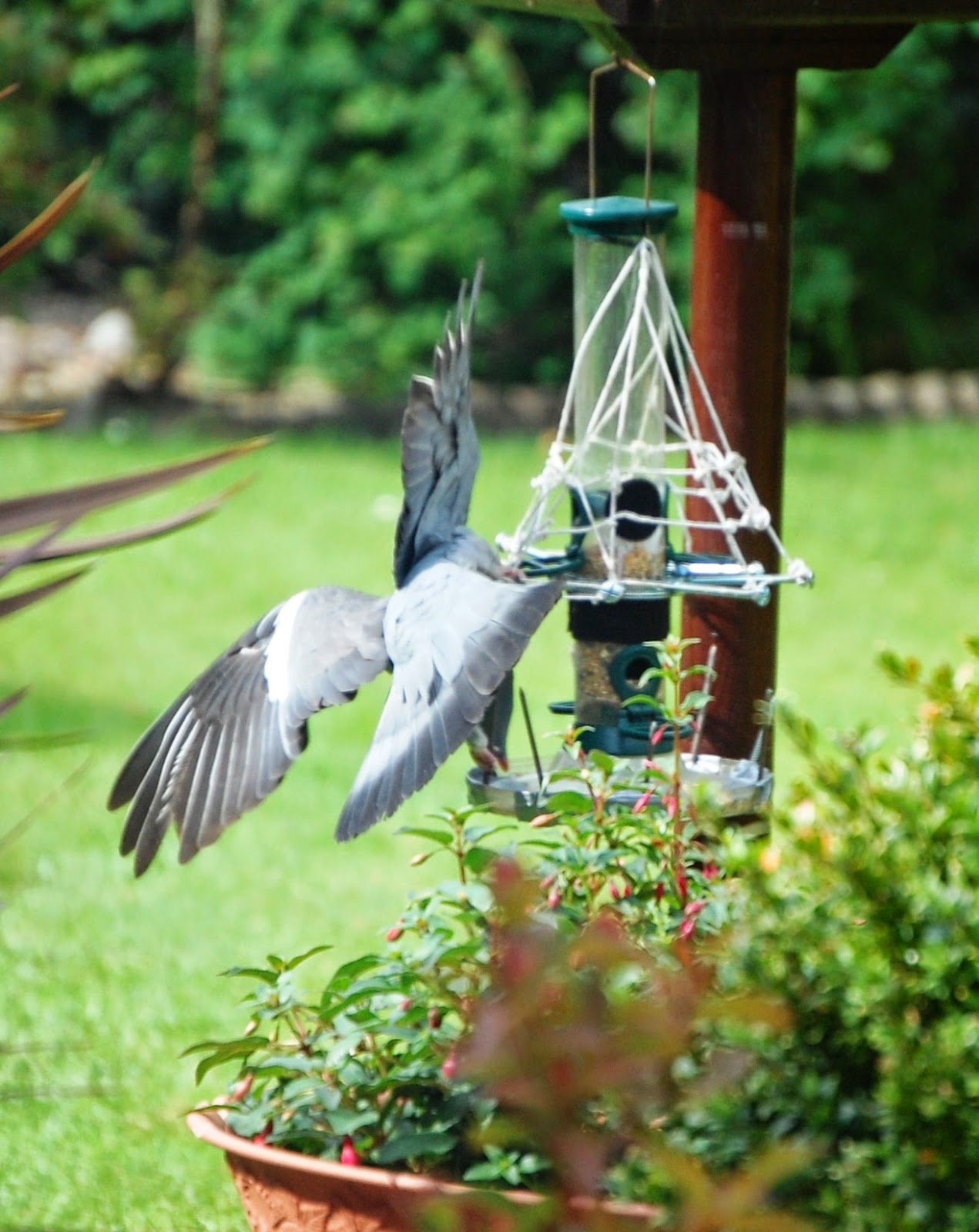
One of the many design modifications
My back garden has in recent days witnessed something of a stand off and mounting tensions reminiscent of Cold War Berlin when Russian and American troops faced each other each day at Checkpoint Charlie. If any of the neighbours have watched the goings on they will, I expect, have been on occasions both confused, amused and intrigued as how it will all end. For me what began as an amusing episode has become something of a tussle in which my very manhood is at stake! One of my defining characteristics is, I am told, that I never give in – I will not be beaten. If we have a problem then I will work away at it until I find a solution – it may not be the expert’s solution or even the best answer, but it is my solution. I will happily lie in bed at night wondering how I might approach the problem in order to resolve it. I am, in short, and as my wife has many times reminded me, a typical Taurean, both persistent and stubborn. She may well be right but in some ways it is an almost primeval desire to prove my very masculinity. And, I suppose, that as I have got older and in small ways become a little more limited in what I can do – go for a long walk, lift heavy loads, run to catch the bus, climb ladders – it becomes increasingly important to me that I am able to prove myself and my worth in the smaller things of life.

I'll get to those nuts somehow - and he did!
One leg holds the tray one leg holds one of
my deterrent screws!
Well, over the past few weeks a battle has developed in my back garden with an equally persistent, stubborn and determined foe – the neighbourhood pigeon! What began as a minor and amusing irritation has developed into the situation where we both – the pigeon and I – like enemy soldiers stand in our respective trenches looking across no-man's land  glare at each other. I glower through the window, he sits on the garage roof or the lawn and eye balls me back. Both of us are equally determined that we will each prevail in the end. Both unwavering in our belief that our respective manhoods triumph. Let me explain!

We have in our garden a bird table and hanging from it a bird feeder which we regularly fill with nuts and seeds. It is visited by a variety of birds – nothing extravagant just ordinary garden birds – sparrows, a couple of robins, blue tits and so on. In recent weeks the local pigeon has begun to take an interest in it and slowly but surely he has taken it over. He’s  far too big to access the roofed bird table, he devours the nuts and bread that we throw on the lawn and has now turned his attention to the bird feeder. Because of his huge size  if he tries to land on the feeder it swings like some deranged pendulum and he has to twist himself into all sorts of positions to access the nuts. But, not to be beaten, and as the days and weeks have passed, like a well drilled SAS officer he has honed his skills and can now cling on precariously for hour after hour while he empties the feeder completely of its nuts and seeds. He leaves nothing for the smaller birds and his size prevents others of his smaller brethren using the feeder as he sits and gobbles. When the feeder is empty, like some lumbering, overweight behemoth flaps his wings to struggle slowly into the air – like a heavily laden B47 bomber his hold filled.

And I'll use my wings to help!
This, we decided, had to stop. We had no objection to the pigeons, or this pigeon in particular, enjoying the food but being fair minded people thought they too ought to share the nuts with their lesser brethren. A way had to be found of making it just a little more difficult for him to access the feeder whilst still allowing the smaller birds free range. That is the nature of my battle with the wild life of the village!

The passing days have seen me plan and execute a number of design modifications to the feeder – each one calculated to counteract the latest pigeon strategy. First I put Velcro around the cylinder in which the nuts and seeds are held. The Velcro had some short screws protruding out of it to gently prod the pigeon in his huge flank as he clung onto the feeding tray at the bottom of the feeder. This plan didn’t work – he simply used his body mass to push the screws out of the way. Something more brutal and solid was needed. So next, used the drainage holes in feeder tray to insert short screws to put him off landing. This failed miserably – he completely ignored them. Even though each time he left the feeder he also left a few feathers - he was obviously quite happy to sacrifice  these to fill his belly.  I drilled the feeding tray and inserted long nails, my reasoning being that these would surely put him off landing  whilst but still allow smaller birds to land. If he did alight on the feeder, I reasoned, the nails would give him a sharp reminder of where he was. It had a small success but temporary only. He soon learned to calculate exactly where to land in order to minimise the impact of the nails. He could also now stand one footed on the rim of the feeding tray and use his other foot as a counterbalance holding onto one of my deadly nails! That incensed me – I became convinced he was  having a laugh at my expense! Clearly this called for a further refinement so I added more nails. In response he became more skilful yet and I swear sat and mocked me as I peered out of the kitchen window! There was a limit to how many nails I could insert if other birds were still to use the feeder – another plan was needed.
See - I can get past any security you put up

After a few nights lying awake at night pondering my next plan a trip to the local DIY store was undertaken. I came back with what I thought was my master stroke, something that would surely win the battle – some very long bolts and a metal ring that would enclose the cylinder and prevent a large bird like him getting close to the seed. I sat at our garden table constructing my metal cage and fitting it to the feeder. He sat on my garage roof watching and nodding his head as he worked out his strategy. At last it was finished. Initially it was successful – it certainly prevented him landing easily and undoubtedly made it more difficult but by the time that I woke next morning and stood in the kitchen making the first cup of tea of the day he had cracked it – he perched regally, his legs spread eagled over two of the bolts, his head twisted under him as he thrust his beak into the seed tray. It was at this point that I resorted to banging on the window and running outside in my dressing gown. He merely rose majestically up to the garage roof and looked down at me savouring his victory. Had I had a shot gun at that point I might have used it!

And I'll invite my friend for lunch - just to raise
your blood pressure even more
Observation and scientific analysis of his feeding habits were called for. Clearly, I was making it more difficult for him and equally clearly, whatever I did must be done so that other birds were not prevented from enjoying the food. Slowly but surely a plan emerged. All that I had done so far was useful but something else was needed. After a few days of watching it hit me – a kind of net that would allow small birds through but prevent this particular bird getting his beak to the nuts. Next morning I sat at my garden table with string, super glue and scissors. I was ready this time. I knew that I might have to adapt and refine it because I already knew my enemy and he knew me. –I knew he would find a way through. When my net parasol was complete I put up the feeder. He sat there watching and shaking his head. True to form he was soon at it. It didn’t take him very long to find a way through. He was not fazed by having to put his head through a network of string and although I might shake my head in anger and frustration I had to admire the sheer grit, determination and bravery of my adversary. We were, I felt, beginning to develop a mutual respect for each other. I continued to watch him. By watching carefully which bits he used to put his head through I slowly developed a plan for improving the network. It took three more  refinements and the substitution of garden wire for string but now it seemed to work. He still fluttered on, but so far he was, for the most part defeated. He glared in obvious frustration and anger when he saw smaller birds hop on and feed happily while he sat on the lawn below, forced and humiliated by to pick up their dropped seeds. As I peered through the window, a small smile on my face he glared back – obviously planning his next move. Whoever coined the phrase “bird brain” to describe someone who is rather stupid could not have been more wrong – this particular bird might exasperate and infuriate me but I cannot but respect his ability to solve a problem and develop his skills.
And now I'll just sit and eye ball you while my
dinner digests!

The grudging respect that we have developed for each other means that I now throw seeds on the grass for him – he can compete there with the rest of the birds. He gobbles them up but all the time keeping a watchful eye on the full feeder swinging tantalisingly above his head. I don’t know what curses pigeons use but I’m pretty sure he is cursing me. I might feel smug at my “success” such as it is, but the battle is not, I know, over. I may have temporarily beaten him but even as I write this I can see him hanging upside down clinging to the wire network which is supposed to deter him as he stretches to find a weak spot and an access so that he can nibble at the few seeds that smaller birds have left in the tray at the bottom of the feeder. Earlier, I watched as he squeezed himself under the network in a vain effort to get to one of the bottom feeding holes – I cannot fault his perseverance. He will, I am sure, like a determined terrorist eventually find a way through my latest security systems  and added to that I know that what I have created is not the finished article. The  net will, in time, rot and lose its tension and I know that he will be back even more determined to exploit any weak links in the system. I’m already planning my next refinement and have a plan which I will put into operation after my next visit to the DIY store. And I know that he will be waiting to test it out. I may have won this battle but I know that I haven’t won the war! I have a very formidable foe!


08 June, 2014

Out of Date, Irrelevant and Faded "Tat"

The  Queen's Speech
(photo: Carl Court/AFP)      
After the State Opening of Parliament (which took place a couple of days ago) there was much reporting on the event – the Queen’s Speech, the government’s proposals for the next year of their administration, the “fainting” of a page boy, the grandeur of the ceremony and so on. It’s always a magnificent window on Britain and its traditions, the nation’s history and most importantly the unique British parliamentary balancing act of monarchy and democracy. Even a staunch anti monarchist like myself cannot help but be stirred by the grandness of the occasion and the historical and democratic significance of the various ceremonies and rituals.  When Black Rod, for example, summons the Members of Parliament  to attend the Queen’s Speech  he approaches the doors to the chamber of the House of Commons which are then slammed in his face to symbolize the Commons' independence of the Sovereign. He then strikes the door three times with his staff, and is admitted to issue the summons of the monarch. This ritual is derived from the attempt by King Charles I to arrest the Five Members in 1642, in what was seen as a breach of the constitution. This and prior actions of the King had led to the Civil War. After that incident, the House of Commons has maintained its right to question the right of the monarch's representative to enter their chamber, though they cannot bar him from entering with lawful authority. Theatre this might be, but it is important theatre – and, I suppose, every nation must have similar little bits of ritual that go the very heart of their nationhood and parliamentary system.

However, amongst the many press  photographs of the day one stood out – for all the wrong reasons.  It was of a group of Lords and Ladies in their full regalia. When I gazed at it I sank into depression. The Ladies Sharples, Rawlings, Trumpington, Lawrence and the Lords Grade and Howe looked totally misplaced – indeed, their largely vacant faces, shambling appearance and general decrepitude made them look  “past it” and “seedy”.  These were members of the House of Lords, the “Upper Chamber”, the “Second House” – the people who ultimately vet and approve the bills and laws proposed by the elected government. They are in a way the guardians of the nation’s conscience and democracy. They are too, by default, amongst the shakers and movers of society – there because of their good deeds, their past record, their alleged wisdom. Sadly, however, they looked like escapees from some care home. In the society of twenty first century Britain who are these people? I asked myself. Only Lady Lawrence looked of this life - and she clutched her mobile phone - telling indictment of our times.  Like an overdressed tourist she stands apparently sending a text message in this one of the most sacred and magisterial events in our nation’s democratic calendar. Sadly the whole scene was a grotesque snapshot of all that is wrong with the Second Chamber and, indeed much of the governance of the country.
The noble Lords and Ladies of the Upper Chamber (L-R): Lady Sharples, Lady Rawlings, Lady Trumpington,
Lord Grade, Lady Lawrence, Lord Howe (photo: Carl Court/AFP)                  

It is critical that we have a “Second Chamber” – possibly in this day and age more important than ever before. Extremist political views, lobbying,  the impact of global politics, big business and the potential influence of the media and technology are all anxious to nibble away at our elected representatives. A Senate, or in our case, the Lords fulfils a critical function in curbing excess and bringing a longer term vision to simple party politics. Clearly, the members of that Second Chamber must also be people who by their actions, thoughts, words, experiences and beliefs  be able to fulfil this important task. What I saw in the photograph was a group of largely senior citizens who might indeed once have been the glitterati of national life but now looked slightly confused at where they were and what they were about.  I wondered how representative they were of our society – I don’t mean representative in the sense of racial or gender mix but rather how representative they are of the feelings, emotions, aspirations, hopes, fears, needs and way of life of the sixty million or so people that inhabit this tiny island. Yes, I am sure that they have all done much good in their lives and I am sure that the counsel of Lady Lawrence (mother of the teenager Stephen Lawrence who was brutally murdered some years ago in a savage racist attack) or of Lord Howe (a man who has held many of the great Offices of State) would be immensely valuable and wisdom not to be lost. But to be at all relevant, the qualification for membership of  Upper Chamber,  seems to me to be not past good deeds or longevity.  It is, rather, that the members are able to understand and be in tune with the aspirations of the nation. Yes, there might be a need for older members , but there is, too, a greater need  for  people who are understanding of the workings of society, the economy, politics, business and all the rest work in the United Kingdom of today. The House of Lords must, above all things be relevant – not a club for senior citizens who once did the nation some service. And, since today we live in a more open and transparent society where the press  and  24 hour news reports and shows all that is happening in the Chamber and what the members are saying, it must be seen to be relevant. In the State Opening of Parliament there was much wonderful history and tradition which is part of our heritage and which helps bind us as a nation – but the way that the Lords is composed, how it conducts itself, how it and its members  presents themselves and especially the photograph that I saw makes it look  irrelevant and a mockery. There are many more critical reasons why politicians today are viewed with cynicism and why the electorate are becoming increasingly apathetic, but the irrelevance and perceived lack of reality in their Lordships should not be easily dismissed.

If I’m pushed to it and wearing my “religious hat” I might applaud the fact that the Bishops of the Church of England all sit in the House of Lords – yes, all 26 of them - and are known as the Lords Spiritual. (They read prayers at the start of each daily meeting and play an active role in the work of the Upper House). Even in modern, multicultural Britain I might accept that a strong Christian input is vital to the work and decisions of the Upper Chamber. In the social tapestry of 21st century Britain. I might find it difficult to  defend on grounds of relevance, democracy, good governance, common sense or any other given criteria. But I will live with it and accept that, maybe, someone greater than I can see its value.

But there are other aspects epitomised in the photograph that I cannot accept. I read yesterday that one of the Ladies in the photograph – Lady Rawlings - has been criticised for her bizarre comments  about how “the poor” should cope with their predicament (this, in austerity Britain, a country with one of the most unequal societies on the world – a fact that politicians of all persuasions agree on).  Her comments were not only  staggering but offensive. That this woman should be one of those we are supposed to admire, respect and look up to – for after all she is a “Lady” and a member of the nation’s  highest political chamber, the House of Lords – says much with how out of touch the Second Chamber is.

Black Rod demands entry to the
Commons to summon MPs to hear
the Queen's Speech
(photo: Carl Court/AFP)      
Amongst the good Lady’s suggestion for “the poor” in these hard times are: that the poor should keep the crusts from their toast to dip into their boiled eggs on the following days. And, when they have guests for dinner the table should be arranged so that guests can help themselves to the lobster rather than giving it to them on a plate. This will cut down on waste and so be cheaper and more economic/eco-friendly. If you do that, says Lady Rawlings you “....won’t be left scraping luscious lobster into the bin.” Oh, and another good bit of advice from the Lady who lives in a 13-bedroom mansion set in 38 acres near the Queens house at Sandringham, Norfolk is that people should “Grow their own apples, pears and quinces........” Lady Rawlings has previous “form” in matters like this. A few months ago, at the height of winter when there was much concern that old people might not have enough money to keep their homes warm she made the helpful suggestion that instead of heating the home they should plug in their electric blanket and wrap it round them – this would be much cheaper that heating a whole house. Well, I suppose there is a sort of logic to that.

And another of the pictured Baronesses, the Lady Sharples,  was widely reported for using her handbag on a cyclist passing her outside the House of Lords. He had, allegedly, jumped a red light and nearly knocked the 84 year old over. Describing the incident, she said: "I had a bag and I swiped him. I did not hit him hard enough. They are a ruddy nuisance.”

Now, many cheered her bravado and perhaps this is all good knock about stuff but the worrying thing is that she then raised the matter in the Upper Chamber. She asked the government's transport spokesman: "Can the Minister say whether I am within my rights when, at a pedestrian crossing, a cyclist rides straight at me when I have the lights in my favour?.....I swiped one with a bag the other day. Would I be in trouble?"  is this what the Upper House is for? Is this why we pay huge amounts of money to subsidise the little personal foibles, prejudices, adventures and experiences of the noble Lords and Ladies? I think not. Does it show off our government at its best? Does it make them appear relevant, worthwhile and important to the nation on the eyes of the electorate? I think not.

I read these little tales and look at the photograph and think to myself how divided we are as a society. Do we need any more evidence of the unequal society? How can an Upper Chamber composed of people like the Ladies Rawlings and Sharples conceivably understand the life and needs of the pensioner living in a tower block unable to get out because the lifts do not work; how can they really get to grips with the fact that the parents with the handicapped child who requires full time care are finding it very difficult to afford “luscious lobster”; how can they comprehend the parents on zero hours, minimum wage contracts for whom the advice on toast crusts and eggs will be largely irrelevant because they can’t afford bread and eggs in the same week? But still the noble Ladies will don their ermine gowns,  live pampered in their mansions and every so often travel, all expenses paid, to sit in judgement and graciousness in the Upper Chamber quite oblivious to most of 21st century Britain.  

A bit of ceremony, tradition and heritage
(photo: Carl Court/AFP)      
Like a real life version of Dickens’  Marquis St. EvrĂ©monde  in A Tale of Two Cities  Lady Sharples sees it as her right to injure a peasant of whom she disapproves and  she feels has wronged her. Like a modern version of Marie Antoinette  telling the poor to eat cake when they have no bread Lady Rawlings advises “the poor” how they should live their lives – and then both Ladies continue to draw their expenses for attending the House, mix with other Lords and Ladies, sip the wine, enjoy the lobster and believe all is well with the world. But, since we all know what happened to the  Marquis St. EvrĂ©monde and  Marie Antoinette. Just maybe, the Lords needs to look at itself.

In writing this, the words of Mabel Layton in Paul Scott’s  great series of books on the last days of the British Empire in India, The Raj Quartet,  came back to me. It is 1944 and Mabel, the widow of the ex-commander of the Pankot regiment is at a family wedding. She is  standing in the Officer’s Mess at Pankot. She  looks around at the fading battle flags, the antique silverware and mahogany. It is the final months of the Second World War and the British Raj in India is in its death throes. Mabel has not visited the Mess for many years – when her husband died she became somewhat of a recluse mainly because as a younger woman she had incurred the wrath of the Raj military and social elite of Pankot when following the Amritsar massacre by Brigadier Dyer at Jallianwala Bagh in 1919 she had secretly made donations to the victims of the massacre in the local Sikh population. Mabel knew there was something profoundly wrong with the Raj and the way that it clung to the past rather than moved India forward to its future as an independent nation. As she stands there taking in the faded glory and outdated, prejudiced atmosphere and behaviour she turns and says to her friend “I thought there might have been changes, but there aren’t. It’s all exactly the same as when I first saw it more than forty years ago. I can’t even be angry. But someone ought to be.”  To a small degree that was how I felt when I looked at the photograph of the Lords and Ladies and thought about the prejudiced comments by Lady Sharples and Lady Rawlings.
Mabel Layton (played by Fabia Drake) as she was
depicted in the TV version of The Jewel in the Crown

History, tradition and theatre can and should be wonderful and vital to the dignity and soul of a nation. There is nothing wrong with ritual, tradition, history, heritage, theatre and the rest but it must not prevent the institution being vibrant, up to date, relevant and dynamic. What was in the photograph was just faded “tat” and the out of date utterances and behaviour  of the  Ladies Rawlings and Sharples  both prejudiced and offensive. To use two 21st century clichĂ©s  the Upper House is “not fit for purpose” and many of those who inhabit it bring it “into disrepute”.  That we have not developed a Parliament and Upper House which retains the heritage, the tradition and theatre but at the same time reflects the times and the nation in all its many facets is a sad indictment of our governance and society. As Mabel Layton said of the Officers’ Mess “Someone ought to be angry”.