06 August, 2015

Lire a la Plage!

Back again to our superb B&B in Hendaye and to our wonderful 
hosts - Monsieur and Madame Coppola. Home from home. 
That's our suite with the balcony
Blogging has had to take a back seat for the past month or so. A wonderful two and a half weeks touring France followed by a week spent with our granddaughters and, mixed in with all this, a very nasty bout of back pain associated with my slipped disc and the result of all this means that my lap top has had a bit of a rest of late!

As I say, Pat and I have just returned from a superb two and a half weeks in France. We took the ferry from Portsmouth down to Bilbao in northern Spain and then drove the short distance into south west France. As we did two years ago we stayed for a few nights at a wonderful B&B in Hendaye, right on the border between France and Spain and once again enjoyed the company and hospitality of Monsieur and Madame Coppola – two wonderful hosts – in one of our favourite seaside resorts. We enjoyed a beer in the garden with Monsieur Coppola and each morning listened as he set both France and the rest of the world to rights with typical Gallic humour and wisdom -  a true grumpy old man! After my own heart! We felt completely at home and one of the family!  While at Hendaye we explored the foothills of the Pyrenees, enjoyed tapas in the wonderful Spanish resort of San Sebastian as well as visiting local French resorts such as St- Jean-de-Luz,  a place that we really loved.
Deep in the pine woods at Capbreton - notice the surf board on the left. 
From Hendaye we travelled the short distance to Capbreton, just north of Biarritz, and enjoyed the sun, sand and surf of this stretch of the Atlantic coast. Capbreton and neighbouring Hossagor are sometimes venues for the world surfing championships and our B&B reflected this. Remote and deep in the woodland just outside Capbreton it was a real “one off”. Milko, the owner, was a skilled surfer and keen motor cyclist and was a delight – providing us with wonderful breakfasts, a super swimming pool and a magnificent home decorated with surfing memorabilia. We felt as if we had gone back in time to the 60s music of the Beach Boys. It all felt bizarre to be sitting by a pool in the middle of woodland and surrounded by surfboards, photographs of Hawaiian surfers and retro American merchandise – but it was indeed a place to remember and to enjoy. 
Breakfast at Capbreton - never bettered
Then on to Fouras - a return to a place we both love. Splendid beaches, castle, boat trips to the islands and a really friendly town filled with ordinary French folk getting on with their everyday life. Our B&B there was what can only be described as quirky - a rambling house, filled with twisting staircases, hidden corners, low ceilings, chicken, goats and bells which one rang to attract Madame Chognot by pulling innumerable pieces of string. Madame took care of us like a mother hen – ensuring that our every need was met – breakfast in a sunny garden complete with even fridge to keep drinks and butter cool, shady trees to sit under when the sun became too fierce and freshly laid eggs whenever required!

Breakfast in the garden at Fouras - chickens and goats
wandered around as we ate
And then finally a long journey north to the Channel coast where we enjoyed a couple of days just outside Dieppe revisiting places where  we had first experienced French B&B accommodation with our children thirty or so years ago. Senneville, Fecamp, Varengeville - all places that we knew well from the past and our B&B at Quiberville a magnificent and imposing house overlooking the Channel and the little fishing village. Madame Vergnes cooked us a splendid meal on our arrival and provided a hearty breakfast each day. Our room was in complete contrast to that at Fouras – high ceilinged and high French fashion. It was called the Guy de Maupassant suite after the famous French writer and indeed we felt almost as if we were in some late 19th century Parisian salon into which would walk one of the great names of French literary or artistic society!

Milko - a lovely man: surfer, racing motor
cyclist, vintage Beetle owner, B&B
owner. A man doing what he loves,
living the life he loves -  a real one off
So many experiences, and so much to remember! We joined with other locals on July 14th in Fouras as the town folk, the mayor, other local dignitaries and representatives of local organisations celebrated Bastille Day, one of the great days in the French calendar. As the little band struck up the opening chords of the Marseillaise it was good to see every French man and woman stand tall and join in with pride – surely there cannot be a more stirring national anthem. And we will look back with amusement when we remember going into the local Leclerc supermarket  in Capbreton because we were hopelessly lost and could not find the way to our B&B – even the car’s sat nav was confused. The staff could not have been more helpful – turning on their computers, making phones call on our behalf, nothing was too much trouble.

And we will long remember the mile long trek through the pine woods after Milko – complete with beautifully maintained and ancient VW Beetle (the ultimate surfer’s car!) - the owner came out to “rescue” us and guide us to his remote home, our Capbreton B&B. How I wished for an SUV to negotiate that bumpy road! Or maybe when the cold days of winter set in we’ll remember all the lovely restaurants that we sat outside while eating our evening meal – Les Vivaldi in Fouras, Embata in Hendaye or the Mona Lisa in Capbreton – idyllic summer evenings with a lovely meal and a cold beer – what more could one ask.

Another day another beach - this one on the beautiful, car free
Île-d'Aix off  Fouras
On a more sombre note we’ll certainly remember the motorway accident that we passed as we drove to Dieppe. It occurred only a few hundred yards ahead of us and within minutes emergency services were arriving. Unlike the UK however, the management of the accident was slick and efficient – within a very few minutes traffic was moving again despite two lanes being closed while emergency services did their jobs. I have absolutely no doubt a similar event in he UK would have closed the motorway for several hours. Both of us, I know, will look back and remember our lunch time picnics – wonderful ham or salad or chicken baguettes enjoyed while surrounding us French families enjoyed their picnics on the beach or in the woods. The French, when having a picnic do it properly: table clothes, full range of utensils, starters, main course, sweet, bottles of wine – a French pique-nique is a positive banquet and seems to operate under the same rules of French etiquette! And we’ll remember, too, the beaches – always very hot and with little shade. As the afternoon wore on they gradually filled up – the French seem to like to visit the beach in the late afternoon but never once did we feel “surrounded” – everything was very gentle, no loud behaviour, no screaming children or noisy teenagers. I’m not a sun worshipper or beach lover but Pat was in heaven and even I had to admit it was wonderful – day after day of endless sunshine, temperatures in the upper twenties of mid thirties with rarely a cloud in the sky.
The tallest sand dune in Europe, the Dune of Pilat  at 

La Teste-de-Buch near Bordeaux
 Yes, our holiday was a thoroughly pleasant experience. I could go on and on – the wonders of French markets, the delights of sitting in a French street cafe and watching the locals, other visitors and passers by simply going about their everyday business. And we will certainly remember with a smile the mi French lady at the Bastille Day celebration in Fouras. She was one of the flag carriers and as she stood there erect and proud just before the  actual service began she suddenly realised that her flag was only half the size of all the rest. She had forgotten to bring the bottom half of the flag pole. She scurried around searching in her car to no avail and was then reduced to fits of giggles as her friends and comrades teased her. And as the Marseillaise was struck up she proudly held her short flag aloft while at the same time tears of laughter ran down her face. She was nto alone - uit was a source of merriment to everyone.

Bastille Day in Fouras - flags are lowered in honour of
French soldiers. And the lady bearing her flag realises that everyone else's
flag is twice as big as hers. Much merriment ensued!
Or maybe we’ll remember the sand storm that we experienced on Hendaye beach – a fairly frequent occurrence we understand - caused by the Bay of Biscay winds “hitting” the mountains of northern Spain and consequently turning inland towards France. No one left the beach, the sun still blazed down, parasols turned inside out and everything and everyone got covered in a layer of fine sand.  It was something never to be forgotten. 
The little band strikes up the Marseillaise

So much to look back upon. So much to reminisce about. But there is one this I haven’t mentioned. A small thing perhaps but something which I found a delight at the end of the holiday. It was also something that I suspect one would not find in many other countries – certainly not in the modern UK.

 When we arrived at our final destination – the area around Quiberville on the Normandy coast – we noticed that each little beach that we visited had something common. This area of Normandy is the department of Seine-Maritime and stretches along the coast around the mouth of the River Seine and includes the port of Le Havre to and the city of Rouen. And on each beach that we visited there was a large beach hut with decking in front of it. On the decking were placed about twenty brightly painted deck chairs. The huts were attractive, welcoming, well maintained and beautifully painted in white, red and yellow and each proudly boasted on their roof the legend Lire a la Plage – “Read on the Beach”.


Le Vivaldi in Fouras -  a splendid restaurant with a delightful staff.
Pat choosing the healthy options: with one of her sweets at Le Vivaldi and enjoying "the
best banana milk shake ever" in an ice cream  parlour on the front at Fouras
Each hut was staffed by a couple of young people and inside was a mini library – all the shelves labelled as to their contents: children’s books, romances, non-fiction, local interest, thrillers, magazines, newspapers, foreign language books, guides, and so on. Something for everyone. There were displays of leaflets advertising local events and a handwritten board where the staff recorded particular events to be held at the hut – book readings, book reviews, visiting authors, poetry reading sessions and the like.  And all this, I discovered when I read the board outside the hut on Fécamp beach went on throughout the summer months when the beaches were full of visitors and children were on holiday from school.

And all this is presumably the brain child of and funded by the local authority – the Department of Seine-Maritime.  What a wonderful use of public funds. I don’t know how the initiative is funded – do locals donate books, can you bring a book along and exchange it for another, are the books in one beach hut exchanged every so often for books in another to ensure a recycling of books and interest? But whatever, it is a glorious idea. In an age where in the UK libraries and library services are being severely cut back in the name of austerity this French department is encouraging reading by putting books on the beach!

Lire a la Plage at Fecamp
At a time when in the UK  high culture and is deemed to be the next Pixar animation or the next episode of some TV soap,  where anti-intellectualism stalks our streets and schools and where many book shops selling worthwhile literature are increasingly being forced to close down as supermarkets and Amazon flood the market with the cut price selling of cheap “chick lit” paperbacks to satisfy the dumbed down end of the market it seems that France, thankfully, remains a society in which good literature and reading as a worthwhile and engaging activity is still viewed as important. Indeed a common denominator of each B& B we stayed in were the shelves of books and walk through any French town and it will not be long before you come upon a well stocked book shop, its shelves and displays filled with books of “worth” reflecting France’s literary, cultural and academic heritage as well as current popular reading material. And, as we sat on the beach at  Veules-les-Roses it did not escape my notice that on the promenade  immediately behind the Lire a la Plage hut was a restaurant - Le Victor Hugo – named after that giant of French literature who often visited the resort.

And as we sat on the beaches enjoying the sun or our picnic we watched a steady stream of people using the facility. Mothers taking their children for a quiet few minutes of reading as an escape from paddling in the sea or playing in the sand and pebbles; older people sitting in the sun on one of the deck chairs and leafing through a magazine; two children of about 10 who sat for ages with an atlas and tracing where they were and where they were going; a steady stream of people thumbing through the leaflets on display or discussing books and events with the young people in charge, or a couple of people that I noticed who sat engrossed in the afternoon sunshine in books they had taken from the shelves. This really was “reading for pleasure” whilst at leisure – and what  a positive message to send out to all, but especially the young about the joys and the relevance of the written word.


As we sat and watched this literary pastime on Fécamp beach or on the beach at the tiny seaside village of Veules-les-Roses it occurred to me that the general principle and ideas behind this initiative could be applied in virtually any situation. In Nottingham we have a vast concrete wilderness in the city centre – the Market Square. It used to be a pleasant place with raised sections, plants and the like – now it is just an expanse of concrete. So sterile and uninteresting it is that the city council ensures that throughout the year there are a number of activities – fairgrounds, Christmas markets, a big wheel, a beach (tons of sand are imported) and so on to brighten its appeal and its sterility.

But why not a “Read in the Market Square” hut as in France – not just to promote the centre of Nottingham and this sterile concrete environment but to promote reading and literature? Why not at the railway station, the bus station, the shopping mall or my local country park here in Ruddington? When I walked through one of the vast shopping malls in Nottingham the other day I noticed a couple of “soft play areas” where children could be taken or even left for a period while parents went off to shop. They were full of noisy children throwing themselves on padded mats, play fighting or scrambling over plastic blocks. True, it perhaps got rid of excess energy but my experience of working wit  young children throughout my teaching career suggests that it also made them more excited, sweaty and boisterous when it was time to go. But why not a reading area – surely much more beneficial – calming, useful, educational, a much more positive way of  occupying children? Sadly, unlike our French neighbours, I’m of the view that we in the UK perhaps do not value and expect our children to value such quiet, calm and cerebral pursuits. Nor, increasingly, do we perceive books and reading as pleasurable activities worthwhile for their own sake. In UK schools today books (often bizarrely referred to as “texts” when one reads modern school and educational documentation) are to be studied, analysed, and comprehended not necessarily enjoyed, loved and remembered. Reading is a skill to be mastered not an activity that will inspire, light up the imagination or take us to another place.

Plenty of seats for everyone

This French idea seems to me to score on every front – everyone wins – adult, child, local area, education. Not only is it providing a worthwhile option for leisure time but importantly is passing on a powerful and positive subliminal message: that reading is part of everyday life and not just something to do at school or to find out things. In short, reading and books  are things of pleasure to be enjoyed for their own sake in our leisure time. What better message could one pass on to any child -  or indeed adult - than that?


04 July, 2015

EAT, SLEEP,TRAIN, REPEAT!

The Body Centre on our village green
As Pat and I went for our pre-breakfast walk the other day we passed, as always,  what was formerly known as the Youth Club and which stands on the edge our village green. It is a building that has recently had significant refurbishments although the building itself is still relatively new – probably about 35 years old. It stands on the site of what was originally part of the old junior school where both Pat and I began out teaching careers. During the past few decades the building has been a youth club, a place where the local Baptist Church meet to worship each Sunday and a place where various groups of people have met for different types of activity – table tennis, community meetings, old folks’ groups,  discos and the like. A few months ago the building was refurbished and it now is proudly called  “The Body Centre”. Maybe all the activities which previously went on still occur but there is no doubting now its intended use and as we walked past the windows I noticed a young man in boxing gloves and shorts punching the guarded hands of his trainer; clearly, he was hoping one day to be heavyweight champion of the world. It was reminiscent of a scene from the Sylvester Stallone film “Rocky”! On the wall behind him in huge black letters were the words: “EAT, SLEEP, TRAIN, REPEAT”. When I came home I Googled “Body Centre Ruddington” and discovered  that many physical activities go on there: “Boot Camps, Kettlercise Classes, Metafit Classes, Personal Training, Sports and Remedial Massage and Corporate Wellness Programs (sic)” says the web site. Rooms can be hired for parties, the outside artificial grass pitch can be used for outside activities and clearly every effort is being made to utilise the facility – and judging from the tweets it seems to have a strong base of support. Obviously the local council will want it to be successful and financially viable rather than standing unused so all this is good news. But deep down I wondered – does this “success story” reflect a little on the priorities of our modern society?
The Centre's web page

Wherever one looks today we are reminded in a million different ways of the physical aspects of life. Each day we seem to be subjected to the latest research advising us to adopt this diet or take this course of action if we want to improve our life chances. Don’t eat red meat, eat oily fish, stay away from alcohol, eat a Mediterranean diet, fried breakfasts are bad for you..... and so the list goes on. If we follow the advice we are assured that we can add a few months to our lives; except it doesn’t always work like that. A good friend ate the most healthy, vegetarian diet imaginable, rarely used alcohol, was a long distance walker, was exactly the right body mass, didn’t smoke and had regular health screenings and check ups.........she developed a nasty aggressive bowler cancer followed by pancreatic cancer from which, sadly, she died very young. Another good friend – a sportsman through and through, and apparently supremely fit – collapsed and died in his late thirties  some years ago while taking part in the Robin Hood Marathon here in Nottingham.  Fate is cruel.
Pumping iron  here in Ruddington

Each bit of health advice often, too, contradicts others. As we swelter in the UK heat wave at the moment we are advised to cover ourselves up to avoid the chances of developing skin cancer. And yet there has been a well proven trend in recent years suggesting that this policy is causing a recurrence of rickets – a condition principally caused by a lack of vitamin D which we mainly get from sunlight. We are bombarded with healthy “must dos” – keep our body mass index in line with government recommendations, eat five vegetables or fruit each day, take regular exercise.......and so on. We flick the pages of the Sunday supplements and look at the magazines on display in the newsagents and we see a wealth of slim, well honed and young (usually female) bodies staring back at us.  All of them passing on, both overtly and covertly, the same message:  “you can look like this.....you should look like this.....if you don’t look like this then you are failing”. And just as we are obsessed with the notion of the body beautiful we also fret about the young becoming “couch potatoes” and our health experts warn of a growing obesity epidemic. We regularly read of young people who have been bullied, because of their size or young women  who feel ashamed that their bodies do not match up to the super slim models who prance up and down the catwalk. We all too often read of young women  undertaking potentially fatal diets or suffering from one of the many slimming diseases. Only this week in Nottingham we have had the inquest on a young girl who died weighing only four stones after starving herself. She “fooled” her doctors by wearing hidden ankle weights to make it look as if she was heavier than she really was. Such is the pressure that as individuals and as a society we impose upon ourselves to conform to what society deems as an acceptable physical appearance and such is the overwhelming  importance that we attach to the physical aspects of our personality. We can blame the super models, we can complain about the fashion media for this state of affairs but they merely reflect our priorities.  In the end we buy into the fashion magazines, follow the diets and  follow the advice; we are society and we create the pressure. We increasingly are fixated with the search for health, fitness, good looks, eternal youth – or at least the look of eternal youth.  Individually and a s a society we have an obsession with the body and a desire to look and behave “young” - to not grow old and to be fat, wrinkled or to be unable to do the things that we could do when we were young.
Circuit training.....Eat Sleep, Train, Repeat! Body
building maybe but mind numbing
In this quest for youth thousands turn out to run marathons, mini marathons, fun runs and the like.  The benefits of sport are promoted at every level: our government  ploughed billions into the promotion of the Olympic Games and its underlying premise was that it would encourage people to take up sport and exercise for all the benefits they give us. Sporting bodies like the FA pour billions into their respective sports and indeed fans pour money into them at the other end. Newspapers have whole sections and pullout supplements dedicated to sport; even my beloved Guardian – arguably the most “serious” newspaper in the UK- has a daily sport supplement several pages in length. It devotes little more than a page or two to other cultural pursuits – the theatre, music, books and the like. But such is sport’s claim on the mindset of our society that it has become ring fenced and beyond criticism. Our roads are increasingly filled with lycra-clad men (and sometimes women) peddling their hugely expensive bicycles as they seek to emulate their Tour de France heroes and at the same time maintain their youth and fitness levels. Incidentally, I often find this amusing. Those involved in cycling often quote the Netherlands as a cycle friendly country and that we in the UK should adopt the same ideas in our design and use of cycle lanes etc. They are right, but there is, however, a difference as a trip to the Netherlands will quickly show. The emphasis there is not primarily upon sport and maintaining fitness but on practicality. It is quite rare to see the lycra clad cyclist on his or her designer racing cycle. It’s true one sees thousands of everyday people, peddling away down Dutch streets and through Dutch cities. They are clad in their everyday clothes and mounted on very traditional machines using the cycle as a simple and easy means of getting themselves (and often their children ensconced in a huge basket on the front of the machine) from A to B. For the Dutch it seems largely a matter of practicality but for us it is a matter of style, of keeping our youth and of our obsession “image” and with the physical.
One of the billions of  trivial platitudes
posing as "wisdom" and to be found on any
social networking site in the 21st
century. They speak volumes about the
maturity and priorities of our society.

In short we have become, in the UK at least, obsessive about the value of sport generally but in particular fixated with the desire to maintain our bodies, our health and indeed our youth for as long as possible. As the message on the Body Centre’s wall said: “EAT, SLEEP, TRAIN, REPEAT” –  the modern mantra, it seems, for today’s good life. There is, of course, nothing wrong with that – indeed it is probably a pretty laudable goal that we try to keep fit and healthy - but it also says much about us and our priorities.

Firstly, this trend, increasingly, reflecting what I will call “the culture of youth” – the desire of people to still be “youthful” despite the fact that they are well beyond that age – which has become firmly rooted in our 21st century culture belies, I believe, a certain immaturity. On Saturday Pat and I went to see our grandson aged seven play in a football competition. We had a lovely day and saw some super football. We were surrounded by all the parents of the hundreds of players.  The vast majority of the young (and not so young) men stood there in their football shorts, their designer trainers and their logo emblazoned replica football shirt proclaiming  the name of their favourite player from Manchester United or Barcelona or Chelsea or Liverpool. It seems to me quite natural that a little boy might want to wear a top just like his favourite player .......but a grown man? At what point does he accept the mantle of adulthood or does he always want to simply be rather large little boy? In a similar vein we see middle aged ladies keen to get in on the latest keep fit dance routine in sports halls or gymnasiums or places like our newly opened facility on our village green. Of course, there is nothing wrong with all this, but underpinning it is the desire not to grow up; American moral philosopher Susan Neiman  suggests that “...by clinging impotently to youth we impoverish youth and maturity alike”. Quite. And Robert Pogue Harrison – Professor of Literature – observes “.....the collective drive in modern western cultures to make ourselves younger in looks, behaviour, mentality, lifestyle and above all, desires is a malign influence. Our age’s self defeating ruse is to give the young sovereignty of culture, all the while depriving them of the opportunities, solitude, the example and the  shelter needed to cultivate an authentic and creative  adult life.....”  My feelings exactly. In short if we, the older generations, still cling to youth and childish things then how are the young to grow up to maturity of outlook, expression, desire, culture or  opinion ? As I write this blog the words from the Paul’s First Epistle to the Corinthians keeps intruding into my mind:  “When I was a child, I spake as a child, I understood as a child, I thought as a child: but when I became a man, I put away childish things”.  Mmmmm!

Modern day Peter Pans in their footy shirts 
supporting their team (Arsenal) 2015
But if this desire to stay young, keep our bodies on good shape, be obsessed with the physical aspects of our existence is a cultural priority of the modern world it begs, I believe, a question;  namely why the physical? Why not a similar desire – or to use Harrison’s term “drive” - to make ourselves “brainier” or “wiser” or more “spiritual”? Indeed, I would guess that the current fixation on the physical is a relatively recent phenomenon. Although, clearly we have always had recreations – many of them physical in nature – there has not been, I believe until the second half of the twentieth century, the same emphasis upon our physical well being on such a  mass scale. People have enjoyed participating or watching some form of sport for hundreds of years but it has never reached the stage that it has today of being a leviathan within the western culture. Maybe people simply have more time to indulge themselves now? Maybe, as relative wealth has increased, people have more opportunity to be narcissistic or to devote time to sporting pursuits? But again it begs the same question why sport and fitness – why not other more cerebral, artistic or spiritual pursuits? Whatever the reason we are a culture obsessed with physical over more cerebral, academic, artistic  or spiritual interests. In this we are, too, a culture of contrasts.
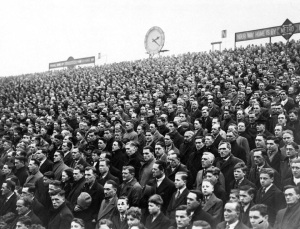
Mature men, women and children supporting  Arsenal in 1948
At the same time as we prioritise and become increasingly obsessed with the physical we increasingly marginalise the other aspects of our personalities: fewer and fewer of us admit to any great religious belief, our churches are less well attended now than ever before and as a western culture we seem increasingly suspicious of those who do have a faith – especially those from the middle east. Our health provision consistently devotes less resources to the needs of the mentally ill and to  psychological and psychiatric well being than it does to physical illness – and this despite the fact that all research indicates that there is a far greater need than ever before for effective mental health support in this age where an ageing population, drug  and alcohol use, social isolation, the breakdown of the family and extended family, unemployment  and a myriad of other 21st century conditions all contribute to a growing mental health problem. As austerity bites local council shave been forced to cut back on “non-statutory” educational and social provision; libraries are marginalised and where they do continue or perhaps blossom it is often because there has been a conscious effort to make them “accessible” and user friendly, to increasingly stock materials that are light entertainment rather than more demanding places of learning. Masses of people will pay eye watering amounts of money to watch their favourite football team, to enjoy their SKY entertainment package or to enjoy the facilities of their local gym but perceive a night at the opera or a visit to a concert hall or a subscription to a library or evening school course as not worth it or too expensive. And I wonder why – why, and on whose authority, should the physical be deemed more desirable than the mental, the academic, the cultural or the spiritual.

The things that I write of are not confined, I believe, to this country - they are prevalent throughout western societies. Noam Chomsky in his book "How the World Works" comments that: "I used to haunt the main public library in downtown Philadelphia.........those were the days when people read, and used the libraries very extensively. Public services were richer in many ways in the late 1930s ans early 1940s.......I think that's one of the reasons why poor, even unemployed people living in slums seemed more hopeful then....Libraries were one of the factors....[not] just for educated people - a lot of people used them. That's much less true now......I travel a lot and often get stuck in some airport or other. I used to be able to find something I wanted to read in the airport book store - maybe a classic, maybe something current. Now it's almost impossible...I think it's just plain market pressures. Bestsellers move fast and it costs money to keep books around that don't sell quickly..... One of my daughters lives in a declining town.... the town happens to have  a good library staffed by a couple of librarians. I went there with her kids on a Saturday afternoon and nobody was there except the kids of a few professional families. Where are the kids who ought to be there?....probably watching TV....for them going to the library just isn't the thing to do. That's a big change since my younger days. It was the kind of thing you did if you were a working class person fifty or sixty years ago. [The] emptying people's minds of the ability or even the desire, to gain access to cultural [and intellectual] resources is a dangerous thing that is one step along the way to the totalitarian state". Absolutely - the unthinking and the uneducated rarely ask searching questions of those in power. Put it into the minds of people that the only thing that matters is "EAT, SLEEP, TRAIN, REPEAT" and you have a healthy but a docile, easily manipulated population.

Me (front row, extreme left) in my draughtsman and
night school days
When I left school in 1961 I was lucky to gain a post as a trainee designer draughtsman in a local engineering firm. For two years I attended night school four nights a week to study for the necessary mechanical engineering qualifications. From Monday to Thursday I would leave home at 7.30 in the morning with two packets of sandwiches and two small thermos flasks: one of these was for my lunch as I sat at my drawing board and the other I would eat and drink for my tea. I  left work at 5.30 pm, walked the couple of miles through Preston to the college and I would sit with other similar students in the classroom – all of us doing the same thing, eating and drinking – waiting for the class to begin at 7 pm. Then, at 9.30 pm, we would all troop off home.  After two years I was given a day off from work so that I could continue my studies in “work time”. I still, however, had to go to night school for one night each week since I had left school without a GCE  O level in maths and had to, therefore, do a “catch up course”. I didn't see all this as a problem – of course I would rather not have had to study every night but I was not dissimilar from many of my friends and it was firmly planted in my head that study was the way forward. Of course, I still loved watching my favourite football team, Preston North End, but I knew that any mid week games were only rarely an option for me. It never occurred that I was missing out on going to the gym and even if it had I'm quite sure that common sense would have told me that my future qualifications were of more importance that pleasure pursuits. I would like to think that young people today would view the world similarly – but I fear that might not be the case – it would interfere with their “me time” or “chilling time”.

Pleasure, games, sport, keeping fit  were, for previous generations largely secondary to the pursuit of some kind of self improvement. We might have wanted to go to that football match or go ten pin bowling but these were games, pleasures and to be kept in perspective – brief interludes in the job of growing up. Leaving school was, at the time, a life marker; one was going to be concerned with more adult things. As for going to the game in a replica football shirt bearing the name of my favourite footballer I have absolutely no doubt that had I turned up like that then Tony and Gary Clarkson, Stewart Kilner, Alan Smith, David Bradshaw and the rest would have laughed at me, probably called me a “Big Jesse”  and advised me to go into the children’s section of the ground or go and hold my daddy’s hand. In short we looked forward to growing up and the responsibilities that went with it – today, it seems young men, especially, want to be Peter Pans who never grow up. In writing this I am reminded of the feminist joke that appears with monotonous regularity on social media sites: a little boy says to his mother that he can’t wait to grow up. Mum replies “Don’t be silly you’re a boy – you’ll  never grow up, you’ll just get bigger”. Harsh?  - maybe, stereotyping? – yes. But as with all stereotyping containing more than a grain of truth.
Headlines like this no longer raise an eyebrow. We can blame the government
but in the end the clue is on the right hand side of the page. As a society we have
changed our priorities: happy to narcissus like  pay £99 for "Botox and fillers" less
motivated to pay more tax or fees for libraries; happy to pump iron and get the 
adrenalin going less willing to read a "boring" book - this is a huge social change.

Society has changed. Up until about twenty years ago virtually every area of the UK had thriving night school classes where one could, for a small or moderate  fee, go to learn some skill or develop and interest: learn a foreign language, learn how to maintain a car, become skilled in needlework of some kind,  learn cooking skills, dabble in a bit of philosophy, develop your artistic skills, take a course in beginners’ economics or psychology or Latin, develop photography skills, learn how to set up and get the best out of your stereo system, refresh your basic English or maths, learn how to make your own wine or beer. The list was endless. They weren't about gaining qualifications – although that was sometimes an option – but rather about developing an interest, widening horizons, keeping the mind active. Sadly in the past two decades these have dwindled. Since Margaret Thatcher’s governments  local authorities have been forced by economics to charge more for the use of the facilities and classes have became more expensive. At the same time there has been a move to focus more upon the gaining of qualifications rather than simple personal development so courses leading to academic or professional qualifications have become assimilated into the formal education system whilst those of a more informal nature have simply fallen by the wayside. Whereas once I could attend a German language course aimed at my two week holiday in Germany – now if I want to brush up on my German I have to enrol on a course leading to a qualification.  Inevitably this is more demanding and more costly and in my view it also removes one of the basic elements of “education” – that real education is done for its own sake and not first and foremost to gain a qualification.
Jesse Boot

With this in mind I am reminded of Boot’s the Chemist. In Nottingham where we live is the head office of Boot’s the Chemist and many local people are employed in the factory and warehouses that are centred here. For those not familiar with the UK, Boot’s have shops on virtually every High Street throughout the country – they are a leading company. Boot’s was founded by Jesse Boot here in Nottingham in the latter years of the 19th century – it began as a small back street shop selling various “cures” and evolved into the giant pharmaceutical dispensing chemist that it is today. Jesse Boot was also a philanthropist – he has a school named after him and was very much the founding father of Nottingham University. From his earliest shops he insisted that his staff took every opportunity to better themselves; he paid over £5000 to install a great organ in the Albert Hall here in Nottingham – the organ is still there, Pat and see it each time we visit the venue for a concert. He encouraged his employees to learn a musical instrument and provided them. There was a Boot’s Brass Band and a Boot’s Orchestra – still in existence, a friend of ours plays in it today. He paid for the fees of the organist at the Albert Hall but insisted that the organist played one concert a week for as many of his employees (and their families) who cared to attend.  The concerts were to be on Saturday afternoon in order that they were available to all his workers and so that the children of his workers could also attend and thus gain from the experience. He insisted that each seat should cost no more than three pence. Each concert was to be a recital - enjoyable but also worthwhile in that it would expose his workers to music that they might not otherwise have the opportunity to hear and which would  encourage an interest in good music. Finally he requested that concert goers should be well turned out so that the event was treated as special and with respect; in short not only was Jesse Boot widening the musical horizons of his workforce he was also helping them to move up the social ladder. Records show that every seat was regularly filled.
The Albert Hall Nottingham - the "descendent" of Jesse Boot's
great organ still present
Boot’s was and  has always been traditionally seen as a “good employer” in the locality. In following Jesse Boot’s ideas throughout the years one of the “perks” of working at Boot’s was the company’s desire to have a better educated work force, so all staff were encouraged to attend night school classes – it was not compulsory nor was it intended to necessarily gain further qualifications (although that was always on offer) – but to simply broaden their horizons, better themselves and thus, hopefully make them more aware people and thus more useful employees. I don’t know whether this situation still appertains – Boot’s has long since been taken over by one of the multinationals although its base is still here. But, if it is a policy that the company still pursues then I would guess that it doesn’t operate in quite the same altruistic and philanthropic way. Certainly the unavailability of evening school courses of the type I described above will limit it as will financial considerations,  and I wonder, too, whether people of the 21st century will be quite so willing to commit themselves to an evening  a week to some kind of “study” however mild or light. I wonder, too, whether it would have the same attraction for many as a night pumping iron or playing badminton or keeping one’s figure trim. Maybe I'm wrong – but I don’t think so.

Ex-Archbishop of Canterbury Rowan Williams
I have just finished reading two wonderful biographies – that of Rowan Williams the ex-Archbishop of Canterbury and of Roy Jenkins the Labour politician often described as the best Prime Minister we never had. These two men  came from very similar backgrounds – working class and from the mining communities of south Wales. Rowan Williams’ parents like many of that generation - and especially in that area – saw learning and church going as very much part of personal development. It was the way to self improvement; as Williams’ biographer Rupert Shortt  suggested it was a world of “the tight knit, rooted in the world of the hearth, infused with the spirit of decency”.  There was a disdain for what Shortt describes as “the homogenising effects” – or to use our modern phrase “dumbing down” - of mass entertainment. Books and learning were prized above all things – Shorrt records how “delighted” Rowan Williams was to receive as his tenth birthday present a Latin Grammar book. Meal times and evenings were the time for serious discussion, where the child was gradually introduced to the world of the adult. There was little place for the trivial – a far cry, I believe from much of today’s child rearing and today’s world.

Roy Jenkins 
Roy Jenkins came from a similar background; in the words of the biographer Jenkins’ father, Arthur, came from “the great (now largely lost) tradition of Welsh self improvement”. Arthur  Jenkin’s left school at 12 to go down the pit but  over the next twelve years by educating himself through evening classes and discussion groups he won a miners’ scholarship to Ruskin College, Oxford – the college founded in 1899 to offer the opportunity of higher education to working men who would not otherwise have had access. On completion of his college course he had to return to the pit but continued to read, attend classes and became involved in local politics and slowly but surely he worked his way up. A relative talking about the house that Arthur Jenkins and his family lived in commented  “And the books! Why, there were books everywhere”. In 1945 when Clement Attlee swept to power with his great reforming Labour government Arthur Jenkins was appointed as a junior education minister – surely a tribute to his endeavours. Sadly he died in 1946 but by then his son Roy – who reflected many of the beliefs, values and aspirations of his father - was already contesting parliamentary seats and became an MP in 1948. Roy fulfilled his father’s ambition by becoming  a cabinet minister and holding many of the highest offices of state until his death in 2003.

John Meynard Keynes
When the great economist John Meynard Keynes left Cambridge in the early years of the twentieth century he took his first job in the Government Treasury in Whitehall. Keynes came from a privileged family, the son of a Cambridge don and Keynes himself was considered to have a brilliant mind as his later career showed. When he began work at the Treasury he was advised by his chief, Lord Chalmers, that every man on his team and  in life generally must “drive two horses abreast, one his work horse and the other some scholarly enthusiasm”  - I suppose in  modern usage we would term this as being something of a Renaissance Man. Chalmers himself was a world authority on Pali and translated the sacred texts of Buddhism. Basil Blackett one of Keynes’ colleagues was a renowned translator of Byzantine Greek. Another colleague was an established poet, another was an expert on classical literature and so the list went on. Keynes himself was an authority on a number of things: the writings of the world's great philosophers, art, civic architecture and so on. When Keynes, shortly before his death, was presented with an honorary degree (one of many) by Cambridge University in his acceptance speech he commented that for "....the first time in history humankind faces the challenge of coping with freedom from economic worry........ how will [mankind] occupy the leisure that science and economics will have won for him...there [are] no nations that can look forward to the age of leisure and of abundance that we now and increasingly will enjoy without a dread......"  Keynes was clear in his own mind that it was the responsibility of all men and women to involve themselves in "things of worth" that would satisfy the moral imperative as he saw it to live "the good (worthwhile) life". And for Keynes and his peers this meant things of the mind. Of course, one may argue that what constitutes "the good life" will vary from person to person and what night be termed a "thing of worth" will be a personal choice. But, whatever, Keynes's views reflect the difference in values between his age and our modern perception and what is certain is that Keynes, his peers and past generations would not think that "EAT, SLEEP, TRAIN, REPEAT" constituted a "thing of worth" or fulfil the imperative to live "the good life".

The chess room at Derby Mechanic's Institute
Stories like the above, of course, are of a different time and may well be considered not typical. One might argue that these were rather special people - indeed, in Keynes' case he was from a privileged position - the son of a Cambridge don and from a social circle and well to do family to whom learning would be natural and expected. But the desire to self improve and to value learning, skills pastimes and aspects of the personality that were perhaps more cerebral, reflective, intellectual or spiritual were embedded into the mindset of very ordinary people and families.  People like Jesse Boot or Arthur Jenkins or Rowan Williams' family were not educational high flyers or “posh” – they was an ordinary people whose priority was to make good. Jesse Boot and the rest were not against having fun, enjoying themselves, playing sport or involving themselves in pleasant recreations. Indeed Jesse Boot regularly hosted sports days for his employees at this home where sports, refreshments, entertainments and the like were laid on for  everyone’s enjoyment. But that was just what they were - entertainments, pastimes. Not to be confused with the serious aspects of an adult’s  life and personality, the development of knowledge, skills, understanding, self improvement.

Part of the library at Otley Mechanic's Institute

Only this week I received a programme from  the Oldham Coliseum Theatre. Pat and I visit there once a year to take our grandchildren to the pantomime – it is quite near where our grandchildren live. One of the plays to be performed this coming season is “The Pitmen Painters”. The programme tells me that: “it is the true story of a group of Northumberland miners in the 1930s who, desperate to improve their knowledge and understanding of art, employed Robert Lyon, Master of Painting at Kings College Newcastle.  Unfortunately, the lectures were not too successful, they were too academic, but Lyon realised that a better approach might be to get the men actually painting rather than talking about it”. 

Some of the work of the Ashington School of Painters
The results were amazing  -  the group went on to become an art phenomenon, celebrated throughout the art world. The men continued to work in the pit until they each retired but their work (known as the Ashington Group) was – and is still - displayed in galleries across the world. This is self improvement at the sharp end.  All these examples  coincided with the age of institutions  such as the Workers’ Educational Association (WEA) or The Mechanics Institutes  - both hugely popular amongst working men and women as a source of educational self improvement, of being able to hear visiting lecturers of national standing, of a place for listening to concerts or of hearing national politicians speak. Every town and city in the land had such places and they were well used. Thousands, like Arthur Jenkins, or the Ashington miners profited from their presence and the ambitions of individuals to develop knowledge, skills and intellect were met. They thrived because they were consistently well used just as today our towns are filled with gymnasiums, sporting centres, boot camps and the like filled with individuals who want to improve their physical well being, lose a few pounds in weight or look a bit younger.

Nottingham Mechanic's Institute - records show that
people had to be turned away so popular was it
All of these people would, I believe, find it not only strange but very wrong that in our modern world leisure time is filled with going to the gym or being obsessed with the physical aspects of one’s life. They would be unable to comprehend that grown men are so immature and trivial that they  walk round in football shirts proudly boasting their favourite footballer. They would find it immoral that people diet - sometimes with fatal consequences - or undertake extreme physical programmes simply to make themselves look good or to “copy” their fashion icons. They would be horrified that libraries are considered a drain on resources and that in order to make them well used they often have to be stocked with the mundane and the trivial. Jesse Boot and all the others would never believe that evening schools and the like have been allowed to wither away because people are no longer anxious to support them or choose to spend their money on other things. They would not believe that we have allowed successive governments to ensure the demise of libraries and evening classes. They would be distressed that great swathes of our society have abandoned  the spiritual aspects of their personality – not because everyone should be a practising be Christian (or of any other faith), but simply because modern man and woman more often than not never even bother to think about it. Religion and spiritual awareness has largely been marginalised by many, condemned to the dustbin of history without even a second thought. In short, they would simply not understand why both individually and as a society we have largely rejected and allowed to fall into disrepair the vast array of opportunities that we had for developing learning, knowledge, awareness and skills - be they learning a foreign language, playing chess, learning the skills of  needlework, understanding car mechanics or philosophy, or ballet or Buddhism.  They would not comprehend why modern man or woman might choose the boot camp option or the slimming club or the 5 a-side football night over the art appreciation class, the improver’s course in maths or the introduction to home maintenance.  They would be bemused why someone might find a motto like “EAT, SLEEP, TRAIN, REPEAT” to be inspiring or worthy of response. They would be horrified to read the trivialities posing as "wisdom" and repeated ad nauseam  on social networking sites; for example,  "Being an adult was the dumbest thing I ever did" or "Do what makes you happy and be done with all the rest".   So many today have consciously or subconsciously adopted the mantra “I know what I like and I like what I know”  rather than widening and deepening their horizons and their understanding of the world in all, its many facets. They choose, just like Narcissus in the Greek myth, to be fixated by themselves, their physical well being and their  appearance  content in their own little world filled the trivial and the dumbed down.


11 June, 2015

Wonderful Sublimity and Devilish Hubbub

Nottingham on a typical Saturday night - "The best place in
the country to get p****d" I was advised
I stepped out into the night air and, dodging the traffic that accelerated away from roundabout at the end of Maid Marian Way, crossed Derby Road. I began the short climb up Vernon Street and passing the Strathdon Hotel dodged  the traffic again and made my way along Wollaton Street;  over Clarendon Street then towards Hanley Street. By now, although only a short distance, the gradual climb was starting to take its toll on my breathing. As I approached Hanley Street, silent and almost empty apart from parked cars, two young women staggered towards me. Both wearing very short dresses and tottering along on their very high heels they were clinging to each other. As they drew level one of them sobbed loudly, her friend putting her arm around her trying to cheer her up. They both carried beer bottles and stood there propping each other up, half leaning, half half falling against the wall of an office building. As I hurried past them I caught a glimpse of the black streaks of make up  that ran down the cheeks of the one who was sobbing. As I looked down the street towards the City centre from where these two young women had come I could hear, and almost feel, the night life throbbing away in the distance - a mixture of police sirens, thumping music, the occasional car horn and background noise. I hurried on my way up silent Hanley Street and  passing Wollaton Street car park I could still hear the sobbing girl and the slurred, alcohol fuelled strident voice of her friend. As I reached the top of Hanley Street and crossed Talbot Street I heard behind me the smash of glass - presumably a breaking bottle - and a young woman's voice shouting "f**k". I walked the last few yards into Stanley Place to the Talbot Street Car Park.  By now I was breathing rapidly, the last few hundred yards up the steep hill had taken their toll. As I passed the glass doors of the   Welbeck Hotel four young people - two women and two men - came out, their voices loud and harsh, giggling and laughing, oblivious of the hour and silence of this quiet cul de sac.  The Car Park was silent as I climbed into Pat’s little VW Beetle, sat for a  moment to regain my breath and then drove out onto Talbot Street on my way back to meeting my wife, who I had left at the St Barnabas’ Cathedral.
Yes, I saw lots of this sort of thing as I drove the
one way system

As I drove along the one way system I passed Rock City – a Nottingham back street “institution”. Outside were several hundred youngsters, some, it looked to me, no older than 14 or 15, waiting to get into the club. It was just after 10.30 and I grumbled to myself that they should be in bed by now! Then towards the Royal Centre and past the front of Trent University. At the traffic lights I sat and looked into the windows of the Uni Express Convenience Store, its window posters advertising their late night delivery service for students “We deliver to your door seven days a week till 6 am” it told them and me. The pavements were now thick with youngsters – mostly in large groups, and mostly staggering along the footpaths. Taxis filled the road, spilling out their contents of loud, youths and scantily clad girls. As one taxi pulled away, having deposited its contents, two or three of the youths chased it as it edged into the traffic banging with their fists on its back window and roof until it picked up speed and disappeared. At the end of Talbot Street I watched the queue that stretched as far as the eye could see – youngsters all waiting to gain admittance to The Comedy Club. Another huge queue stood alongside as youngsters waited to withdraw money from the two ATMs that stand there and at the side were the brightly lit windows of Wagamama’s restaurant, every table it seemed full with revelling young diners. In the far distance I could see flashing blue lights and hear police sirens. A group of girls, arms linked, tottered, whooping, laughing and screaming across the road in front of me as I sat at the lights. One of them covered, as far as I could see, in tattoos, her skimpy dress leaving little to the imagination put a bottle to her lips. Then the lights turned green and I edged forward to turn into South Sherwood Street but was momentarily startled as a police car, lights flashing, shot across the road in front of me and disappeared down South Sherwood Street.
Dante's vision of hell - looks a lot like what I drove past 

And so away from the City Centre – left onto Shakespeare Street past the beautiful old Arkwright building that was originally a constituent college and library of University College London but is now part of Trent University. And then, through the vast complex of buildings and halls of residence that now constitute Trent University and at finally back to silent  Clarendon Street filled with once grand Victorian Villas now turned into offices of the University and student accommodation. Then, still  following the one way system, I got back to the Derby Road roundabout to pick up Pat for our journey home. By now the time was nearly 11 o'clock, and as we drove up Derby Road away from the city centre we again saw police cars with their flashing blue lights pass us heading towards the city -  a last reminder of what had seemed to me like modern version of Dante’s vision of hell in his allegorical Divine Comedy . For this is Nottingham – and probably many other English cities - on a Saturday night.
Definitely city centre Nottingham on Saturday

I noticed recently that the area through which I had walked and driven on Saturday night is described on tourist information leaflets for my home town as “vibrant”. Mmmmmm – no matter how much I try I cannot help but think that is a very liberal use of the word and being incredibly economical with the truth. As we drove over Abbey Bridge and through the Lenton area of Nottingham  the silhouette of the Queens Medical Centre with the lights of the hospital wards pinpricking night loomed out of the darkness. I knew the A&E department in the hospital  would already be stacking up with the victims of the night’s city centre revelries.  Idly my mind went back to an interview that I conducted some years ago when involved with interviews for trainee teachers at Trent University. A young man entered the room for his interview with me. There was and is a desperate shortage of men applicants for primary teaching courses so he had a distinct chance of acceptance.  He was smartly dressed and his references and academic record were excellent. He was a strong candidate for admission. Near the end of the successful interview, as I mentally prepared to add him to the list of candidates who should be offered places, I asked him the final question.  I was required to ask him (as of all candidates) why he had chosen Trent University as a place to do his training. I expected him to refer to the excellent reputation of the University, or the suitably interesting course etc. But, no, he staggered me when he smiled and said in his broad Geordie accent: “Oh, it’s a no brainer man, my brother came to Nottingham Uni two years back and he says it’s the best place in the country, except for Newcastle, to get pissed every night of the week” . I was utterly lost for words at both his reason and his unashamed willingness to share this in an interview situation. As I sat lost for words at his candour (and, I think, his lack of judgement) I was initially unsure how to respond so I simply thanked him, shook his hand and showed him the door. I then put a question mark at the side of his application and left it for others to decide whether he should be offered a place. When I wrote up the notes from the interview I commented upon his obvious academic potential but also suggested that should he be offered a place I would not be prepared to host him in my school as a trainee teacher nor would I offer him a job should he ever apply to me. I explained that in my view his maturity, his judgement and his personal and professional understanding of the role of  a teacher were seriously lacking. My comments did not go down well with "the powers that be" - they were deemed "an unacceptable reason for refusal" but I rather took this as a sign of the way we are declining in our expectations. I lost no sleep over it but, having said that, I think my experience on Saturday night was, perhaps, unfortunate proof of what he said.
The last rehearsal for the concert

And then we were joining the Nottingham Ring Road at the Lenton traffic island. We picked up speed - me still in grumpy old man mode muttering that “No one should ever tell me that the young are short of money or that students are having a hard time” and in the darkness of the car I'm sure that I detected Pat raising her eyes to heaven as I grumbled “I'm sure that the fathers of those girls don’t know they’re going go out dressed like that!”  But, as we sped away from the city, other thoughts gradually entered our minds and conversation. Both of us thought and spoke of where we had been and what we had seen and heard – something that was a very far cry from my walk and drive through Nottingham’s “vibrant” streets. What we had heard, seen and enjoyed in St. Barnabas’ Cathedral was not the modern vision of Dante’s Inferno that prevailed on Nottingham’s city centre streets but rather, and to use the programme notes, something “sublime”, almost one might say heavenly. We had sat humbled, spellbound and overawed as we saw and heard  Bach’s mighty B Minor Mass. Surely one of the greatest creations of mankind.
Albert Schweitzer

“The salient quality of the Mass in B Minor is its wonderful sublimity. The first chord of the Kyrie takes us into the world of great and profound emotions: we do not leave it until the final Dona nobis pacem”.  So said theologian, musician, philosopher, physician, missionary and Nobel Prize winner Albert Schweitzer. He was not wrong. Not only is the B Minor one of the very greatest of Bach’s works but stands amongst those at the very peak of the world’s  greatest works – some may say it is indeed the greatest. And although the performance that Pat and I had just enjoyed was an amateur performance with no great orchestra, stars or expensive tickets it was outstanding and bore comparison with any of the other performances we have seen or CDs we have played. As Schweitzer said, it really did take us, and judging by the applause and response the rest of the audience as well, to a “world of great and profound emotions”.
The logo - Pat has one in the back window of her Beetle
The Mass had been performed by a local east midland choir – the East of England Singers and their accompanying orchestra the New Classic Players. The singers and players are two of the many music making groups that comprise the Nottingham based music and music education organisation Music for Everyone  founded by Angela Kay thirty years ago this year. The performance of the B Minor was part of the celebrations of this thirtieth anniversary year. Angela, by profession a teacher, wanted to create an organisation which would offer music making opportunities to people of all ages and abilities. The only criterion for participation was and still is, enthusiasm. She wanted to enable singers of all kinds to enjoy together the breadth of the choral repertoire – those who could not read music singing alongside those who could; and those who had never sung in a choir alongside the experienced choral member. During the last thirty years Angela Kay’s ideas have grown and today offer music opportunities across the full musical spectrum: concerts, workshops, choral, jazz, instrumental, adult, youth groups, children’s opportunities, sold out concerts like the one we attended, quiet choral weekends where participants come and learn works and sing them just for the pleasure rather than for an audience. As well advertised and stand alone concerts there are groups – “Daytime Voices “- that meet in various areas of Nottingham to provide regular, weekly musical opportunities at a local level. Similarly, there are events such as the one entitled “Blow the dust of your instrument” – aimed at encouraging those who might have once enjoyed making music to get back into the habit. Later this summer there is to be a choral weekend where singers come and rehearse with a choir for much of Saturday and Sunday and then perform a concert (this one is singing Leonard Bernstein’s Chichester Psalms) for an audience on the Sunday evening. Pat has taken part in this sort of venture on numerous occasions.

Angela Kay
No stone of the musical world is left unturned and a look at the web site will show the breadth and depth of what is on offer. And, throughout the thirty years the original criterion has held firm – enthusiasm and love of music are the entry points. Music for Everyone choirs and orchestras have performed in established concert venues like the Royal Concert Hall here in Nottingham as well as in schools, colleges and churches throughout the area. Angela Kay has stayed at the helm and often, as on Saturday night, is the conductor of the choir and orchestra. But finally and most importantly, it must be said that although Angela and her organisation have remained true to her first guiding principle of universal participation, this has not been at the cost of quality – every concert, every event is first class, enjoyable, exhilarating and above all excellent.

The view from our seats
In 2014 Angela Kay was rightly awarded the MBE for her services to music and music education  within the region and as she turned to receive the audience’s applause and shouts of “more” on Saturday night I think that everyone who had seen and heard the performance felt the same; not only had they enjoyed a very memorable event but they were aware that Angela Kay must have been exhausted so much had she put into getting the very best out of her singers, her orchestra and indeed Bach. The audience clapped and cheered – partly for the wonderful music that we had heard - but also for what Angela Kay had given on Saturday night and over the thirty years of her organisation’s life.

One of the children's music making
activities run by Music for Everyone
It is not wrong to use the word monumental when describing the B Minor and like all Bach’s music the Mass is taxing. As the programme notes reminded us, virtually every section, every movement, every orchestral accompaniment is a concerto in its own right. Additionally, in its 2 hour length, there are precious few moments when choir, soloists, orchestra or conductor can coast, switch off or hide. It is physically demanding as well as musically taxing. It is not a piece for the faint hearted. But, as with all Bach, it is glorious. Its 27 sections range from the most serene and sublime to the truly spiritual and the magnificent and grand. Its sheer scale and grandeur make it both musically and spiritually an awe inspiring work; within this vast piece there is great pathos, unadulterated joy, magnificent splendour, extreme emotion, wonderful melody, exquisite beauty and breathtaking brilliance. Quite simply, it is why Bach is so revered and why conductor and Bach scholar John Eliot Gardiner refers to the music of Bach as “music from the castle of heaven”.

East of  England Singers, orchestra and conductor
Bach composed his Mass around 1748–49, a year or so before his death in 1750. He didn't even give the work a name, and it originally only existed as a collection of itinerant manuscripts written over many years. Indeed, this is largely what it was, a piece of music the composer had been building up to for the whole of his life; it is, therefore, a reflection of Bach’s musical life. The first part was written 1733 and other parts have their origins even earlier, but it was not finally put together until the very last years of Bach's life, when he had already gone blind. It was probably the last major project he involved himself in. Sadly, he never heard the work performed in its entirety – he died in 1750.  As part of his requirement as Cantor at the Thomaskirche in Leipzig Bach had spent much of his life churning out a vast quantity of choral works, works that many would argue are the greatest choral music ever written. But these were for performance as part of the religious life of both the Thomaskirche and the town. The B Minor Mass is different; it was written for no specific occasion in the church or in Leipzig’s year and it stands among those supreme works which occupied Bach’s final years and which seem almost to be a planned summation of his great life. The Art of the Fugue, The Goldberg Variations, The Well  Tempered Clavier and The Musical Offering. Each of these with the Mass are not simply pieces of music or even great pieces of music – they are works that have defined our western  music.. Quite simply  the Mass, the Goldberg, the Art of the Fugue  and the Well Tempered Clavier  and are at the root of all music that we hear today.
Blow the dust off your instrument....!
To listen to the B Minor is to hear something very close to perfection. It touches one at every level – musically, emotionally and spiritually. It crosses boundaries. Conductor and Bach scholar Robert Shaw wrote: “....Bach’s Mass in B Minor holds a unique position in the minds and hearts of men and women of all faiths – and no faith at all – [it speaks of] the oneness of humankind with the universe, and the responsibility of human life to seek beauty and to do good..... Bach’s Mass in B Minor has become, some two hundred and fifty years after he bound its 27 movements together, the most remarkable musical allegory of human existence – [with all] its pain, aspiration and promises.”  The musicologist and Buddhist Yoshitake Kobayashi  commented that:  “The universal spirit of Bach which manifests itself in the B-Minor Mass produces the great paradox that this, the most Christian works in all of sacred music, transcends and dissolves its confessional limits, serving instead the whole of humanity – non-Christians included.......It may seem odd that as a Buddhist I have theologically come to terms with one of the most Christian works of European music history but the spirit which manifests itself in this work nevertheless encouraged me to do so”. I have absolutely no doubt that every member of Saturday night’s audience - whether they be of a Christian faith, an non-Christian faith or no faith at all - would agree with those words.

One of Bach's original pages of
manuscript for the Mass
The German writer and philosopher Goethe described himself as "not anti-Christian, nor un-Christian, but most decidedly non-Christian," and listed the symbol of the cross among the four things that he most disliked yet he also said this of the Mass 'It is as though eternal harmony were conversing with itself, as it may have happened in God's bosom shortly before He created the world.'  And, finally one of the many other tributes paid to the B Minor is that of modern minimalist composer Michael Torke who simply commented “Why waste money on psychotherapy when you can listen to the B Minor Mass?”. Why indeed? - as one who frequently turns to the Mass before I put out the light to go to sleep or when I’m feeling down or stressed I know Torke to be exactly right.
How can such sublime work have been 
produced by a man who seems so ordinary, 
so opaque - and occasionally so intemperate?

But perhaps the best and most telling comment comes from Bach himself. Not about the Mass in particular but about all the music that he wrote: “The aim and final reason of all music should be none else but the glory of God and refreshing the soul. Where this is not observed there will be no music, but only a devilish hubbub.”  When I think of the sublime and uplifting two hours that Pat, I and the audience had spent in the beautiful St Barnabas’ Cathedral and where we had experienced  a “world of great and profound emotions”  I’m sure that I was not alone in knowing that Bach’s glorious music and the wonderful playing and singing and conducting  did indeed glorify God  and refresh the soul.  It was a powerful reminder that it is not all the “devilish hubbub”, or the vision of hell that that I had witnessed only a few hundred yards away in Nottingham city centre on Saturday night but rather, a  recognition that there is still, in this world,  the good, the profound, the exquisite, the spiritual, the sublime, the serene and the truly great and magnificent.