08 January, 2013

One visitor, once a week and no children – how expectations have changed.

Hardly a day goes by in the UK without the state of our hospitals and issues concerning the National Health Service being front page news. This weekend, for example, the Health Minister, Jeremy Hunt has announced that hospital managers and administrators will be sacked if they fail to provide the best patient care. For much of the past year or so there has been a continuing political debate at all  levels about changes that the government proposes to make in how the Health Service is organised, funded and run. We have almost weekly exposures of particular problems – poor care, lack of funding, financial mismanagement and waste, medical errors, anomalies of provision in different areas of the country, inequalities of access amongst different age groups and so the list goes on. There are clearly issues that need to be continually addressed and improvements that need to be made but at the same time it seems to me vital not to miss the point – that the National Health Service is a most wonderful thing and something that we should all be very proud of.
Dickens, drawn at the time, giving
one of his readings

This was brought home to me last week when I read that at the beginning of 1858 Charles Dickens became President of the Great Ormond Street Children’s Hospital Appeal and on February 9th of that year he read his great book “A Christmas Carol” to an assembled audience of social reformers and potential donors. Before the reading he gave what is often regarded as one of his greatest and most powerful speeches about the social conditions of his time. The whole, very long, speech is recorded The Nursing Record of that time. In it he told of an experience he had had whilst on one of his many – almost daily - night time walks around London’s poorest areas:

“There  lay, in an  old egg-box, which the  mother had  begged  from a shop, a little feeble, wasted,  wan,  sick  child.  With  his  little  wasted face,  and  his  little  hot  worn  hands folded over  his breast,  and  his little  bright  attentive  eyes,  I  can see him  now looking  steadily  at  us.  There  he  lay in  his  little frail box,  which was not at all a bad  emblem of the little body,  from  which  he  was  slowly  parting, - there  he lay  quite  quiet,  quite  patient,  saying  never a word.  He  seldom cried,  the  mother  said;  he seldom  complained;  he  lay  there  seeming  to  wonder what it  was about.  “God  knows” I thought, as I stood  looking  at  him,  he  had  his  reasons  for wondering- how  it  could possibly come  to  be  that  he  lay there,  left  alone, feeble  and full of pain......... There  he  lay  looking  at us, saying  in  his   silence,  more  pathetically  than  I have ever  heard  anything  said by  any  orator  in alI my  life,  “Will  you please  to  tell  me  what  this means,  strange  man?  and  if  you  can  give me any good  reason  why  I should  be  so  soon  so   far advanced  upon  my  way  to  Him  who  said that children  were  to  come  into  His presence,  and were not to  be  forbidden,  but  who  scarcely  meant,  I think,  that  they should  come  by  this  hard  road by which 1 am  travelling..........”

Today, Great Ormond Street is still providing care for very sick children – not only from this country but, when necessary, all over the world. What began with only 10 beds in the early 1850s is now one of the world’s foremost  hospitals.  And as I read Dickens’ words I reflected upon a number of things. Certainly, how pleased Dickens would be that for the most part the conditions that he described are long gone. He would be amazed if he could walk around a modern hospital – especially Great Ormond Street - and witness the vast amounts of money, care, expertise and support that is freely available and at the disposal of the hospital and thence the patients. At the same time, I have no doubt that Dickens’ eye for injustice, anomaly and hypocrisy would, even today, soon spot weaknesses, unfairness or inequalities in the system.
Great Ormond Street today

Just before Christmas an MP Ann Clwyd complained, bitterly and publicly, of the treatment that her terminally ill husband had received in his final days. He was, she said, “treated like a battery hen” and called into question many issues in relation to the quality of basic nursing, care and compassion. Her comments, both then and since have received much coverage, and have sparked off a debate about the quality of nursing and care. I’m sure that Mrs Clwyd had a very valid point to make – indeed, there have been instances in the past few years when I have had similar concerns myself when my father and mother in law were in hospital. But it was also good to read a timely reminder in the Guardian a couple of days later when a lady wrote a very long and impassioned letter to the paper extolling the wonderful nursing, care, love and compassion that her young son had received in hospital over a very long period as he battled against a potentially fatal illness. Coincidentally, the hospital was Great Ormond Street but her comments, I’m sure, would have been equally true of any other hospital – she was praising the NHS not a specific hospital. She ended her letter by listing all the people – nurses, doctors, admin staff, cleaners, carers, porters and many others who had played a part and to whom she was very grateful. It was a very long list and went a long way, I felt, to redressing the balance and keeping things in some kind of perspective.
The NHS lauded in the Olympics Opening Ceremony 2012

As anyone who lives in the UK will know the National Health Service is something which politicians meddle with at their peril. Whatever its shortcoming – and I am sure that there are many – it is perhaps the one facet of national life most valued by the electorate. Indeed, the use of the NHS in the Olympic opening ceremony a few months ago was met with great public approval and pride – it clearly set the Service as very much a jewel in the crown of British daily life.  Because it is so valued and crucial both metaphorically and politically to the life of the heartbeat of the nation it also engenders strong feelings of support – and sometimes criticism  when things are perceived to be not right. Add to that the fact that it deals with highly charged matters of individual and public concern –  matters of life and death – and it is surely a recipe for strongly held opinions. On the one hand when your child gets better after a life threatening illness and a stay in hospital and the nurses are rightly regarded as “guardian angels” by relieved family and friends. But when your terminally ill father dies a lingering death born of old age then nurses can easily be seen as callous and uncaring – they didn’t, it can appear, make him better or make his painful exit from the world manifestly less distressing when you, the relative, wanted it to be.

This is the problem, amongst many others, that the NHS faces – differences in perspective and expectation. I have absolutely no doubt that even if the NHS were funded to the hilt, even if it was awash with the world’s most wonderful staff, even if it could cure the most threatening of diseases in the blink of an eye – it would, and could, never satisfy expectations. In Dickens’ time to have a health service of the kind we have today would have been unimaginable. Dickens and his peers  really would have thought they were in paradise. Indeed, even in my life time things have changed so much – and not just the curing of illness – important though that is.
The hospital where I lay as  four year old - and the lawn on
 which my mother stood and waved. I was in a bed near one of
the ground floor windows. The hospital had previously been
 the local workhouse - something Dickens would  have
known and maybe found worthy of comment! 
I have some little reminders of that in my box of family “heirlooms”. I have a post card posted on 28th Feb 1949 – I was four then and the NHS was in its infancy. It was sent to my mother from the local hospital to tell her that I would be ready to leave hospital on 1st March at 10 am. I had been in hospital suffering from scarlet fever – a common complaint at the time. It was highly infectious and I was allowed no visitors – my memory is of my mother standing outside the window on the hospital lawn waving to me as I sat up in my bed. She often said that she was never allowed to set foot inside the hospital because of the infectious nature of the illness. I was in the hospital for almost a month. The wording on the postcard is clear – be there at 10 am - no negotiation, no consideration about whether it was convenient or whether my mother was able to do this, no other information of what to bring or to expect. Any hospital today that took this line would be subject to massive criticism and accused of callousness and lack of consideration for the needs of people. Times have changed.
The permits and instructions my mother recieved
And the other memento – a little visiting card from 1954.  My grandfather was in hospital – he died soon afterwards – and the card is a permit (notice the wording) for ONE person to visit him – at a designated time once a week. My mother (she is named on the card – could see her failing father on Wednesday 3rd April between 2.30 and 3.30 pm. No other visitors were allowed, no children. There were only four visiting times per week – Wednesday, Thursday, Saturday and Sunday – and you were allocated one – no reference to convenience, work issues, travel issues, family responsibilities etc. – that was the rule. If you wanted to see your loved one then you fitted in with the hospital rules – and people willingly accepted this. They knew that the alternative was to go back just a few years when there were no facilities such as this for the ordinary man and woman. How times have changed. How much more we expect and demand today. And this is the problem – we make far more demands on the NHS now than we  ever would have done in the past – it can never meet all our needs and desires. I suspect those working in it often feel overwhelmed as they run faster and faster to keep up with society’s expectations but fall further and further behind.
I have often reflected when I have visited people in hospital and several of us have sat around the bed, how this affects the daily life of the ward. We hear today that infections are a major problem in hospitals and we are reminded, it was so much better in years gone by – nurses kept things scrupulously clean. Our modern NHS doesn’t do such a good job is a common criticism – lazy, uncaring cleaners and sloppy nurses don’t provide basic care the right wing press often remind us. Mmmmm,  well maybe that is right but it always seems to me that in days gone by when a single visitor per patient was the norm it must have been so much easier to keep outside infections at bay – and, as is common today, when visiting hours can stretch from (say) 2.30 to 8.30 it cannot be easy for staff to ensure that everything is kept as clean as maybe it should be. But, society demands open access – you try telling today’s young mum that she cannot actually go into the ward where her child is lying – that she has to stand (as my mother did) outside on the lawn and wave through the window, or that she can only visit once a week at a pre-ordained time. You try turning the large family group away who all want to see desperately  ill granddad at the same time, you try telling mother that her little boy or girl cannot go into the ward to see their ailing Dad and that they will have to sit outside! Do so and your hospital manager, your nurse, your doctor would soon be headlines of the popular press and labelled as uncaring, callous, unsympathetic monsters. Times, indeed, have changed.

I find it beyond reason that anyone would go into a career like nursing and not have at least some innate measure of compassion and commitment – indeed, the lady who wrote to the newspaper praising the many different staff at her son’s hospital made exactly that point. What I believe does happen is that the constant pressure and unrealistic expectations imposed by society and, more especially, politicians, anxious for a quick vote, can take its toll on even  the most committed of  professionals. In this morning’s Guardian this point is well made by another correspondent: "...... compassion that led them [nurses, doctors etc.]  into the profession … [is] ground out of them" said the correspondent  And he went on "For the last three decades the NHS has been subject to a constant stream of Stalinist directives: "You must do this – no discussion, no piloting, no argument [and] the constant denigration of public sector staff as being lazy, incompetent, immoral or a combination of all three [by politicians];  the lies told by generations of politicians, who pretend a small uplift in budget or yet another "cost improvement programme" can deliver more and more services, of greater and greater complexity, without any real attempt to understand the true staffing and other costs of the planned service... [results in undercutting professionalism, endeavour and commitment]". Having spent four decades in the classroom and experienced the sort of criticism referred to above by a succession of governments one does, in the end, say "why bother".
Dickens could never have dreamed of this -
Victorians, and indeed my Grandfather would have seen it
as paradise
 Another aspect that has to be added into this complex equation  is the belief today that everyone will get well – that modern medicine is so miraculous that a solution can always be found – and, by association that health workers, therefore, have a responsibility to ensure that this happens! In Dickens’ day and indeed until relatively recently people, I think, were far more accepting of illness, pain and indeed death. Today, we get a cold, which we know will eventually go, but our response is to go along to our local GP and demand antibiotics. When the doctor is reluctant to prescribe them we feel slighted – we expect health and freedom from pain. I read recently that this is  major problem in many parts of the western world – especially the USA where many, I understand, are “hooked” on prescription drugs so that they never suffer any sort of pain. And, following on from this, we have expectations  for the health service that Dickens would never have recognised – nor indeed would many older people like myself: when our noses are too big or our skin aged or our breasts too small we increasingly demand that  the medical world  help us – we look for, and demand, physical perfection.  Or, go to a hospital casualty department any night of the week and you will see people in there who have come for the most minor of conditions – and then they complain when the service is slow or somehow doesn’t meet their expectations. When we watch the multitude of TV programmes about hospitals and their work we see high tech equipment, cutting edge diagnosis, hugely talented surgeons and the resulting happy and smiling patients leaving the hospital after being close to death. It is a twenty first century manifestation of some Biblical miracle, the lame are made to walk, the blind are made to see and the dead rise from their beds! And we think that this always happens – or should do. We forget that reality can be rather different, and all too often is. Sadly, however, death, the unpleasant aspects of aging and illnesses that cannot be cured do not, on a regular basis, make for good TV ratings. Better to have happy endings and an optimistic glimpse into the future that promises health for all than the reality of life, illness and death! The result, unfortunately, is that we all have a mistaken concept of the reality of illness and what can or should be done to help us. And, when I go to my GP I can now go for a variety of things - not simply to be cured when I am ill; I can have my annual flu jab to prevent my getting influenza in the coming winter, I can get advice and help if I want to improve my diet or stop smoking or limit my drinking. If  I am a woman I can arrange for a variety of gynaecological tests to be carried out. If I am a non-English speaker there is provision for some nineteen (yes, nineteen at my local GP!) languages to be made available to me so that I can explain my symptoms and know what is being proposed to help me!  I can get all the necessary injections I need to go on some holiday to a far off land. I can have my blood pressure monitored or my children can be immunised against many illnesses – now, wouldn’t that have impressed Charles Dickens when he spoke of the sad child in the egg box!   Each month when I visit my chemist to collect my regular prescription of eight or nine separate medications that keep my heart working, I stand in the chemist feeling slightly guilty. These wonderful drugs keep me upright – and yet cost me not a penny. I am not rich, but nor am I poor. And, yes, I’ve paid my taxes all my life so many would argue that I’m entitled to these “free” drugs. I’m not so sure – I could easily afford to make a significant donation each month towards the cost of the drugs – it seems to me only reasonable - and in doing so it would maybe ensure that those worse off than me might enjoy slightly better provision. But should any politician or party talk of raising prescription charges or ending free prescriptions for those like me who are retired - and all hell breaks loose.
A far cry from the suffering child Dickens described
And don’t think I am just  looking through rose coloured glasses  - that I do not see any problems in the NHS. Over the years I have complained with the best – and still do! When I can’t get the appointment that I want, when I disagree with what the Doctor tells me, when my father seems to not be getting the right sort of support, when my mother in law seems to be wasting away before our eyes because no-one appears to help her to eat her food, when my son breaks his leg and then has the operation to insert a pin postponed three or four times because of other priorities, yes I have complained and do complain. Sadly, in the emotive and highly charged world of health provision that is what happens - self interest, a lack of ability to sometimes see the bigger picture,  unreasonable expectations and the rest all kick in.
Dickens, I think, might have recognised these human characteristics  of self interest, intolerance, greed and the rest  that we all display – I’m sure that in their many ways they were just as prevalent in Victorian England as they are now. He would not, however, have had much truck with many of our 21st century responses and unreasonable expectations.  Nor, do I believe, that when the NHS was born in the late 1940’s such expectations were implicit in its original conception.

High tech health - a modern day re-enactment of a Biblical miracle
Times have changed. The expectations now placed upon what the NHS can and should provide are skewed and, perhaps, totally unreasonable. The government (and indeed, sadly, the Labour party) see the use of the private sector as a solution to many of the problems. I read this morning that the government is to allow many of the traditional NHS functions to be undertaken by what is called “Any Qualified Provider” (AQP) – physiotherapy, hearing aids, MRI scanning, dermatological services and the like can be provided by private companies. I’m sure that there is much to recommend this but it leaves me more than a little uneasy. I’m sure that it will be fine, indeed, the hearing aids that I use I bought privately from a separate provider. But, deep within me, I cannot escape the notion that it is a basic function of any society to provide for its citizens in matters of health and well being and that this is not a matter for big business, profits, the stock market or any other commercial enterprise – it is not a thing that you hive off for someone else to fund and from which they will profit. It is rather about what a society should be doing for itself and its citizens.
And that, for me, is the glory of the NHS – it is provision for the people by the people. That rationale says much about that society and its values – it was the back bone of the various social measures – including the NHS - introduced after the War by Atlee’s government. It says something about what we are as people. It says, whatever the shortcomings, whatever the costs we are prepared to fund, for the benefit of all – not just those with money – the necessary facilities to ensure health and well being - something that Dickens would have recognised and approved of all those years ago.
What Dickens saw each night on his walks around the East End
In his appeal for Great Ormond Street Dickens did not advocate the use of private companies – he knew only too well the potential conflict that ensues when care and compassion collide with  cash and capitalism.  On the night he made his appeal he  read to his audience “A Christmas Carol” – a story intended to point a finger at the excesses of the City and at the gradgrind world of the  accountant and selfish  Scrooge-like  figures that haunted it. He knew that people mattered when it came to care and compassion not cash, cheque books and capitalism. No, Dickens was appealing to ordinary people to pay up, to be responsible for the health and welfare of their fellow men to have a moral standpoint. His little story of the young child in the egg box was intended to plant a moral question into the minds of his audience and to ask them to shoulder the responsibility – not hand it on to some management accountant or venture capitalist or private equity company.
Part of Dickens' speech
Later in his appeal Dickens appealed directly to his audience and put the ball squarely in their court:   " Now, ladies  and  gentlemen,  such  things [the sick child in the egg box] need not be,  and will  not be,  if  this  company [the audience],  which  is  a  drop of the life-blood of the  great compassionate public  heart,  will  only accept the means of rescue and  prevention  which it is mine to offer [to make a donation]........ if every grateful mother who brings a child  there [the hospital]  will  drop a  penny  into  it [a box placed on the wall of the hospital],  the  Hospital  funds  may  possibly  be increased  in  a year by so large a  sum  as  forty pounds......... I will  not believe that  in  a Christian  community  of  fathers  and  mothers,  and brothers  and sisters,  it [the hospital] can fail........ to  be  well and  richly  endowed.   

The man himself
As Dickens concluded his appeal, the records tell us, that there were great cheers from the audience.  It worked - the appeal was very successful. Dickens acknowledged , it was a small drop on the ocean – he was originally looking for only thirty beds (an increase on the 10 beds that the hospital had started its life with only a few years previously) but in fact by 1865 there were 75 beds available.  It wasn’t the NHS; it was very small stuff with which to tackle the giant health and social problems of the time. The hospital had to depend upon the goodwill of well wishers and patrons - but work it did. People put their hands in their pockets, not necessarily for themselves but for their fellow man and woman – reflecting the basic premise and contract of a fair taxation system. It was a small start but what would he think today as he saw the results of his appeal and as he looked at all that we have and take so much for granted? I’m sure he would be unimaginably proud and be keen to remind us that we need to keep things in perspective and appreciate gratefully the magnificent provision that we have.


04 January, 2013

Fine Times in Oldham

Lighting up the streets of Oldham - in more ways than one!
The windscreen wipers were working overtime and the headlights peered through the misty motorway spray as we drove around the M56 and M60 from Hale Barns to Oldham on the other side of Manchester. It was New Year’s Eve and we were off to make our annual pilgrimage to the Oldham Coliseum Theatre having driven from Nottingham to spend New Year with our daughter and her family. We didn’t mind the dreadful weather because we knew that once at the theatre we would enter a magical world where motorways and bad weather would be forgotten. Once we had parked our car and made our way up tiny Fairbottom Street we would quite forget Oldham’s road works and be welcomed into a bright, cosy and heart warming world of fun and make believe. We were not going to some great theatre, some London Palladium or La Scala Opera House. Nor were we going to see some great stars parading their egos and plugging their latest song. We were going to be entertained and transported to a world of fun, innocence, smiles and one heck of a lot of hard work on the part of the cast – and indeed all at the theatre.
Ready for the show!
For the past seven or eight years we have taken our two  granddaughters to see the pantomime at the Coliseum and what started as a one off event has become part of our family Christmas. We first went when the two girls were really too young to know what was going on but now they and we join in with the singing and the calling out like every other child and  adult in the audience .....”He’s behind you” we all scream. “Oh no he isn’t”......... Oh yes he is”. We know the words well, we know what is coming, we know that the bucket of custard is going to fall on Button’s head, we boo the nasty Ugly Sisters, we join in the “corny” songs with gusto – and like every other member of the five hundred or so audience we love it! I’m not a “panto person” – but I have to confess that the afternoon at the Coliseum each New Year’s Eve is one of my year’s highlights. Once summer is over I soon start thinking about going on line to book some tickets for us all – a family outing on New Year’s Eve!
And I am too!
Every single  production we have attended over the years has been wonderful. This year was particularly enjoyable. Other members of the audience sitting near us made similar comments as the curtain fell for the final time and we all pulled on our coats and gloves  knowing  that we had to leave the magical world of Cinderella behind and venture out  into Oldham’s dark, wet streets and the less than wonderful world of the M60! “Worth every penny” I commented as we walked down Fairbottom Street. And worth Pat’s and my 200 mile round trip from Nottingham to be in Manchester. I read in the programme that next year we can see Jack and the Beanstalk – I already feel a visit to the on-line booking department coming on!
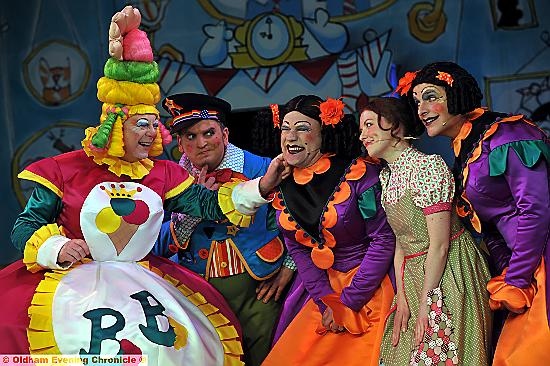
Fine Time and the Ugly Sisters

But what is it about the pantomime at Oldham that we (and, I think, everyone else) loves so much? For me it is several things. Firstly, the theatre itself. As you walk up the little street, no more than a darkly lit side street the brightly lit theatre is like a welcoming beacon. It speaks of tradition. The Coliseum was born in 1885 starting its life as a home for a circus and in its time it has hosted some of the stage greats – Charlie Chaplin, Thora Hird, Eric Sykes Dora Bryan and others have stood on its stage. It is from an age when the theatre, music hall and silent films were  all. It speaks of ordinary people getting their entertainment not from a sterile plasma screen and high tech 3D but from real people.  Ordinary Oldham folk paid their few pennies to be entertained by silent films or a non-stop  programme of plays and other entertainments - in the hard life of the early 20th century to  have an hour or so of bright lights and fun was perhaps a relief from the drab streets and long hours worked in the cotton mills of this north Manchester town. It even has its own ghost – an actor who incurred the curse of Macbeth many years ago and is still reputed to be seen occasionally in the theatre!  In years gone by there were as many as twelve similar places in the Oldham area – I can remember the same situation in the town where I grew up, Preston,  just a few miles up the road from Oldham. Now only the Coliseum survives – and it is still doing what it has done best for over a century - making people smile or cry, taking themselves out of their world, bringing great literature, drama and make believe to the people - and on the day we were there, on this New Year’s Eve’s drab, windy and wet afternoon providing a beacon of warmth and fun. When we entered the cramped foyer the staff, as  always, were welcoming – the programme seller who happily ran upstairs to get more programmes when I asked for three and sold me them with a real smile and word of welcome. The house manager standing – as we have seen him each year - in his highly decorated waistcoat, welcomed us as we came through the doors – directing us to the cosy bar where we enjoyed not a designer cup of coffee but a mug, steaming hot. It may not have gone down well and La Scala or even the Nottingham Royal Centre where fancy glasses and cups are the order of the day – but it was good and wholesome, warm and friendly - welcoming. It was a real place staffed by real people! And we had come to see a pantomime – we were attracted by the entertainment not by some great star who happened to be in a pantomime. So often I see seats being sold because of the “big names” in the show – we do love our celebrities don’t we – but here it was Cinderella and the Coliseum that was selling the tickets not the leading man or lady!
Buttons never stopped

And the show built on this – real people, ordinary, hard working people either on the stage or behind the scenes. Throughout the afternoon I sat there thinking , as I did a few weeks ago, when I watched the great Simon Callow in London perform Dickens (see blog “Beautiful and Magical”) how do these people keep this up. Giving their all for two or three hours – and then having to raise themselves again a couple of hours later to repeat their performance to the next audience.  Awe inspiring and at the same time humbling. As I said on my Simon Callow blog it puts the pathetic utterances of Premiership footballers, cricketers or tennis players  and indeed Olympic athletes into perspective when they have to produce one great performance a week or once or twice a year!
Prince Charming
The cast – to a man and a woman - were superb. How did Buttons keep up his hectic performance and still be racing about, smiling and encouraging the audience after two and half hours? How did the Ugly Sisters maintain their horridness (and their vocal chords!) to the very end? How did the troupe of local youngsters who formed the dancers keep going so long, never missing a step and with smiles on their faces that dropped not one jot? How did Liz Carney doubling up as both the fairy Godmother and Dandini keep going with so much enthusiasm and success right to the end! Every single person on the stage - the Prince, Dandini, Cinderella and the rest looked as if they were putting everything into it and enjoying it so much – and so did we.
Such tasteful dresses!

But above them all – and maybe because of him – was Fine Time Fontayne! This wonderfully named man (Ian Crossley, when not using his stage name) was, as always, supreme. Vastly experienced on stage and TV Fine Time dominated the show with his magnificent presence and his splendid voice as the Dame – Baroness Bunty Hardup! Resplendent in outrageous  and extravagantly wonderful costumes  he was not only the star but also co-wrote the production - and indeed was the show’s heart and soul. From the moment he made his first entry the audience were with him and from previous years we all knew what to expect – gentle humour, long looks at the audience, good family fun that made us all feel better. No dubious, unnecessary and unseemly double entendres, no charmless asides or the unpleasant language that seems to constitute so much of what is sadly, today, believed to be humour. Just good honest fun delivered by a true comedian and great actor.
Ian Crossley aka Fine Time Fontayne

Watching Fine Time is to watch a true master at work. True masters – be they carpenters, brain surgeons, top footballers, builders, teachers or artists.....or indeed any other highly skilled craftsman have one capacity above all others - they always look comfortable in what they are about. They have time, they are always operating within their comfort zone. To watch the great Bobby Moore or Bobby Charlton play football in their prime was to see true masters – they never got into trouble when they had the ball at their feet, never had to make a rushed or hectic last minute tackle to make up for a mistake – they had always anticipated, read the game and taken the necessary steps to eliminate the danger before it happened. It is a similar story when we watch great surgeon at work – never flustered, always in charge. Over the years I have sat at the back of classrooms to watch teachers at work – and the one thing that characterised the truly successful?  - they never looked under pressure, had always anticipated what was going to happen, always in charge, ahead of very child sitting in front of them. The less gifted when under pressure look harassed and unready and that is when they make mistakes are less successful. In the modern world Barack Obama has the capacities of a master but David Cameron does not – hence his outbursts in the House of Commons and his tendency to become irritable and red faced when under pressure from other MPs.
Cinderella


Fairy Godmother
 Fine Time Fontayne has the same characteristic – he was so much in charge that he not only was totally on top of his part but had the time to keep the rest of the cast on track - not that they needed it. He was the master of the stage and the whole theatre. I swear that had he wanted to he could have served ice creams, shown any latecomers to their seats and sold programmes whilst still performing his part - and all without missing a cue! On his first entry, the audience drew in breath at his extravagant costume – but more than that, even before he spoke a word he had a presence and we in the audience who had seen him on other occasions knew that something great was coming........ . And so it was – a wonderful afternoon of sparkling entertainment delivered by a set of great actors who gave it everything they had. And, as the final curtain came down at just before five o’clock I commented that when we got home and relaxed and enjoyed our evening meal and a New Year drink these people would be starting again for the evening performance – making another five hundred people smile and forget their daily cares. Worth every penny that we paid and worth every penny that they earned.


And as we pushed through the thronging foyer to leave the theatre and emerge into the dark streets of Oldham, the House Manager was still standing there, resplendent in his waistcoat, bidding everyone good bye and a "Happy New Year" and smiling as we went out into the late afternoon gloom and damp. The Oldham Coliseum has been around for more than a century. I’m sure that its founders in those far off Victorian times would be pleased that it is still not only going strong but providing such a wonderful focus for life and entertainment in the area. The local paper the Oldham Chronicle said “The best traditional pantomime you are likely to see in the region” – indeed it is. You will not see finer anywhere – we all had a fine time with Fine Time! The people of Oldham are very lucky to have this facility to enjoy - and so were we to be there.

19 December, 2012

The Mayor & The Simpleton

When I was about to retire from teaching some seven or so years ago people told me that I would  especially miss the Christmas festivities that go on in all schools - the singing of carols, Christmas parties, the Nativity, the disco, the excitement of the children and the like. I can’t say that I have – in fact I’ve been happier in the more moderate build up to Christmas without the frenetic activity of pre-Christmas school life!
There is , however, one element of school Christmases that I have rather missed – the words of Christmas. For many, many years I was the person who “wrote” and produced the Christmas carol concert or nativity. Each year we concentrated on telling the Christmas story in a different way – it may have been via the Russian story of Babushka, or by taking a historical theme such as a medieval mystery play or by looking at how Christmas is celebrated in different parts of the globe but, whatever, it was a vehicle to retell the great story of the first Christmas. Each year I would plough through books to find suitable poetry, words and ideas to put the whole thing together so that in the end the kids not only retold the Christmas story but also maybe learned a bit – a wonderful poem, a bit of history or some legend from long ago or some far off place. In my researches and resulting “scripts” I came across many wonderful pieces and somehow or other tried to fit them jigsaw like into the tale.

And at this time of year I often think back to some of the great words that I came across and I find myself flicking back through my old school books and re-reading some of the wonderful verses and extracts that I used and which, through the ages, people have scribed down as their thoughts on the Christmas story.

Some of my favourites might only be a couple of lines long......

”And did you know that every flake of snow,
That forms so high, in the grey winter sky
And falls so far is a bright six pointed star......”
(Clive Samson: “Snowflakes”)

Others might be great tracts that retell the whole story from a particular perspective......
“Three Kings came riding from far away,
Melchior and Gaspar and Baltasar;
Three wise men out of the East were they,
And they travelled by night and they slept by day,
For their  guide was a beautiful wonderful star..........”
(Longfellow: “Three Kings Came Riding”)

Of all those I used over the years two or three stand out above all others as having something special and pertinent to say at this time of commercial frenzy when it is easy to forget what it is all about. One is the great poem by John Betjeman “Christmas” – see blog: http://www.arbeale.blogspot.co.uk/2012/12/the-waiting-bells.html .

Another is Kipling’s “Eddi’s Service”:

“Eddi, priest of St Wilfrid
In the chapel at manhood end,
Ordered a midnight service
For such as cared to attend............”

Read Kipling's short poem and I defy anyone not to at least feel a twinge about the true meaning of the Christmas story.

And yet another is TS Eliot’s masterpiece: “Journey of the Magi”

“A cold coming we’ve had of it,
Just the worst time of year
For a journey, and such a long journey:
The ways deep and the weather sharp,
The very dead of winter..........”

Like Betjeman’s poem “Christmas” Eliot’s is at one level a superficial, if different,  retelling of part of the Christmas story, but it  asks great questions in the final stanzas.
Ian Serraillier

And right up with the best of my favourites is the wonderful poem by Ian Serraillier “The Mayor and the Simpleton” . Serraillier is one of my favourite authors. I could not even begin to imagine how many times I have read his most famous work “The Silver Sword” to classes of children. Serraillier was a Quaker and a pacifist. In the Second World War he was a conscientious objector and his message of peace runs all the way through “The Silver Sword” – the story of refugee children in the war damaged Europe of the second World War. It is the sort of book that children can learn something about themselves and about growing up – as well as being edge of the seat exciting. Whenever I read it to a class, children would exclaim “Ohhhhh” when we got to the end of a chapter – and want to read another one!

Serraillier’s poem, it seems to me, gets to the heart of what Christmas is about – in a rather strange way. It reminds us of what we are about as we tear open our Christmas presents or we  sing “Silent Night” . I always think of it at this time of year – I know the words by heart – I have so often spent time with children as they learned their lines or put expression into the words as we rehearsed it for a  Christmas “production”. But a couple of days ago I was reminded of it for another reason.

Making up food parcels in one of the
world's richest countries. We should be
ashamed not making excuses.
In the UK (and, I guess, in other parts of the world) a day does not pass without newspapers and TV reporting people being thrown out of work. The other side of the coin is that we still hear each day it seems of bankers and others associated in high finance and corporate life receiving huge bonuses, of vast wealth in certain sections of society and of calculated misuse of  influence by those with access to power and wealth. Our society is becoming, daily, more divided between the “haves” and the “have nots”. I read only the other day that in my area – a wealthy area of the midlands - there has been a huge increase in the number of ordinary people receiving food handouts – this, in one of the world’s richest countries. In Monday’s Guardian a full page article described how the head teacher of a highly successful and government applauded school in Essex is concerned and angry at the number of his pupils who come from “good” homes but are increasingly ill clothed or fed simply because austerity is biting. The Head was using his own money to buy a winter coat for a boy whose parents could not afford one - a symptom of an escalating economic crisis that has seen the number of pupils in the area taking home food parcels triple in a year. The Head described how even children with a parents in work were often struggling and having to choose between heating their homes, buying their children clothes or having enough food.
Oh! I am such an important man -
I havequick riposte and glib gag
for every occasion

And against this backdrop of an ever more unequal society this weekend the Mayor of London, the amiable buffoon, (and, because of that carefully cultivated persona, highly dangerous) Boris Johnson made another of his misguided utterances. Except that this was, I felt, offensive, unacceptable and thoughtless from an extremely wealthy and, sadly, very influential man. The fact that Johnson finds himself the leader of our capital city is, in my view, an affront to decency and, indeed, democracy. That Johnson has risen to this position (and is, staggeringly, tipped as a future national leader) sadly says far more about our society and the people who voted for him than it does about the man himself. His glib “off the cuff” comments, his “clever dick" one liners, his relentless self promotion and pathetic pseudo intellectualism built upon a mock veneer of the odd Latin quote and affected accent reflect badly not only upon the man himself but also upon an easily impressed and gullible electorate. Johnson is the personification of shallow pomposity and while being interviewed on TV over the weekend he suggested people should not to "sneer" at the coffee chain Starbuck’s over its decision to grudgingly pay £20m in corporation tax. The company has paid £8.6m in corporation tax in its 14 years of trading in the UK and nothing in the last three years, despite UK sales of nearly £400m in 2011. Starbuck’s, he reminded us was showing "corporate responsibility" and the issue was "difficult". 

It is not "difficult". In an age when millions are out of work – largely because of the lack of “corporate responsibility” in past years it is  an eye wateringly irresponsible and offensive statement. In the past weeks there has been much media comment and hand wringing about multinational companies “playing” the tax system and legally paying less tax than they might – Amazon, Google, Starbuck’s and many others have jumped on this money laundering band wagon. Starbuck’s have been highlighted and a series of demonstrations have occurred outside many of their shops. For Johnson to suggest that they should not be criticised or that they are now showing “corporate responsibility” by making a nominal tax donation because they have been “caught with their trousers down” says much about Johnson’s own beliefs and possible actions. The issue is not, as Johnson suggests, “difficult” – it is extremely simple: Starbuck’s and others pay the tax required in the spirit it is intended and be pleased to do it – there can be nothing simpler.
Starbuck's have the spotlight turned on them

I do not suggest that Starbuck’s paying of appropriate tax will solve the problems of the Head Teacher who takes his children down the local “Primark” to buy them a coat out of his own money – there are deeper issues. But a few extra billions in the national coffers will certainly help and it would say much about the sort of society we would all wish for. For Johnson to come out with this pathetic and pompous defence of corporate greed is a disgrace - especially at a time when we are reminded daily that many in the UK  (one of the world’s richest nations) will be without basic comforts this Christmas. Reading this
my mind idly wandered to another mayor - the one in  the Serraillier Christmas poem “The Mayor and the Simpleton”. And in a flash I saw Boris Johnson in this other guise! The unthinking, callous and irresponsible utterances by the pompous, self important Mayor of London seemed to me to be a twenty first century mirror of Serraillier’s pompous mayor – full of talk, full of trivial and misguided comment but with no feeling for common humility and humanity. Johnson should be ashamed - but perhaps, too, should all those people who elected him as Mayor of London and who now talk of him as a prospective national leader.


The Mayor & The Simpleton

They followed the Star to Bethlehem – Boolo the baker, Barleycorn the farmer,
Old Darby & Joan, a small boy Peter, and
A simpleton whose name was Innocent,
Over the snowfields and frozen rutted lanes
They followed the Star to Bethlehem.

Innocent stood at the stable door
and watched them enter. A flower
stuck out of his yellow hair; his mouth gaped open
like a drawer that wouldn’t shut.
He beamed upon the child where he lay
among the oxen, in swaddling clothes in the hay,
his blue eyes shining as steady as the Star overhead;
beside him old Joseph and
Mary his mother, smiling
And Innocent was delighted.

They brought gifts with them – Boolo, some fresh crusty loaves
(warm from the baking) which he laid
at the feet of the infant Jesus, kneeling
in all humility.
And Innocent was delighted.

Barleycorn brought two baskets – one with a dozen eggs,
the other with two chickens – which he laid
at the feet of the infant Jesus, kneeling
in all humility.
And innocent was delighted.

Darby and Joan brought apples and pears from their garden,
wrapped in her apron and stuffed
in the pockets of his trousers; the little boy
a pot of geraniums – he had grown them himself.
And they laid them
at the feet of the infant Jesus, kneeling
in all humility.
And Innocent was delighted.

The mayor rolled up in his coach with a jingle of bells
and a great to do. He stepped out with a flourish
and fell flat on his face in the snow. His footmen
picked him up and opened his splendid
crimson umbrella. Then he strutted to the door,
and while the white flakes floated down
and covered it with spots. He was proud of his umbrella
and didn’t mean to give it away.

Shaking the snow off onto the stable floor,
The mayor peered down at the child where he lay
Among the oxen, in swaddling clothes in the hay,
His blue eyes shining steady as the Star overhead,
Mary his mother smiling.
And Innocent was puzzled.

And the mayor said: “On this important occasion
Each must take a share in the general thanksgiving.
Hence the humble gifts – the very humble gifts –
which I see before me. My own contribution
is  something special -  a speech. I made it up myself and I’m sure
you’ll all like it. Ahem. Pray silence for the mayor.”

“Moo, moo” said the oxen

“My fellow citizens,
the happy event I refer to -  in which we all rejoice –
has caused a considerable stir in the parish....”

“In all the world” said a little voice.

Who spoke? Could it be Innocent, who, always shy,
Timid as a butterfly, frightened
as a sparrow with a broken wing? Yes, it was he Now God had made him bold.
“I fear I must start again” said the mayor.
“My fellow citizen, in the name of the people of this parish
I am proud to welcome one
who promises so well......”

“He is the Son of Heaven” said Innocent

The mayor took no notice
“I prophesy a fine future for him,
almost – you might say – spectacular.
He’ll do us all credit. At the same time I salute in particular
the child’s mother, the poor woman who.....”

“She is not poor but the richest, most radiant
of mothers.”

“Simpleton, how dare you interrupt!”
snapped the mayor.

But God, who loves the humble, heard him not.
He made him listen, giving Innocent the words:
“Mr Mayor, you don’t understand. This birth
is no local event. The child is Jesus,
King of kings and Lord of lords.
A stable is His place and poverty his dwelling place –
Yet he has come to save the world. No speech of yours
Is worthy of Him....”

“Tush” said the mayor.
“I took a lot of trouble. It’s a rare
and precious gift, my speech – and now
I can’t get a word in edgeways.”

“Rare and precious did you say? Hear what the child
has brought us – peace on earth, goodwill towards men.
O truly rare and precious gift!”

“Peace on earth” said the neighbours
“goodwill towards men! O truly rare
and precious gift!” They knelt in all humility,
in gratitude to the child who lay
among the oxen, in swaddling  clothes in the hay,
his blue eyes shining steady as the Star overhead,
beside him old Joseph and
Mary, his mother, smiling.

The mayor was silent. God gave the simpleton
no more to say, Now
like a frightened bird
over the snowfields and frozen rutted lanes
he fluttered away. Always, as before, a flower
stuck out of his yellow hair; his mouth gaped open
like a drawer that wouldn’t shut.
He never spoke out like that again.

As for the mayor, he didn’t finish his speech.
He called for his coach And drove off, frowning,
much troubled. For a while
he thought of what the simpleton had said
But he soon forgot all about it, having
Important business to attend to in town.

Ian Serraillier

Goodwill to all men...as long as it's corporation tax deductable

I suspect that Boris Johnson and others on the corporate/power bandwagon will, too, have “important business to attend to in town” over Christmas – he and they will "soon forget", Serraillier's mayor did,  about the poor and the homeless on London’s streets and those having to choose between warmth, food and clothes. He and they will, I have no doubt, have lots of corporate gatherings to attend, pompous speeches to make, lots of self adulation in which to wallow, much champagne to drink and turkey to eat. And, I have no doubt, they will all – unlike the Essex schoolboy - have a warm coat on their backs and maybe a few presents under their corporate Christmas trees. 

And no, Mr Mayor, problems with corporate tax avoidance are not "difficult" to resolve – they are so very simple that even a simpleton could come up with the answer – pay the required tax, pay it on time, do not employ people whose sole purpose is to find ways to legally and often shady ways to  minimise your tax obligations and last, but not least, be pleased that your corporation is given the privilege (and yes, it should be considered a privilege) of trading in our country. That is the humanitarian message that the Mayor should have been sending out. Instead he decided to side with greed and excess and maybe that’s why our pompous and shallow Mayor of London may have  a little “Christmas Greetings and Best Wishes for the New Year” card from a certain multinational company’s PR department under his Christmas tree!