16 December, 2012

Thank You Mr Handel, Thank You RDCS

A full church and everyone takes their seats
As the final “Amen” rang out in St Peter’s Church Ruddington last night Handel’s great Messiah came to a close and the audience erupted as one into a tremendous applause. Christmas had arrived for me, and I suspect very many of the audience, choir and orchestra. Everyone in the church knew that they had witnessed and taken part in something not only very special – the 50th anniversary of the Ruddington and District Choral Society - but also a very special performance.  The Choir has performed this piece many, many times over the years – but I suspect none more successfully or more fully and warmly acclaimed than this. To say that everyone put their hearts into it does not begin to do it justice.  (See previous blog: http://arbeale.blogspot.co.uk/2012/12/sdgsoli-deo-gloria-to-god-alone-glory.html).

The day had started well. When the postman delivered the mail, included in our little pile of Christmas cards was one easily recognisable from its envelope. The oriental script  and the “air mail” stamp told us that it had come from Japan. A young Japanese lady who lived in Nottingham until three or four years ago and was a keen choir member each year sends a card and a small donation to the choir – for the card to have arrived just before the performance seemed a good omen from the far side of the world.

The audience stood as one for the "Hallelujah"
Sadly, however, things soon began to look less auspicious. The omens ceased to look so good! Winter chills, sickness bugs and throat infections had meant that a number of stalwarts had had to cry off and so depleted the choir. And only a few hours before the performance was due to start two of the soloists succumbed to illness and so replacements had to be found at very short notice. Programmes had to be amended to advise the audience of the changes – it was a very busy day! Having rehearsed throughout the afternoon everyone would have felt just a little anxious and perhaps a little jaded.
The "Amen" reaches its climax

But, as they say, “it was alright on the night” – well actually it wasn’t – it was quite magical, an outstanding performance by anyone’s standards and a fitting tribute not only to the current choir but indeed all those people who have been part of it during the last fifty years. Every single person rose to the occasion wonderfully. The soloists were superb and the orchestra – English Pro Musica - truly outstanding. But, of course, the real star was yet again Handel’s great oratorio. From the very first note, through the next two hours, to the point where the audience stood as one when the great  Hallelujah Chorus sounded and when the audience erupted as the final Amen rang out this was a recognition of something great and wonderful.
And the applause burst out!

I have no doubts that if Mr Handel was looking down on our village church last night he might just have nodded his head in approval – and maybe he pondered upon and smiled that three centuries after the wrote his mighty piece it is still performed and loved by so many throughout England and the rest of the world.

Christmas is here. Thank you, Mr Handel, thank you RDCS!

11 December, 2012

"Beautiful & Magical!"

One of my pet hates and guaranteed to put me in grumpy old man mode  is the way in which, today, adjectives like “amazing”, “fantastic” “ great” and so on are applied to very ordinary situations and people. “It was a fantastic goal” sports pundits scream when in fact the scorer simply kicked the ball between two posts 24 feet wide and 8 feet high (wider and higher than my living room!). “He’s amazing” we hear young people say as they describe some pop celebrity. The wedding was “awesome” I recently read on the front of a celebrity magazine in the newspaper shop.  It seems to me to be becoming ever more difficult to distinguish between the truly good or great and the everyday or the trivial. I have long since come to the conclusion that the more hyperbola that is attached to a person or situation then generally the more quickly it will be forgotten. The truly great people and events do not need advertisement and  hyperbola – they speak for themselves.
The Porcupine -
an excellent lunch

I was reminded of this on Saturday – a day which for two very different reasons I do not think I will forget. An increasingly  painful day turned out to be one of those days when I saw something that truly was "awesome", "amazing" and "great" - and so very memorable. 

Pat and I were visiting our son and his family near Maidenhead. We had decided to take advantage of our proximity to London to go up to London to the theatre and had managed to get tickets to see the wonderful classical actor Simon Callow perform his one man show retelling Dickens’ Christmas Carol. I am a great fan of Simon Callow - his wonderful melodious voice, I swear could make the telephone directory sound like great literature. But he is more than that - much more. He has a commanding stage presence and yet a great humanity - and the result is that no matter what the part he slips into it's like slipping into a well worn shoe. He has such a feel for the language and the character that he makes every character he plays utterly believable. 

Unfortunately we got off to a bad start – I woke up on Saturday morning in severe pain from sciatica – a condition that I occasionally suffer from. However, we set off but as the pain got worse I began to question the wisdom of this decision! With the help of my walking stick and a lot of difficulty, we managed the packed underground stations and eventually found ourselves at Leicester Square. It was a matinee performance so we thought we would have some lunch in London and then go to the theatre just off Leicester Square. By the time that we arrived at the theatre I was desperate to find somewhere where I could sit down for a good period to ease my back and leg pain! We were in luck – within yards of the underground station and virtually opposite the theatre we found a very pleasant pub – The Porcupine - where we had a lovely lunch and were able to sit and relax a little. After lunch, and by now I was in some agony, we crossed the road to the theatre. As we sat in our seats waiting for the show to begin I took two more painkillers and began to think maybe we should have gone home. Fortunately, the seat was comfortable and my pain eased a  little..........and, at last, the lights dimmed in the little theatre and Simon Callow shuffled onto the dimly lit  and bleak set.
The Arts Theatre

And from the moment Callow appeared and opened his mouth I sat entranced, my pain all but forgotten as I watched – sometimes open mouthed, always immensely moved at this great, great actor retell Dickens’ wonderful tale. Callow is not only a great actor but a great lover of Dickens – to simply hear his rich and constantly changing voice repeat Dickens’ great words is to hear the very best of our language. To have been privileged enough to have sat for an hour and a half in that theatre and watch this man, totally alone and with no technological aids or the razzmatazz  so often associated with so much theatre  and film today retell, with gentle humour, passion, humility and immense tenderness the story of Ebenezer Scrooge was quite humbling. Every one of the three or four hundred people in that packed theatre knew the story as well as I and, I guess like me, knew many of the words – but we all saw the characters and the story with new insight on Saturday afternoon and we all hung on every single word uttered by Callow. For ninety minutes the whole audience sat mesmerised and in awe of this performance – our attention never wavering one millimetre – as Callow’s words, expressions, gestures, stagecraft, body language, wonderful voice and command drew us into the world of Dickens. We were no longer in a 21st century theatre in the busy West End but had been transported, as surely as Ebenezer Scrooge was transported by the spirits who visited him, to the dimly  lit back streets and alley ways of Victorian London. We were present with Scrooge as we peeped into poor home of Bob Cratchit; we were afraid, as was Scrooge, when Callow invoked the ghost of Jacob Marley; we were joyful with Scrooge when he realised the error of his ways. We watched in awe as Callow effortlessly slipped from one character and into another – one second he was grasping, withered Ebenezer and in the twinkle of an eye changed to be Scrooge’s jovial, loving nephew. Then he was a spectre guiding and terrifying Scrooge as they visited Christmases past, present and future – and next Tiny Tim or Mrs Cratchit carrying in the Christmas pudding "her face flushed but smiling proudly"! At once he was Mrs Fezziwig, dancing with his wife and then Bob Cratchit plaintively and overwhelmingly sadly describing Tiny Tim's final resting place. We all laughed and our minds eye saw the London ragamuffin gazing up at Scrooge's window that Christmas morning as Scrooge called down to the lad "What's to-day, my fine fellow"  and we all "saw" the great turkey hanging in the poulterers window. Callow's magic ensured that we inhabited Scrooge's miserable rooms and we could almost taste the "speckled cannon ball" of a Christmas pudding that Mrs Cratchit proudly bore. He was these people, he took us to these places –  we were there with him - he made Dickens' words and  Dickens' world real!
Callow in the Programme

And, as Callow spoke the great words, their great message of love for mankind, became clear to us. This was not just a nice Christmas story - it had a message and Callow brought it to life with force, energy and great insight and no little humour. When Jacob Marley  ruefully and pitifully confesses to  Scrooge that he wears his chains because of the selfish life he had led and says “Business! Mankind was my business. The common welfare was my business; charity, mercy, forebearance and benevolence, were, all my business. The dealings of my trade were but a drop of water in the comprehensive ocean of my business.......why did I walk through crowds of fellow-beings with my eyes turned down........” Callow and Dickens together pricked all our consciences. This was a message as relevant today as it was in Dickens’ time. If Dickens were alive today he could and would write every bit as sad and piercing indictment of Britain (and maybe much  of the western world) as in his day.  And Callow took us all to that world – a world we had all read about before but never actually visited – until Saturday afternoon.
He held us in his palm!

In his programme notes, Simon Callow gave us a little peep into Dickens’ the man and the story of his writing A Christmas Carol. Dickens’ said that he “wept and laughed and wept again” as he wrote the tale. He knew that what he was writing was extraordinary and when he finished he underlined the words The End three times. The moment the book went on sale its first print run of 6000 sold out immediately as did the next two runs. Praise for the tale was overwhelming and from every level of society. Lord Jeffrey said “(it) had done more good “than all the pulpits and confessionals in Christendom” Thackeray said “it is a national benefit and to every man and woman who reads it a personal kindness”. Callow commented “A Christmas Carol is many things – a ghost story, a parable about a man forced to face truths about himself, a realistic picture of social life, a celebration of Christian ideals – but at its heart is a frightening vision of abandoned, half human children – Ignorance and Want – that should make us shiver just as it did the prosperous Victorian classes......Dickens was not making this up; he had, on his ceaseless wanderings through the East End seen such children; he had given them money, held them in his arms, ensured they were provided for.....Dickens being Dickens, his story was no dry analysis of social conditions; he dramatised the whole ugliness of crude capitalism in the character of Scrooge – “a squeezing, wrenching, grasping, scraping, clutching, covetous old sinner”........a sort of pioneer Thatcherite, believing there is no such thing as society and that the right place for the poor is the workhouse or the prison.” 


This was, at one level a truly great bit of theatre; at another level a telling indictment of the times in which Dickens’ and we live; at another level it was simply a wonderful reminder of the richness depth of both Dickens and the English language and literature. And in Callow’s hands he light heartedly but forcefully reminded us all of the inner message Dickens was sending to his fellow Victorians. I have absolutely no doubt that if Dickens were gazing down on that little theatre on Saturday afternoon he would have so approved of what Callow presented and reminded us of.
The First Edition in 1843

I have always loved to watch and listen to Callow – now, as the afternoon ended, I was quite overwhelmed – as were so many in the audience. When the tale ended and Callow uttered the words we all knew he would utter at the end  “He had no further intercourse with Spirits, but lived upon the Total Abstinence Principle, ever afterwards; and it was always said of him, that he knew how to keep Christmas well, if any man alive possessed the knowledge. May that be truly said of us, and all of us! And so, as Tiny Tim observed, God bless Us, Every One!” the audience erupted as one. Yes,  a standing ovation took place but that does not tell the full story or come close to describing the warmth and approval of us all. Every member of that audience knew they had witnessed something special  and had been privileged. Every person knew that not only had they seen a very special talent but had also been in the presence of a very great actor and very special human being. Callow stood there, erect, taking his bow, surrounded by the six old wooden chairs, the little fire and the old raincoat that had been his only props as he had strutted about that stage. Everything we had "seen" - the Cratchit's Christmas pudding, the spectres who visited Scrooge, the gravestone on which was writ "Ebenezer Scrooge", the great turkey that Scrooge sent to the Cratchit's, the merrymaking at Mr Fezziwig's, and the rest we saw because Callow and Dickens together painted them in our minds - they were word pictures and all the more powerful for it than mere stage props.And as he bowed again and again I could only wonder at how much a performance like that must take out of him and how can he reproduce it performance after performance. It makes the utterances about “pressure” that we hear from top soccer players, and the like, who play only one game or maybe two a week be seen for what they are pathetic moans. And I wondered at what makes true greatness? Here was a man who really can be described as amazing or great. Here was an event that will live long in the memories of all who sat there – truly “awesome”, quite unforgettable.
My damp marked book - illustrations by
 John Leech the first illustrator of A Christmas Carol

And today, as I sit at home nursing my painful back, I think again and again how glad that I am that we didn’t return home on Saturday when my back was so painful - that we struggled on to the theatre to witness Callow’s performance. A painful but wonderful and lasting experience. In the programme there is a quote from the Daily Telegraph review of the show. It is exactly right: “Beautiful and magical. There will be bigger, flashier shows on offer this Christmas, but none, I suspect, that will leave one quite so warmed and moved as this one”. Amen to that.

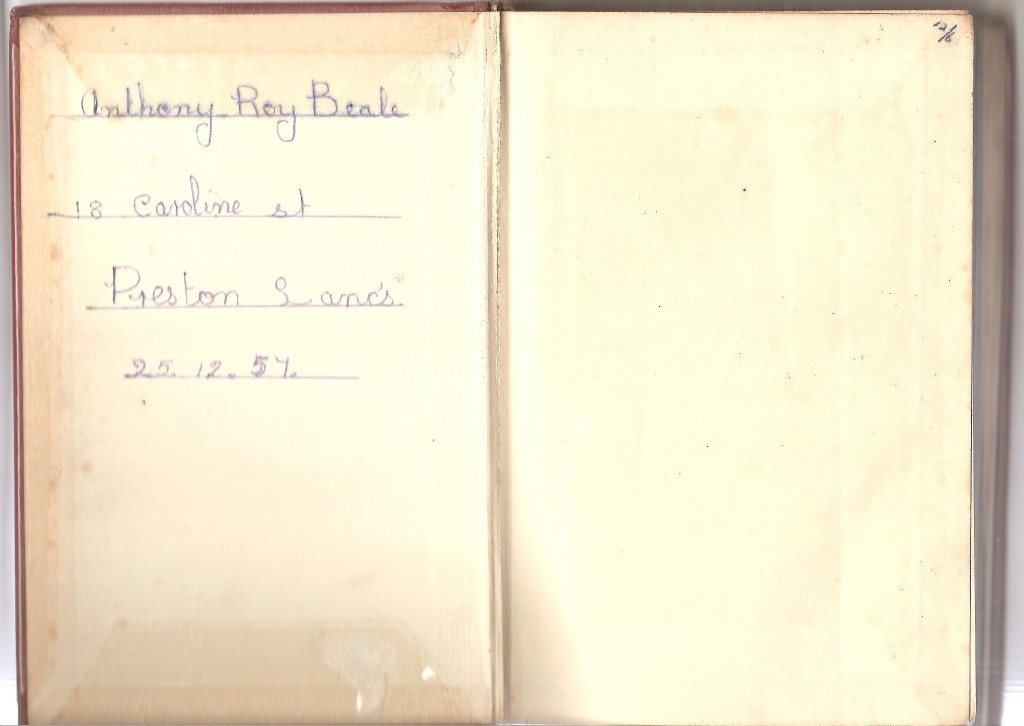
I have just I have looked again at one of the bits of my past – my copy of the Dickens’ “Christmas Books” – including the great “Christmas Carol” In the front cover my name is written in my child-like curly handwriting when I was twelve. The book was a Christmas  gift from my mother – “25.12.57” – my childlike hand has inscribed in the front. I can still today remember opening that book all those years ago and reading the opening words: “Marley was dead, to begin with. There was no doubt whatever about that.........”. 
25.12.57


I can still vividly remember sitting under the little Christmas tree that stood each year on our sideboard, the coloured lights above my head,  reading the words and looking at the pictures. I didn’t know then that the pictures were exactly those used in the very first edition of the book in 1843 – drawn by the Victorian caricaturist John Leech. I didn’t dream that nearly sixty years later I would sit in  a London theatre and watch one of the country’s greatest actors declaim those great words or that I would still gain such huge pleasure from the words and the story – that surely is a mark of greatness.  The pages now are a little faded and with damp marks. But as I flick them near to my nose I can smell the smell of years past – taking me back in time. I can still smell the faint smell of cigarettes (my father and mother were both heavy smokers) that permeated the book as it sat on the shelves in their house – and now in mine. It smells of Christmases past – a reminder to me of what has gone before. Each time I open it and read the opening words, I cannot resist sniffing the pages – they evoke such memories of my own Christmases past. 

What a heritage Dickens has left us – and after Saturday afternoon a whole new layer has been added to my understanding of his great tale – thanks to a truly "great", "fantastic" and "awesome" actor – Simon Callow.

06 December, 2012

"SDG"—Soli Deo Gloria - "To God alone the glory".

As  I noted in my last blog there are many pieces of great  music that I enjoy each year at Christmastide – Bach’s Christmas Oratorio, Telemann’s Festive Suite, Corelli’s Concerto Grosso Number 8 ( often called  The Christmas Concerto) and many, many more – but above them all towers Handel’s great masterpiece The Messiah. Undeniably, like Bach’s St Matthew Passion,  it is one of the very  great musical works.  It is, however,  like other great pieces, more than simply a good piece of music. Just as with Beethoven’s Ninth Symphony, Bach’s B Minor Mass, Bach’s St Matthew Passion or the Mozart Requiem  it is something that  reminds us what it is to be human – just small spots in a vast cosmos – and it confirms to  everyone, I believe, even those of no religious affiliation or view, that there is something deeper and more significant about Christmas than just torn wrapping paper, bottles of wine, Christmas stockings or turkey and stuffing. The Messiah  reminds us of what we are about – or should be about - for those few days in dark December whilst much of mankind watches TV shows and binges on his and her excesses.

Although the Messiah never usually comes out in our house before the beginning of Advent  this year this is not strictly true. For weeks now Pat has been practising. Every other year her choir – the Ruddington & District Choral Society - do a “community, sing along” Messiah in our local church – St Peter’s. This year, however, it is different. It is not a sing along Messiah, where the audience can join in if they wish, but a full concert version.  So, for weeks, the Messiah has been a constant background in Pat’s car radio as she practises her soprano part while she drives along! The community Messiah is a highlight of the choir’s year and the church is always filled – for many villagers, like ourselves, it signals the real start of Christmas. But this year’s concert version, however,  is extra special. The reason? – the Choir is fifty years old this year – and fifty years ago the Messiah was the first work that the newly formed choir sang in far back December 1962.  Today, fifty years later, Pat produces the choir programme and I write the programme notes so in the past few weeks we have been putting final touches to the document. It is now at the printers.

Researching the background to Handel’s great work  has been both rewarding and enlightening. I am always reminded, as I write the notes for a choir concert, of one of the great qualities and virtues of all music – be it pop, classical or any other. It is that when we listen to a piece of music, which might have been written many years before, it links us directly to that point in time when it was first heard - we are hearing what audiences listened to many hundreds of years ago when the notes were first played or sung. Our ears are their ears. If it is a piece written in our own lifetime then there is an extra dimension -  then we are hearing the same thing that we first heard as a youngster or a teenager and it reconnects us with our own past. It is, in short like touching, the past. This is true of many aspects of the arts – great paintings, old books, old buildings – they all mysteriously connect us with the past and with the people who first saw them or listened to or read them. The other night Pat and I sat watching a programme on TV about the Beach Boys pop group of the 1960’s – one of our favourites when we were younger. To hear again some of their songs transported us back to the sights, sounds, feelings, emotions, hopes and fears, tastes, smells of half a century ago – just for a few minutes and we listened to “Surfin USA, Fun, Fun. Fun, Good Vibrations and all the others in the Beach Boys repertoire we were no longer senior citizens but reliving our misspent  youth! Music has that peculiar power. And with something like the Messiah or a piece of Bach or Beethoven, although we cannot experience what the audience who first heard it experienced and thought, we can just get a little glimmer of their lives, aspirations and ambitions – and of course what wafted into their ears all those years ago. A powerful medium indeed.
Hot off the press - the programme

The Messiah research was no exception in this -  and the more that I read, the more I felt a real link with all those years ago when it was first written and performed – and indeed with the thousands of performances that have since taken place in all parts of the world. I also discovered that the story of the Messiah – and indeed I would guess of any other piece of music – tells us much about the people and places of the time – as well as giving us information about the composer or the piece.

I have seen and listened to the Messiah more times than I could possibly guess at. Indeed, it is one of the formative influences on my life – an almost “road to Damascus” experience which brought me to classical music as a teenager (see blog: http://arbeale.blogspot.co.uk/2011/05/i-have-always-been-surprised-and.html). In the many performances I have seen and heard many stand out – often for the strangest of reasons. Twenty years ago Pat and I were holidaying in Florence. It was Easter and we passed a church outside of which was advertised a performance of the Messiah. We went along that night and sat like many others on the cold stone floor surrounded by great Italian works of art that decorated the church. Throughout the three hour performance ordinary Italians popped in and out – many simply walking their dogs but grabbing a few minutes of wonderful music at the same time. It was quite magical. And then as the opening bars of the "Hallelujah Chorus" struck up from the little orchestra, all the Brits in the church suddenly made themselves known – as if a switch had been pressed. We all stood to attention in the time honoured manner! Italians looked in confusion at what was happening when a third of the audience rose in unison and stood proud! Magic!
St Peter's Church Langton

The story of the Messiah is a rich mixture of national history, the great and the good and the everyday. It stretches from great opera houses and theatres to tiny villages; its story includes Kings and humble villagers; it encompasses the great sopranos and  tenors as well as the keen amateur musician and singer. It is a Christmas piece and an Easter favourite, but it is also a piece for all seasons; it is a piece to give us national pride and at the same time something for  “everyday country folk”.

My research on the Messiah began not a few weeks ago or even a  few months ago as this concert began to be planned. I simply came across a bit of the Messiah "jig saw" by accident one day about three years ago. I went, one afternoon, to visit a trainee teacher who  I was supervising as she did her teaching practice in a small village school in Leicestershire. After watching her teach we retired to the school staff room to discuss her lesson. On the notice board there was a notice advertising a performance of the Messiah in the local church and as I read the notice I noticed that the performance included some very well known, international singers. I wondered how the church in so small a village could afford such great names - and then I read the small print.  It was to celebrate the 250th anniversary of the first church performance of the Messiah in England - the great and the good of the singing world were celebrating a very special event. The school was in the tiny village of Church Langton, the church was just across the road.

In the Spring of 1759, only a few weeks after Handel had died in London, a Leicestershire man, Church Langton resident and philanthropist, the Rev. William Hanbury, paid £500 for an organ to be built and transported to the local  church of St Peter’s in his village - mid way between Leicester and Market Harborough. It is about 40 miles away from Ruddington, where I live. According to local records, the sound of the organ was a terrifying prospect “....some of the common people were frighted and hurried out of the church with all speed....they thought the Day of Judgement was really come indeed.....” After the tumult has died down and the villagers had become used to the sounds of the organ and other instruments brought by Hanbury, the very first performance of the Messiah was given in an English parish church - on September 26th 1759. In the two day Handel musical festival that followed in the village records tell us that “the countryside flocked to the performance...accommodation of all kinds was at a premium, the price of food was nearly tripled, there were more than two hundred chariots, landaus and post chaises....” This little snippet of local history and music represents well, perhaps, the bigger tale of the music of Handel and especially that of  Messiah. 
William Hanbury

Hanbury was a wealthy man with great ambitions and aspirations and he not only began the Messiah's church performance. He had plans to build a Minster to rival the great York Minster in his village. He never realised that dream but he did endow his village with other things - most notably the school in which I had sat that afternoon and watched that young teacher teach. It was and still is known as the Hanbury School and was "founded for the education and religious instruction of boys and girls of this parish".

But back to Messiah. It  was  composed in 1741 based on  a scriptural text compiled by Charles Jennens from the King James Bible, the Psalms and the Book of Common Prayer. Jennens, too, was a Leicestershire man - he lived only a few miles from Church Langton. It was first performed in Dublin on 13 April 1742, and received its London premier nearly a year later. After a modest public reception in London, the oratorio quickly gained in popularity, eventually becoming one of the best-known and most frequently performed choral works in Western music.

Handel, of course, was a German – he became a naturalised Englishman and in his life time became almost more English than the English. He walked with Kings and composed some of the very great state music – much of it still with us. His Water Music, for example was played this year as the Royal Barge floated down the Thames in the Queen’s Jubilee Year - as it played in 1717 for George 1st as he cruised down the Thames. This week we have heard of the coming birth of a future King or Queen – the child of Prince William and Kate Middleton. As the crown is placed in that child’s head many years from now  the music that will be played will be that of Handel – Zadok the Priest. Handel's impact on the life of his adopted country was and still is huge. But although Handel walked with Kings he had to earn his crust and he composed furiously to earn a living. He was something of an impresario – putting on operas at a great rate. He owned shares in theatres – he was almost the Andrew Lloyd Webber of his day! His fortunes went up and down and although he died a wealthy and respected man, like everyone else, he suffered success and failure. In an echo of today’s economically challenged times he lost a huge amount of money with the financial banking scandal known as the South Sea Bubble and, just as today, the fickle world of music with its ever changing fashions forced him to continually rethink his approach.
Handel at the time he wrote  Messiah

By the late 1730’s interest in grand Italian opera was declining – there was a move towards English language productions and although Handel continued to write and produce great opera he increasingly moved towards the English oratorio. In July 1741 Charles Jennens, a friend of Handel,  sent him a new libretto for an oratorio, and in a letter said: "I hope he [Handel] will lay out his whole Genius & Skill upon it, that the Composition may excell all his former Compositions, as the Subject excells every other subject. The Subject is Messiah".

The music for Messiah was completed in 24 days of swift composition. Having received Jennens' text sometime after 10 July 1741, Handel began work on it on 22 August. His records show that he had completed it in draft by 12 September, followed by two days of "filling up" to produce the finished work on 14 September.
Charles Jennens - who gave us the words

The score's 259 pages show some signs of haste such as blots, scratchings-out, unfilled bars and other uncorrected errors, but according to the music scholars the number of errors is remarkably small in a document of this length. At the end of his manuscript Handel wrote  "SDG"—Soli Deo Gloria, "To God alone the glory". This inscription, taken with the speed of composition, has encouraged belief  that Handel wrote the music in a fervour of divine inspiration in which, as he wrote the "Hallelujah Chorus”, "he saw all heaven before him". The reality is perhaps more worldy!  Many of Handel's compositions were composed within similar timescales – they had to be squeezed between theatrical and operatic seasons. There is significant evidence that Handel’s finances were at a low, fashions were changing and he needed a new idea to boost his bank account!  In short, for Handel and other musicians of the day, time was money! 

Handel agreed to give a season of six concerts in Dublin in the winter of 1741–42 following an invitation from the Duke of Devonshire, then Lord Lieutenant of Ireland, and in early March it was further agreed to give a charity concert in April 1742 - the premier of Messiah.

He had been given permission from St Patrick's and Christ Church Cathedrals to use their choirs for this occasion - a total of 16 men and 16 boy choristers; several of the men were allocated solo parts. The women soloists were Christina Maria Avoglio and Susannah Cibber, an established stage actress and contralto, who had sung for Handel before. The charities that were to benefit were prisoners' debt relief, the Mercer's Hospital, and the Charitable Infirmary. In its report on a public rehearsal, the Dublin News-Letter described the oratorio as "...far surpass[ing] anything of that Nature which has been performed in this or any other Kingdom". Seven hundred people attended the premiere on 13 April. So that the largest possible audience could be admitted gentlemen were requested to remove their swords, and ladies were asked not to wear hoops in their dresses. The performance earned unanimous praise from the assembled press: "Words are wanting to express the exquisite delight it afforded to the admiring and crowded Audience" said one newssheet.  A Dublin clergyman, Rev. Delaney, was so overcome by Susanna Cibber's rendering of the aria "He was despised" that reportedly he leapt to his feet and cried: "Woman, for this be all thy sins forgiven thee!" The takings amounted to around £400, providing about £127 to each of the three nominated charities and securing the release of 142 indebted prisoners.
The Fishamble Music Hall in Dublin
where the Messiah was first performed

This warm reception to Messiah  however, was not quite repeated in London when Handel introduced the work at the Covent Garden theatre in  March 1743. The first performance was overshadowed by the view that the work's subject-matter was too exalted to be performed in a theatre, particularly by secular singer-actresses such as Cibber. In an attempt to deflect such sensibilities Handel  avoided the name “Messiah” and presented the work as the "New Sacred Oratorio". Although the custom of standing for the "Hallelujah Chorus” originates from a belief that, at the London premier, King George II did so, there is no convincing evidence that the King was actually present. However,  the first reference to the practice of standing appears in a letter dated 1756 – by which time the King had certainly witnessed the oratorio so there may be some truth in the tale.


During the 1750s Messiah was performed increasingly at festivals and cathedrals throughout the country and after Handel's death, performances were given in Florence, New York, Hamburg  and  Mannheim - where Mozart first heard it. These were still relatively small affairs involving twenty or thirty singers in the manner originally scored by Handel rather than grand “theatre” productions.

But by 1784 a fashion for larger-scale performances began with a series of commemorative concerts of Handel's music given in  Westminster Abbey under the patronage of King George III. A plaque on the Abbey wall records that "The Band consisting of DXXV [525] vocal & instrumental performers was conducted by Joah Bates Esqr."  In 1787 further performances were given at the Abbey; advertisements promised, "The Band will consist of Eight Hundred Performers". By the mid nineteenth century performances had become increasingly grandiose. Messiah was presented in New York in 1853 with a chorus of 300 and in Boston in 1865 with more than 600.  In Britain a performance held at the Crystal Palace in 1857 had 2,000 singers and an orchestra of 500!
Handel's autograph on the first score

Everyone, it seemed, wanted to get on the Messiah bandwagon! There were, however, growing dissenting voices towards the grand scale production. George Bernard Shaw commented, "Why, instead of wasting huge sums on the multitudinous dullness ..... does not somebody set up a thoroughly rehearsed and exhaustively studied performance of the Messiah with a chorus of twenty capable artists? Most of us would be glad to hear the work seriously performed once before we die."  Bernard Shaw’s plea was increasingly heard and although the huge-scale oratorio tradition was perpetuated by large ensembles such as the Royal Choral Society, the Mormon Tabernacle Choir and the Huddersfield Choral Society in the 20th century, there were increasingly calls for performances more faithful to Handel's smaller concept.
Despite the popularity of the large scale production the tide was turning. The conductor Sir Thomas Beecham wrote that  "after the heyday of Victorian choral societies.....[there was a] rapid and violent reaction against monumental performances....... [the Messiah] should be played and heard as in the days between 1700 and 1750".

And in the intervening years, the Messiah has increasingly “come home” – to village hall and parish church. We now have “sing along” Messiahs, hugely popular community Messiahs like our own Ruddington biennial concerts; at the turn of the Millenium, choir members from throughout Nottinghamshire filled Southwell Minister to sing, and be inspired as the 21st century began by the well loved words and music. And what was begun in Dublin by Handel and continued only a few weeks after the composer’s death in St Peter’s, Church Langton by the Reverend Hanbury will be continued over 250 years later in our own St Peters here in Ruddington.  And, of course, it will be being heard and sung  in churches and village halls throughout the country. It has come full circle – to a village church in the middle of England just as Hanbury dreamed of when he listened that Messiah in his own village church in the middle of England in 1759.

St Peter's in Ruddington where we will
again listen to the great work
As I rounded off my programme notes I commented that: “We cannot, tonight, promise you the Day of Judgement feared by the villagers of Church Langton and we hope that you will not rush from our own St Peter’s “frighted” as did those villagers in 1759! We cannot promise that your sins will be forgiven as was promised to contralto Sussana Cibber in Dublin! We do not anticipate having to ask gentlemen to remove their swords of ladies remove their skirt hoops as Handel did almost three centuries ago! And we sincerely hope the price of food in Ruddington does not triple or the “village be filled with landaus and post chaises” because of our concert! But we do promise you the greatest oratorio ever written with which to begin your Christmas and, indeed, the next fifty years of the Ruddington and District Choral Society.” And in a week or two when I sit at the back of the church, having done my duty by selling tickets on the door, and my wife takes her place amongst the sopranos as they file to their places at the front of the church to begin the performance I will, undoubtedly, reflect on the history of this monumental work. I'll think of the men removing their swords in Dublin; the ladies being very immodest by not having hoops in the skirts; and the village of Church Langton filling up with "more than two hundred chariots, landaus and post chaises" and wonder if I will be brave enought to stand up in the middle of the performance and shout to the contralto"Woman, for this be all thy sins forgiven thee"! May be not! What I will undoubtedly reflect upon is how this work has been such a part of my life and indeed the life of the nation for so many years.
Handel as a wealthy and
successful man just before his death
   
And, this weekend, as Advent began, we once again switched on our CD player and listened again to the Messiah and to the other great music signalling the start of Christmas.  As we hurtled up the M6 motorway last weekend, the Messiah’s musical message filled our car. Music while you move, at speeds that would have terrified Mr Handel – he could never have dreamed of such a thing, in even his wildest dreams! The Messiah, I have, no doubt, will fill our lounge, again, in a week or two when we put up our Christmas decorations. What would Handel have thought of that – his music being relayed electronically and instantly available on little silver discs in homes throughout the world!  And when he wrote his masterpiece I don’t think that he ever could have forecast the impact that it would have over hundreds of years in tiny village halls and churches like St Peter’s Church Langton and St Peter’s Ruddington (they are only a few miles apart) and in great concert halls throughout the world. I don’t expect he could have ever believed that audiences would stand to attention – even in cities like far off Florence - two hundred and fifty years after his death when his “Halleluiah Chorus” was sung. I don’t suppose that he could have ever have imagined that for many, like me, the opening bars of the Messiah would signal, that Christmas is again with us. What a wonderful heritage he – and other composers (yes, including the Beach Boys!) - have left us! Maybe, on reflection Handel knew what he was doing when he inscribed his masterpiece SDG - Soli Deo Gloria, "To God alone the glory".


03 December, 2012

"The Waiting Bells......."

As Pat and I drove up to Hale Barnes near Altrincham at the weekend to visit our daughter and family our (or rather, my) Christmas began. This weekend, being the start of Advent, meant that I could again listen to some of my favourite  music with a Christmas connection. I don’t mean carols and other overtly Christmas stuff – that comes later, although I do notice that radio stations are  already playing them, and as I walked around the Victoria Shopping Centre in Nottingham the other day, most of the shops were wooing their shoppers with canned Christmas carols  and past Christmas number one pop songs, No, I mean music that may not have been written especially for specifically for Christmas but has become associated with it – and, equally important, is a joyous reminder of the Christmas message. As December and Advent begins I will dust down the Christmas music CDs and we will hear again listen to some of these great works. It is my little “tradition”.
Nottingham Market Square & Council House - Christmas 2012
So, as Advent dawned, and we hurtled to Hale Barnes through Derbyshire, Staffordshire & Cheshire on Saturday morning we listened to some of our favourite Christmas music – Handel’s Messiah, Telemann’s Festive Suite  Correlli’s Concerto Grosso Number 8 –The Christmas Concerto – fulfilling my Christmas “tradition”.

Christmas is, of course, a time for traditions – not only in the retelling of the Christmas story but also all the “trappings” of Christmas – turkey, Christmas stockings, Santa, reindeer ...........and a million other things that have somehow or other become entwined with the mid-winter festival. And, as December opens  Christmas seems, suddenly, just around the corner and I often think of the opening words to John Betjeman’s  poem “Christmas” – surely, not only one of the great poems, but a great meditation and philosophical contemplation on the Christian festival. A timely reminder of what is important at the Christmas season. I am constantly amazed that Betjeman’s poem, written in that quaint, slightly modest, understated language so typical of Betjeman still has the resonance that it has, even today, almost seventy years after it was  first published:

Christmas by John Betjeman
The bells of waiting Advent ring,
The Tortoise stove is lit again
And lamp-oil light across the night
Has caught the streaks of winter rain
In many a stained-glass window sheen
From Crimson Lake to Hookers Green.

The holly in the windy hedge
And round the Manor House the yew
Will soon be stripped to deck the ledge,
The altar, font and arch and pew,
So that the villagers can say
'The church looks nice' on Christmas Day.

Provincial Public Houses blaze,
Corporation tramcars clang,
On lighted tenements I gaze,
Where paper decorations hang,
And bunting in the red Town Hall
Says 'Merry Christmas to you all'.

And London shops on Christmas Eve
Are strung with silver bells and flowers
As hurrying clerks the City leave
To pigeon-haunted classic towers,
And marbled clouds go scudding by
The many-steepled London sky.

And girls in slacks remember Dad,
And oafish louts remember Mum,
And sleepless children's hearts are glad.
And Christmas-morning bells say 'Come!'
Even to shining ones who dwell
Safe in the Dorchester Hotel.

And is it true, And is it true,
This most tremendous tale of all,
Seen in a stained-glass window's hue,
A Baby in an ox's stall ?
The Maker of the stars and sea
Become a Child on earth for me ?

And is it true ? For if it is,
No loving fingers tying strings
Around those tissued fripperies,
The sweet and silly Christmas things,
Bath salts and inexpensive scent
And hideous tie so kindly meant,

No love that in a family dwells,
No carolling in frosty air,
Nor all the steeple-shaking bells
Can with this single Truth compare -
That God was man in Palestine
And lives today in Bread and Wine.

John Betjeman

Betjeman’s simple descriptions of the Christmas preparations: holly decorations in the Church, brightly lit shops, decorated streets, noisy public houses, family gifts, excited children, oafish louts remembering Mum, girls in slacks remembering Dad  and the rest – in fact, all the trappings of Christmas – are just as relevant today as when Betjeman wrote his poem. As we drove up to Altrincham on Saturday, and indeed this morning as I sit in my office looking out onto the street, Betjeman’s  “marbled clouds” do indeed “go scudding by” – he captures the essence  simply and exactly the early December weather. Last week Pat and went to the theatre in Nottingham. As we stood in the foyer waiting to take our seats we suddenly heard loud explosions from outside – at first we thought it was gunfire! – but then realised it was fireworks as the Christmas lights were switched on and the brightly lit trams rumbled by in Nottingham’s nearby Market Square and past the illuminated Council House. Betjeman’s words still ringing true in my city more than half a century after he wrote them:
And bunting in the red Town Hall
Says 'Merry Christmas to you all'
Tasteful?
I am not particularly religious but have long felt that if there be any “message” in the Christmas story it too often tends to get lost in the commercial frenzy that overtakes us as the festive season approaches. Certainly, as I get older, I become more convinced that Christmas has to be about something  more than parties, Christmas number 1 records, shopping frenzy, excesses of alcohol and food, inane gifts, Santa, reindeer, Christmas baubles and the like. Betjeman’s great poem seems to give it all a bit of perspective. Before we get carried away, Betjeman reminds us of the deeper Christmas message. These “trappings”, these Christmas “add ons” are suddenly contrasted with the coming of Christ and the great truths underpinning Christianity and Christmas.
No love that in a family dwells,
No carolling in frosty air,
Nor all the steeple-shaking bells
Can with this single Truth compare -
That God was man in Palestine
And lives today in Bread and Wine.

Not for me!

But, the reality is, of course, like everyone else, I  will be swept up in the Christmas festivities and traditions – the “tissued fripperies and sweet and silly Christmas things”. Already our spare bedroom is filled with gifts waiting to be wrapped up, a pile of Christmas cards lie on the side ready to be posted, Pat has been baking and popping various things in the freezer for weeks now, the Christmas pudding is made.....and so it goes on. And like most families, we have our own little traditions - we always tend to put the Christmas decorations up at the same time each year; as a family our Christmas  tends to follow the same format each year; we always try to attend one of the Christmas Carol Services in the Church where, to coin Betjeman’s words“.... villagers can say, ‘The Church looks nice' on Christmas Day.” 

That's a bit better!
And the beginning of Advent marks the start of it all.  The strange thing is that although, as I get older and grumpier, or more cynical and I think “It was better in my day” or “children get too many presents these days”; as I rail against huge great inflatable Santas filling front gardens and  millions of fairy lights tastelessly decorating ordinary houses,  the reality is that it is still part of the Christmas magic.  No matter how hard I try I can’t help but get just the teeniest bit excited in anticipation of what is to come. We are all frequently disappointed at Christmas – it can never fulfil our expectations – but year after year we come back for more. And maybe that that is part of its magic and its message.


21 November, 2012

Clean Shoes & Doors in Walls - We Are All Victims of Circumstance!

Roger, my son’s university friend, always explained the many scrapes that he seemed to get into as being the result of being a “victim of circumstance”. They were never his fault, always caused, he asserted, by factors beyond his control! Of course, this resulted in much leg pulling and good hearted banter. But increasingly, as I get older, I am drawn to the conclusion that maybe Roger had a point. Not so much to condone his getting very, very drunk or  being involved in some particularly silly student prank that went horribly wrong, but rather that, increasingly, all our lives are to a degree governed and certainly profoundly affected by unplanned events, coincidences, unsolicited meetings and the like over which we have little control.

I have absolutely no doubt that this has always been so, and the modern world is, it seems to me, a much more uncertain place than it was when I was growing up. As a teenager and young man everything seemed simple and possible - I could gain this qualification or that, take this course of action or another, mould my own life and that of my family, move on to greater things, be in charge of my life - everything seemed possible and within my control. But, as I have got older I have come to believe that it isn't like that - nor has it ever been. I have come to realise the world's great uncertainties and that nothing can be taken for granted. I have come to realise that there are always two sides to every story and always other courses of action - that nothing is simple and anyone who has a quick fix solution to life's problems and society's needs is undoubtedly wrong. I have come to realise that even as a young person, filled with great plans, confidence and optimism circumstances are influencing how one behaves, which choices one makes and how the rest of one's life will "pan out". I have come to realise that as an individual I am not excluded from the buffeting and the impact of wider society and the world - in short, I am a very small boat in a very big rough sea - with little real control over my destiny or my world. This might seem a little harsh - but I believe it is true.   

When I was going through the school system the world seemed a much more certain place and pre-destined. We had largely full employment, jobs were relatively easy to find. A youngster could work hard at school, get some qualifications or a good reference and find a job. They could begin their working life and be reasonably optimistic that as long as they worked hard then this job would provide for them; they might work their way up through “the system” and reach the pinnacle – stories are legion of the managing directors of big companies who began their life sweeping the floor of the workshop. They had, in short, a job for life – whether it be a teacher, policeman, bus driver, bank worker or whatever. Today it is very different. A youngster can work hard at school, get all the right qualifications and still find it very difficult to get a job. Having got a job, nothing is certain – takeovers, economic climate, the pace of change, technology and many other factors mean that it is virtually certain that no one can begin a career and expect to still be in that same job or even that same sector on their retirement half a century later. People can be the most skilled, hard working staff imaginable and yet they can be, and are, still made redundant and find themselves unemployed. They are in short, "victims of circumstance"; victims of events over which they have little or no control - but which profoundly affect their lives.

These “circumstances”, these unplanned and unsought events often start as insignificant occurrences quite forgettable and unimportant at the time but over time impinge and impact on one’s life. Sometimes the impact is simply an inconsequential  and trivial aspect of one’s daily routine but others go to the very heart of who and what you are. One or two trivial snippets from my own life illustrate the points well.
Ahhhhhh! Young love-what might
have been! - but Doreen had better
fish to fry! How she must regret it today!

As I stood yesterday morning cleaning the household’s shoes – a regular job to pass my retirement days! – I mused great Satre-like thoughts about the nature of being - as I do each time I stand polishing and brushing! And the focus of my existential musings? -  the lovely Doreen! Each week - usually on a Sunday when get I get out the shoe polishing stuff I, without fail, mutter to myself, "C'mon Doreen, let's have a good scrub!" Whenever I mention Doreen each Sunday my wife Pat's eyes look up to heaven, glaze over and I'm sure that I hear something that sounds like  "you wish" or“sad old man” being muttered across the kitchen!!! You see, Doreen was the love of my life over half a century ago – she was the pinnacle that I only briefly reached. Sadly, Doreen soon tired of me and found, as she saw it, more worthy young men (spotty youths they were!) on whom to dispose her many attractions. But despite our very brief teenage romance Doreen left me with something that is still very much part of my life – my shoe cleaning kit! A thing used weekly for over a half a century and something that always brings fond memories of my teenage love - but, more importantly, reminds me who I am and where I have come from!

I had been at school with Doreen – but, as I say, Doreen soon found others upon whom to lavish her abundant affections. A year or two later, after I had left school, I again met her - once a week when I went to her house  to collect money for the newspapers that had been delivered throughout the week. I worked in the evenings for the local newsagent as I worked my way through college, and week after week, each Friday night, Doreen or her Mum would pay their newspaper bill to me on their doorstep - as I stood there mumbling and tongue tied! When Preston North End reached the FA Cup Final in 1964 - by sheer good fortune I found myself with a few spare tickets - I had no hesitation, of course,  in offering one to Doreen’s Dad.  Yes, there were no depths to which I would not sink to win Doreen back! But it was all to no avail - it didn’t re-kindle any fond thoughts for me in Doreen - however popular I was with her Dad! All came to nought.  Doreen had more worthy pebbles to pick up off the romantic teenage beach!

Eventually came the time for me to leave Preston to go to teacher training college in Nottingham. I had to give up my newspaper collection job and bid Doreen and her Mum farewell, as I packed my bags for a new stage in my life – 150 miles away! And, on my last visit to collect the newspaper money, a little leaving gift was waiting – all gift wrapped.  A shoe cleaning kit in a fine leather holdall. The leather holdall has long gone, as have the tins of polish and cleaning dusters, but the three brushes remain intact and are still used each week. When I pick up the one inscribed in faded and blackened gold lettering  “I remove mud” and scrub the remnants of our walk around the country park from Pat’s boots or when I take up the brush inscribed with “I put on polish” or I brush up my shoes to a gleaming shine with the polishing brush labelled "I shine" I wistfully think of Doreen and what might have been!!!!! They still evoke those memories of a life time ago and of standing, tongue  tied, each Friday evening  on a Preston doorstep - and, as I say, remind me, too, of who I am, what I am and where I have come from. 
I remove mud, I polish, I shine!

This little melodramatic tale is, of course, the stuff of all our lives – little events that happened and which for some reason remain with us. My shoe cleaning kit hasn’t changed my life, it is simply a remnant from the past – lofts and cupboards the whole world over are full of such items. But it not only evokes memories, but in its small way defines me and what I am. As I write this I am reminded of my oft quoted story about the great socialist politician Nye Bevan.  He famously commented that when walking on the hills surrounding his Ebbw Vale constituency he often got lost in the mist. He found his way by looking back – towards the town where the great steel mills with their towers, glowing fires and industrial heat tended to keep the mists at bay. This enabled Bevan to assess where he was relative to the town – where he had come from - and so he knew where he was. Bevan was firm – ‘you need to know where you have been and where you have come from if you are to know where you are at the present and where you should go next.’ The memories that we have, the people that we have met, the small perhaps  forgettable experiences that have occurred throughout our lives each in its small way is a powerful former of our beliefs, successes, failures, ideals, prejudices and all the other aspects of our character. They might be small, petty, insignificant,  unplanned and indiscriminate events within the great scheme of things - but they are not unimportant. My little going away present given to me on a wet doorstep on a Friday evening over half a century ago still plays a small part in my life and as such defines me.
The things that have happened to us, and do happen to us each provide us with unplanned opportunities, grave problems, profoundly held beliefs or in the case of my shoe cleaning kit, simply fond memories. They are the impact of the world crashing into our consciousness - the buffeting of that great rough sea across which we all cross during our lives. And with each wave that laps against us or crashes over us we in turn adapt, harden, become more caring, develop as people or look at life with different glasses because our experiences are giving us a different perspective upon which to make and base our judgements. They make us the people we are - we are "victims of circumstance"!

This is reinforced each week for me in the Guardian. One of the regular features that I always search out is on the obituaries page. I rarely read the obituaries of the great and good – unless I have some connection or reason to do so – but always read what the Guardian terms “Other Lives”. These are small items placed by friends, family or colleagues of some “ordinary” person who has recently passed away. I say “ordinary” In reality, however, each one I read suggests a rather extraordinary individual. One thing that always strikes me is how the lives of most of these people were, more often than not, in some way determined or at least influenced by external factors or specific events which they had not planned or sought. For example, only this morning I read of a lady who ultimately had a very distinguished academic career but who might have died as a child had her parents and she sailed on the ship from America to Britain they had planned for. They were delayed , however, and did not catch the ship and so had to take a later one. The first ship was sunk by submarines in the second World War and all perished. Circumstance, looked kindly on that lady and her family. Reading these little “obituaries’ one is struck by how many people did not have the life that they might have expected when they came into the world; chance meetings, war, marriage, unemployment or whatever changed the courses of their lives. Time after time I exclaim over the breakfast table “Gosh, this guy (or woman) has died and they could never have thought when they were young that they were going to have the life or do the things that they have done”. They were, in short, “victims of circumstance”!

Certainly, my life is filled with such instances. I went into teaching as a result of being made redundant when the company I worked for as a draughtsman  closed down. Teaching was the furthest thing from my mind – I had just passed my ONC, the qualification required for my work as a draughtsman - until I walked into the Labour Exchange one day and happened to see a notice advertising the teaching option. Had that notice not been there, if I hadn’t gone to the Labour Exchange on that day it might never have happened. My love and lifelong interest in classical music came from a visit with my auntie to the home of Kathleen Ferrier and a night out arranged by school (see blog: http://arbeale.blogspot.co.uk/2011/05/i-have-always-been-surprised-and.html  ). When I applied to attend teacher training college I had three applications in – the interview for Nottingham happened to arrive first and I was accepted there. Had I gone to one of my other two options, the York or Chester training colleges then I would not have met Pat, my wife, would not have finished up spending my whole working life in Nottingham, would have had a very different set of professional experiences working elsewhere in the country – and all these in turn would have made me a very different person. Take anyone of the millions of outside, unplanned factors that have occurred to me in my life time and I would undoubtedly have had  a different life and to a degree been a different person. Great life plans, ambitions and schemes seem significantly less important in this context. I could go on and on – yes, the various academic qualifications that I have amassed over the years and the planned career moves etc. have been important but in terms of my progress through life, my beliefs, my prejudices, my family, my friends and who/what I am it all seems a bit more related to chance and minor events than some great plan. In short, my life seems to have been more governed by some aspect of the chaos theory - the butterfly flapping its wings and causing a storm on the other side of the world - than any great plan or certainty. I don’t think that I’m alone – I suspect the same is true about the majority of man and womankind – especially so, now, in this uncertain world. We are all “victims of circumstance”.

Nothing for me illustrates this more than my love affair with The Guardian newspaper. My attachment to The Guardian began over half a century ago – before, even, my love affair with Doreen! I was happily reminded of this a week or two ago. I had occasion to look on Google maps to find an address in Preston. I have not returned to Preston since my Dad died several years ago. Whilst looking at the map I idly noticed some of the streets where I grew up. I “clicked” on the little man on the map, placed him in  a street and hey presto! – there was a photo of the very street where I was born. I could see my old house – number 18! Intrigued I moved the little man around the streets and it wasn’t long before I came across a place that still influences me each day and is responsible, in its way, for the person I am.

Brockholes View today - and I can just see the top of the
house behind the wall!
When I was about twelve years old, in the late 1950s, I began to work as a newspaper delivery boy. I thoroughly enjoyed walking round the narrow Preston streets  reading the newspapers as I delivered them. The majority of papers I delivered where everyday tabloids – Mirror, Express, Herald, Pictorial, Mail etc. One house, however was special  – and the house was at the furthest point of the round  - 220 Brockholes View I think it was. It was to this house that the Google map and my meandering  mouse had taken me.  All those years ago I never saw the house itself as I delivered the newspapers - it had a high wall around it - and so I posted the newspaper through a small door in the wall. The only time I saw the owner - a vicar I seem to remember - was each Christmas, when the wall door would open as I pushed the newspaper through, and he would press a small Christmas tip into my hand. But, he took the Manchester Guardian (as The Guardian then was) - it was the only Guardian I delivered and I quickly learned that this was the only paper worth reading. By 13 or 14 I was an avid Manchester Guardian reader. And, as I sat looking at my computer screen the other day that door in the wall was, once again, in front of me; the wall had changed – now painted white and the door had a different letter box – but this was it. Day after day – each morning I had posted the Manchester Guardian through the letter box; each evening I had posted the Lancashire Evening Post there. It was like time travelling to see it again!
The Manchester Guardian I used to push
through the door of 221 Brockholes View!

As I walked the streets all those years ago, reading the closely printed paper – I read football reports first. But then, as I became a little older, political and news reports which  seemed, so far as I could judge, to be far more factual and unbiased than those I read in other papers in my bag. Political parties and people  of all persuasions seemed to be praised or chastised in equal measure - but always with an argument based on fact rather than prejudice, inference or emotive language. Much of the stuff I read was at that stage beyond me, but I soaked it up, went home and looked in my Mother’s old battered dictionary for words that I didn’t understand. I leafed through my second hand set of Arthur Mee’s Encyclopaedias to find out about places and events that were mentioned in the Manchester Guardian.  The Manchester Guardian headlines seemed to my young eyes and mind to be factual statements and not emotive clarion calls. As I walked the streets all those years ago, with my bag of newspapers around my neck, I knew it was quite different from every other paper that I pushed through letter boxes. It satisfied my inner desire for clarity and detail with news that had some worth, not tabloid dross or scurrilous tittle tattle.  Each day, as I left the paper shop with my  bag full, I took the Manchester Guardian out and read it all the way round the streets.  It was very crumpled and often wet by the time I delivered it to 220 Brockholes View! I devoured it and dragged my feet as I approached the doorway in the wall and knew that I would have to push it through the letter box. Once I began to buy my own paper there was only one for me!
Where my love affair with the Guardian began!

The rest, as they say, is history – The Guardian has been my lifelong companion since – and has influenced my thinking for good or ill - and to a very large degree made me what I am.

But, what, if all those years ago, I had not made this single Guardian delivery to Brockholes View, then who knows, I may have become a convinced Sun or Mail or DailyTelegraph reader – the ramifications of that are too awful to contemplate! But, had that happened I would certainly have become something very different. What if The Guardian that I delivered all those years had been at the first house on my paper round rather than the last - then I might never have read it and become addicted, What if all the other unplanned and unsought events that have happened to me (and you) had not happened? All big "ifs", but important. They are the sum of who and what we are and as such dictate how we act, react, respond to others and to situations, define our beliefs and prejudices and to a large degree, I believe help us make sense of the world.  Roger was right all along -we are all "victims of circumstance"!