20 June, 2014

Bird Brain!

One of the many design modifications
My back garden has in recent days witnessed something of a stand off and mounting tensions reminiscent of Cold War Berlin when Russian and American troops faced each other each day at Checkpoint Charlie. If any of the neighbours have watched the goings on they will, I expect, have been on occasions both confused, amused and intrigued as how it will all end. For me what began as an amusing episode has become something of a tussle in which my very manhood is at stake! One of my defining characteristics is, I am told, that I never give in – I will not be beaten. If we have a problem then I will work away at it until I find a solution – it may not be the expert’s solution or even the best answer, but it is my solution. I will happily lie in bed at night wondering how I might approach the problem in order to resolve it. I am, in short, and as my wife has many times reminded me, a typical Taurean, both persistent and stubborn. She may well be right but in some ways it is an almost primeval desire to prove my very masculinity. And, I suppose, that as I have got older and in small ways become a little more limited in what I can do – go for a long walk, lift heavy loads, run to catch the bus, climb ladders – it becomes increasingly important to me that I am able to prove myself and my worth in the smaller things of life.

I'll get to those nuts somehow - and he did!
One leg holds the tray one leg holds one of
my deterrent screws!
Well, over the past few weeks a battle has developed in my back garden with an equally persistent, stubborn and determined foe – the neighbourhood pigeon! What began as a minor and amusing irritation has developed into the situation where we both – the pigeon and I – like enemy soldiers stand in our respective trenches looking across no-man's land  glare at each other. I glower through the window, he sits on the garage roof or the lawn and eye balls me back. Both of us are equally determined that we will each prevail in the end. Both unwavering in our belief that our respective manhoods triumph. Let me explain!

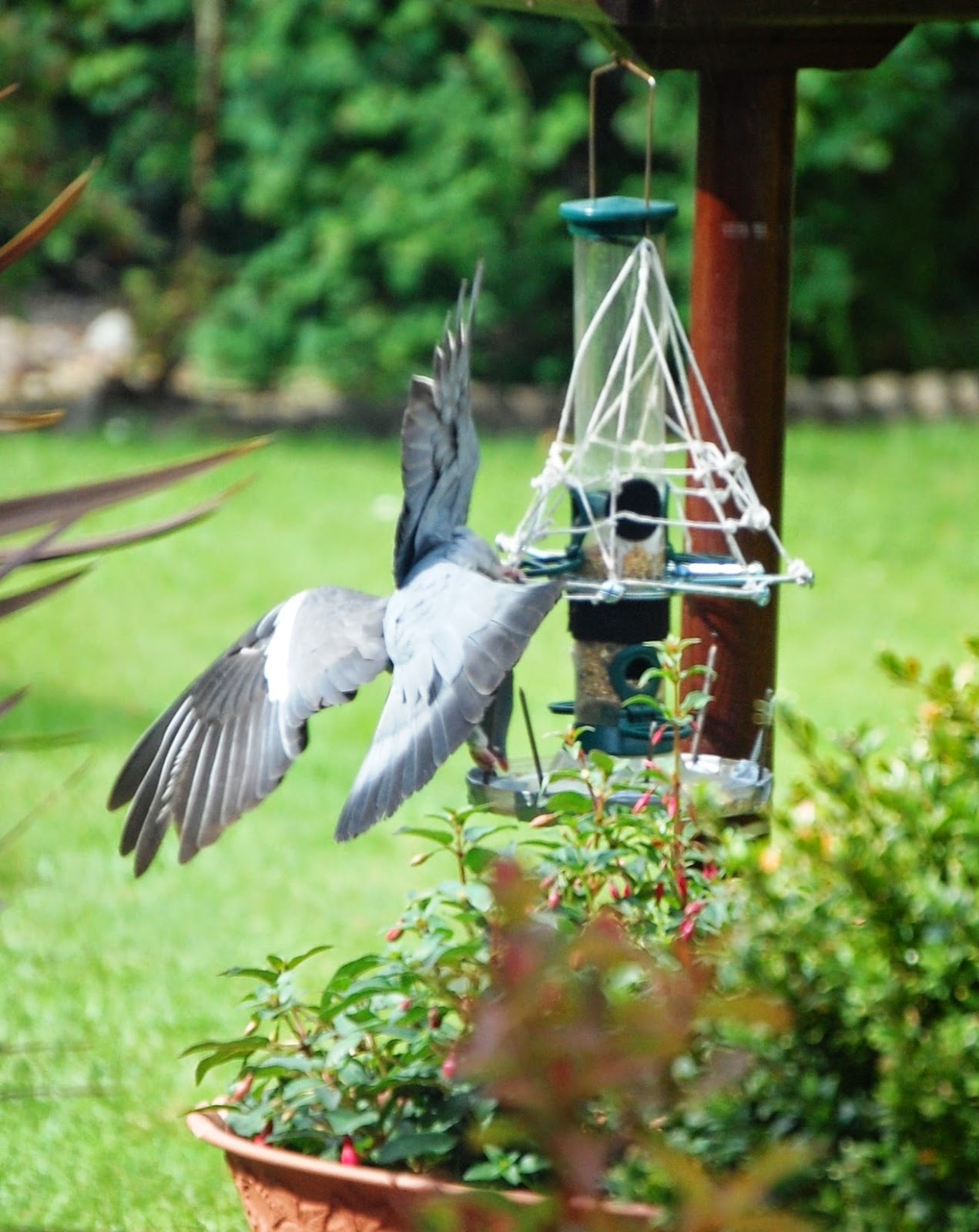
We have in our garden a bird table and hanging from it a bird feeder which we regularly fill with nuts and seeds. It is visited by a variety of birds – nothing extravagant just ordinary garden birds – sparrows, a couple of robins, blue tits and so on. In recent weeks the local pigeon has begun to take an interest in it and slowly but surely he has taken it over. He’s  far too big to access the roofed bird table, he devours the nuts and bread that we throw on the lawn and has now turned his attention to the bird feeder. Because of his huge size  if he tries to land on the feeder it swings like some deranged pendulum and he has to twist himself into all sorts of positions to access the nuts. But, not to be beaten, and as the days and weeks have passed, like a well drilled SAS officer he has honed his skills and can now cling on precariously for hour after hour while he empties the feeder completely of its nuts and seeds. He leaves nothing for the smaller birds and his size prevents others of his smaller brethren using the feeder as he sits and gobbles. When the feeder is empty, like some lumbering, overweight behemoth flaps his wings to struggle slowly into the air – like a heavily laden B47 bomber his hold filled.

And I'll use my wings to help!
This, we decided, had to stop. We had no objection to the pigeons, or this pigeon in particular, enjoying the food but being fair minded people thought they too ought to share the nuts with their lesser brethren. A way had to be found of making it just a little more difficult for him to access the feeder whilst still allowing the smaller birds free range. That is the nature of my battle with the wild life of the village!

The passing days have seen me plan and execute a number of design modifications to the feeder – each one calculated to counteract the latest pigeon strategy. First I put Velcro around the cylinder in which the nuts and seeds are held. The Velcro had some short screws protruding out of it to gently prod the pigeon in his huge flank as he clung onto the feeding tray at the bottom of the feeder. This plan didn’t work – he simply used his body mass to push the screws out of the way. Something more brutal and solid was needed. So next, used the drainage holes in feeder tray to insert short screws to put him off landing. This failed miserably – he completely ignored them. Even though each time he left the feeder he also left a few feathers - he was obviously quite happy to sacrifice  these to fill his belly.  I drilled the feeding tray and inserted long nails, my reasoning being that these would surely put him off landing  whilst but still allow smaller birds to land. If he did alight on the feeder, I reasoned, the nails would give him a sharp reminder of where he was. It had a small success but temporary only. He soon learned to calculate exactly where to land in order to minimise the impact of the nails. He could also now stand one footed on the rim of the feeding tray and use his other foot as a counterbalance holding onto one of my deadly nails! That incensed me – I became convinced he was  having a laugh at my expense! Clearly this called for a further refinement so I added more nails. In response he became more skilful yet and I swear sat and mocked me as I peered out of the kitchen window! There was a limit to how many nails I could insert if other birds were still to use the feeder – another plan was needed.
See - I can get past any security you put up

After a few nights lying awake at night pondering my next plan a trip to the local DIY store was undertaken. I came back with what I thought was my master stroke, something that would surely win the battle – some very long bolts and a metal ring that would enclose the cylinder and prevent a large bird like him getting close to the seed. I sat at our garden table constructing my metal cage and fitting it to the feeder. He sat on my garage roof watching and nodding his head as he worked out his strategy. At last it was finished. Initially it was successful – it certainly prevented him landing easily and undoubtedly made it more difficult but by the time that I woke next morning and stood in the kitchen making the first cup of tea of the day he had cracked it – he perched regally, his legs spread eagled over two of the bolts, his head twisted under him as he thrust his beak into the seed tray. It was at this point that I resorted to banging on the window and running outside in my dressing gown. He merely rose majestically up to the garage roof and looked down at me savouring his victory. Had I had a shot gun at that point I might have used it!

And I'll invite my friend for lunch - just to raise
your blood pressure even more
Observation and scientific analysis of his feeding habits were called for. Clearly, I was making it more difficult for him and equally clearly, whatever I did must be done so that other birds were not prevented from enjoying the food. Slowly but surely a plan emerged. All that I had done so far was useful but something else was needed. After a few days of watching it hit me – a kind of net that would allow small birds through but prevent this particular bird getting his beak to the nuts. Next morning I sat at my garden table with string, super glue and scissors. I was ready this time. I knew that I might have to adapt and refine it because I already knew my enemy and he knew me. –I knew he would find a way through. When my net parasol was complete I put up the feeder. He sat there watching and shaking his head. True to form he was soon at it. It didn’t take him very long to find a way through. He was not fazed by having to put his head through a network of string and although I might shake my head in anger and frustration I had to admire the sheer grit, determination and bravery of my adversary. We were, I felt, beginning to develop a mutual respect for each other. I continued to watch him. By watching carefully which bits he used to put his head through I slowly developed a plan for improving the network. It took three more  refinements and the substitution of garden wire for string but now it seemed to work. He still fluttered on, but so far he was, for the most part defeated. He glared in obvious frustration and anger when he saw smaller birds hop on and feed happily while he sat on the lawn below, forced and humiliated by to pick up their dropped seeds. As I peered through the window, a small smile on my face he glared back – obviously planning his next move. Whoever coined the phrase “bird brain” to describe someone who is rather stupid could not have been more wrong – this particular bird might exasperate and infuriate me but I cannot but respect his ability to solve a problem and develop his skills.
And now I'll just sit and eye ball you while my
dinner digests!

The grudging respect that we have developed for each other means that I now throw seeds on the grass for him – he can compete there with the rest of the birds. He gobbles them up but all the time keeping a watchful eye on the full feeder swinging tantalisingly above his head. I don’t know what curses pigeons use but I’m pretty sure he is cursing me. I might feel smug at my “success” such as it is, but the battle is not, I know, over. I may have temporarily beaten him but even as I write this I can see him hanging upside down clinging to the wire network which is supposed to deter him as he stretches to find a weak spot and an access so that he can nibble at the few seeds that smaller birds have left in the tray at the bottom of the feeder. Earlier, I watched as he squeezed himself under the network in a vain effort to get to one of the bottom feeding holes – I cannot fault his perseverance. He will, I am sure, like a determined terrorist eventually find a way through my latest security systems  and added to that I know that what I have created is not the finished article. The  net will, in time, rot and lose its tension and I know that he will be back even more determined to exploit any weak links in the system. I’m already planning my next refinement and have a plan which I will put into operation after my next visit to the DIY store. And I know that he will be waiting to test it out. I may have won this battle but I know that I haven’t won the war! I have a very formidable foe!


08 June, 2014

Out of Date, Irrelevant and Faded "Tat"

The  Queen's Speech
(photo: Carl Court/AFP)      
After the State Opening of Parliament (which took place a couple of days ago) there was much reporting on the event – the Queen’s Speech, the government’s proposals for the next year of their administration, the “fainting” of a page boy, the grandeur of the ceremony and so on. It’s always a magnificent window on Britain and its traditions, the nation’s history and most importantly the unique British parliamentary balancing act of monarchy and democracy. Even a staunch anti monarchist like myself cannot help but be stirred by the grandness of the occasion and the historical and democratic significance of the various ceremonies and rituals.  When Black Rod, for example, summons the Members of Parliament  to attend the Queen’s Speech  he approaches the doors to the chamber of the House of Commons which are then slammed in his face to symbolize the Commons' independence of the Sovereign. He then strikes the door three times with his staff, and is admitted to issue the summons of the monarch. This ritual is derived from the attempt by King Charles I to arrest the Five Members in 1642, in what was seen as a breach of the constitution. This and prior actions of the King had led to the Civil War. After that incident, the House of Commons has maintained its right to question the right of the monarch's representative to enter their chamber, though they cannot bar him from entering with lawful authority. Theatre this might be, but it is important theatre – and, I suppose, every nation must have similar little bits of ritual that go the very heart of their nationhood and parliamentary system.

However, amongst the many press  photographs of the day one stood out – for all the wrong reasons.  It was of a group of Lords and Ladies in their full regalia. When I gazed at it I sank into depression. The Ladies Sharples, Rawlings, Trumpington, Lawrence and the Lords Grade and Howe looked totally misplaced – indeed, their largely vacant faces, shambling appearance and general decrepitude made them look  “past it” and “seedy”.  These were members of the House of Lords, the “Upper Chamber”, the “Second House” – the people who ultimately vet and approve the bills and laws proposed by the elected government. They are in a way the guardians of the nation’s conscience and democracy. They are too, by default, amongst the shakers and movers of society – there because of their good deeds, their past record, their alleged wisdom. Sadly, however, they looked like escapees from some care home. In the society of twenty first century Britain who are these people? I asked myself. Only Lady Lawrence looked of this life - and she clutched her mobile phone - telling indictment of our times.  Like an overdressed tourist she stands apparently sending a text message in this one of the most sacred and magisterial events in our nation’s democratic calendar. Sadly the whole scene was a grotesque snapshot of all that is wrong with the Second Chamber and, indeed much of the governance of the country.
The noble Lords and Ladies of the Upper Chamber (L-R): Lady Sharples, Lady Rawlings, Lady Trumpington,
Lord Grade, Lady Lawrence, Lord Howe (photo: Carl Court/AFP)                  

It is critical that we have a “Second Chamber” – possibly in this day and age more important than ever before. Extremist political views, lobbying,  the impact of global politics, big business and the potential influence of the media and technology are all anxious to nibble away at our elected representatives. A Senate, or in our case, the Lords fulfils a critical function in curbing excess and bringing a longer term vision to simple party politics. Clearly, the members of that Second Chamber must also be people who by their actions, thoughts, words, experiences and beliefs  be able to fulfil this important task. What I saw in the photograph was a group of largely senior citizens who might indeed once have been the glitterati of national life but now looked slightly confused at where they were and what they were about.  I wondered how representative they were of our society – I don’t mean representative in the sense of racial or gender mix but rather how representative they are of the feelings, emotions, aspirations, hopes, fears, needs and way of life of the sixty million or so people that inhabit this tiny island. Yes, I am sure that they have all done much good in their lives and I am sure that the counsel of Lady Lawrence (mother of the teenager Stephen Lawrence who was brutally murdered some years ago in a savage racist attack) or of Lord Howe (a man who has held many of the great Offices of State) would be immensely valuable and wisdom not to be lost. But to be at all relevant, the qualification for membership of  Upper Chamber,  seems to me to be not past good deeds or longevity.  It is, rather, that the members are able to understand and be in tune with the aspirations of the nation. Yes, there might be a need for older members , but there is, too, a greater need  for  people who are understanding of the workings of society, the economy, politics, business and all the rest work in the United Kingdom of today. The House of Lords must, above all things be relevant – not a club for senior citizens who once did the nation some service. And, since today we live in a more open and transparent society where the press  and  24 hour news reports and shows all that is happening in the Chamber and what the members are saying, it must be seen to be relevant. In the State Opening of Parliament there was much wonderful history and tradition which is part of our heritage and which helps bind us as a nation – but the way that the Lords is composed, how it conducts itself, how it and its members  presents themselves and especially the photograph that I saw makes it look  irrelevant and a mockery. There are many more critical reasons why politicians today are viewed with cynicism and why the electorate are becoming increasingly apathetic, but the irrelevance and perceived lack of reality in their Lordships should not be easily dismissed.

If I’m pushed to it and wearing my “religious hat” I might applaud the fact that the Bishops of the Church of England all sit in the House of Lords – yes, all 26 of them - and are known as the Lords Spiritual. (They read prayers at the start of each daily meeting and play an active role in the work of the Upper House). Even in modern, multicultural Britain I might accept that a strong Christian input is vital to the work and decisions of the Upper Chamber. In the social tapestry of 21st century Britain. I might find it difficult to  defend on grounds of relevance, democracy, good governance, common sense or any other given criteria. But I will live with it and accept that, maybe, someone greater than I can see its value.

But there are other aspects epitomised in the photograph that I cannot accept. I read yesterday that one of the Ladies in the photograph – Lady Rawlings - has been criticised for her bizarre comments  about how “the poor” should cope with their predicament (this, in austerity Britain, a country with one of the most unequal societies on the world – a fact that politicians of all persuasions agree on).  Her comments were not only  staggering but offensive. That this woman should be one of those we are supposed to admire, respect and look up to – for after all she is a “Lady” and a member of the nation’s  highest political chamber, the House of Lords – says much with how out of touch the Second Chamber is.

Black Rod demands entry to the
Commons to summon MPs to hear
the Queen's Speech
(photo: Carl Court/AFP)      
Amongst the good Lady’s suggestion for “the poor” in these hard times are: that the poor should keep the crusts from their toast to dip into their boiled eggs on the following days. And, when they have guests for dinner the table should be arranged so that guests can help themselves to the lobster rather than giving it to them on a plate. This will cut down on waste and so be cheaper and more economic/eco-friendly. If you do that, says Lady Rawlings you “....won’t be left scraping luscious lobster into the bin.” Oh, and another good bit of advice from the Lady who lives in a 13-bedroom mansion set in 38 acres near the Queens house at Sandringham, Norfolk is that people should “Grow their own apples, pears and quinces........” Lady Rawlings has previous “form” in matters like this. A few months ago, at the height of winter when there was much concern that old people might not have enough money to keep their homes warm she made the helpful suggestion that instead of heating the home they should plug in their electric blanket and wrap it round them – this would be much cheaper that heating a whole house. Well, I suppose there is a sort of logic to that.

And another of the pictured Baronesses, the Lady Sharples,  was widely reported for using her handbag on a cyclist passing her outside the House of Lords. He had, allegedly, jumped a red light and nearly knocked the 84 year old over. Describing the incident, she said: "I had a bag and I swiped him. I did not hit him hard enough. They are a ruddy nuisance.”

Now, many cheered her bravado and perhaps this is all good knock about stuff but the worrying thing is that she then raised the matter in the Upper Chamber. She asked the government's transport spokesman: "Can the Minister say whether I am within my rights when, at a pedestrian crossing, a cyclist rides straight at me when I have the lights in my favour?.....I swiped one with a bag the other day. Would I be in trouble?"  is this what the Upper House is for? Is this why we pay huge amounts of money to subsidise the little personal foibles, prejudices, adventures and experiences of the noble Lords and Ladies? I think not. Does it show off our government at its best? Does it make them appear relevant, worthwhile and important to the nation on the eyes of the electorate? I think not.

I read these little tales and look at the photograph and think to myself how divided we are as a society. Do we need any more evidence of the unequal society? How can an Upper Chamber composed of people like the Ladies Rawlings and Sharples conceivably understand the life and needs of the pensioner living in a tower block unable to get out because the lifts do not work; how can they really get to grips with the fact that the parents with the handicapped child who requires full time care are finding it very difficult to afford “luscious lobster”; how can they comprehend the parents on zero hours, minimum wage contracts for whom the advice on toast crusts and eggs will be largely irrelevant because they can’t afford bread and eggs in the same week? But still the noble Ladies will don their ermine gowns,  live pampered in their mansions and every so often travel, all expenses paid, to sit in judgement and graciousness in the Upper Chamber quite oblivious to most of 21st century Britain.  

A bit of ceremony, tradition and heritage
(photo: Carl Court/AFP)      
Like a real life version of Dickens’  Marquis St. Evrémonde  in A Tale of Two Cities  Lady Sharples sees it as her right to injure a peasant of whom she disapproves and  she feels has wronged her. Like a modern version of Marie Antoinette  telling the poor to eat cake when they have no bread Lady Rawlings advises “the poor” how they should live their lives – and then both Ladies continue to draw their expenses for attending the House, mix with other Lords and Ladies, sip the wine, enjoy the lobster and believe all is well with the world. But, since we all know what happened to the  Marquis St. Evrémonde and  Marie Antoinette. Just maybe, the Lords needs to look at itself.

In writing this, the words of Mabel Layton in Paul Scott’s  great series of books on the last days of the British Empire in India, The Raj Quartet,  came back to me. It is 1944 and Mabel, the widow of the ex-commander of the Pankot regiment is at a family wedding. She is  standing in the Officer’s Mess at Pankot. She  looks around at the fading battle flags, the antique silverware and mahogany. It is the final months of the Second World War and the British Raj in India is in its death throes. Mabel has not visited the Mess for many years – when her husband died she became somewhat of a recluse mainly because as a younger woman she had incurred the wrath of the Raj military and social elite of Pankot when following the Amritsar massacre by Brigadier Dyer at Jallianwala Bagh in 1919 she had secretly made donations to the victims of the massacre in the local Sikh population. Mabel knew there was something profoundly wrong with the Raj and the way that it clung to the past rather than moved India forward to its future as an independent nation. As she stands there taking in the faded glory and outdated, prejudiced atmosphere and behaviour she turns and says to her friend “I thought there might have been changes, but there aren’t. It’s all exactly the same as when I first saw it more than forty years ago. I can’t even be angry. But someone ought to be.”  To a small degree that was how I felt when I looked at the photograph of the Lords and Ladies and thought about the prejudiced comments by Lady Sharples and Lady Rawlings.
Mabel Layton (played by Fabia Drake) as she was
depicted in the TV version of The Jewel in the Crown

History, tradition and theatre can and should be wonderful and vital to the dignity and soul of a nation. There is nothing wrong with ritual, tradition, history, heritage, theatre and the rest but it must not prevent the institution being vibrant, up to date, relevant and dynamic. What was in the photograph was just faded “tat” and the out of date utterances and behaviour  of the  Ladies Rawlings and Sharples  both prejudiced and offensive. To use two 21st century clichés  the Upper House is “not fit for purpose” and many of those who inhabit it bring it “into disrepute”.  That we have not developed a Parliament and Upper House which retains the heritage, the tradition and theatre but at the same time reflects the times and the nation in all its many facets is a sad indictment of our governance and society. As Mabel Layton said of the Officers’ Mess “Someone ought to be angry”.

28 May, 2014

"Another Brick in the Wall" - or making racism respectable.

UKIP & Nigel Farage celebrate
In the past months the continuing political debate in this country has largely centred around the fortunes and ambitions of UKIP (United Kingdom Independence Party) – the right wing, Eurosceptic populist party lead by Nigel Farage. Since its founding in 1993 it has slowly but surely gained political popularity despite its leader being constantly labelled as a bit of a political joke and a no hoper. This weekend, as forecast, the party has grabbed the headlines and the votes in the European elections and in doing so has pushed the established parties into the background. It is not alone in its victory – across Europe the extreme right has made substantial gains. In the UK the major parties are in some turmoil as they survey the damage and the recriminations have begun about them being “out of touch” with ordinary voters or of them not taking UKIP seriously enough and challenging UKIP on their policies. Suddenly, politicians of all persuasions are looking to jump on the Eurosceptic, racist band wagon fearful that they will be left sidelined as UKIP celebrate their success and the populist political landscape moves on. Where only a few months ago senior Conservative politicians were describing UKIP as "fruitcakes, loonies and closet racists"  today, following the very poor showing of the Conservative party, Prime Minister David Cameron described Nigel Farage as a “consummate politician” and that the message of the electorate supporting UKIP policies had been “received and understood” by the Conservative party hierarchy. Whatever the  policies, strengths and political manoeuvrings of the various parties one thing is clear – the right, and especially the far right, are on the march across Europe and in the UK we are in the thick of it.
Poor Gordon Brown was vilified for speaking the truth

But politics, national and international events and movements do not simply occur out of nowhere. Although the established parties might wring their hands it is, in reality, a result of their actions or lack of action that has allowed UKIP to grow and become credible. Although I might despise UKIP and all it stands for it does, like all political parties and initiatives, merely reflects a prevailing mood and this mood has been allowed to develop and grow by the established parties. Now, they (especially the Conservative party) want to jump on the bandwagon of its success. In the run up to the last general election the then Labour Prime Minister, Gordon Brown, was savaged by the Tory opposition, his own party and the media when he was heard to describe a woman he met as part of his electioneering as a bigot because of the racist views that she expressed. He was, however, right – she was and is a bigot – but Brown was forced to apologise and many would argue that his branding of the woman as a bigot lost him the election. In that context, in taking the side of this woman we, the electorate, the media, the politicians gave tacit support to her racist views instead of challenging them and calling them what they were. No, although the majority of British society, the media and politicians are anxious about the rise of the right in this country and across Europe, it merely reflects society and, in this case, the lack of firm action by the established parties. That is how democracy works.  
Gregory Peck as lawyer Atticus Finch in "To Kill a Mocking
Bird" -  a tale of racism, poverty and deceit. Not, according
to Mr Gove's department, suitable as an exam text 

Into this situation, at the end of last week came the reports that Michael Gove, the Secretary of State for Education, had “banned” certain books from being studied at GCE level. The books in question are John Steinbeck’s Of Mice and Men, Harper Lee’s To Kill a Mocking Bird and Arthur Miller’s The Crucible – all twentieth century American novels. Apart from any literary worth these books may or may not have it must also be said that they all in different ways deal with the issues of exclusion, racism, intolerance and people who live on the edge of society – and as such they are very pertinent in today’s world. Gove has since hit back and said that he has not banned these books and argued that pupils will, in fact, be studying a broader core of works.  These must now include at least one Shakespeare play, poetry from 1789 onwards and a 19th century novel, as well as a work of fiction or drama originating from the British isles since 1914. Methinks that Gove “doth protest too much” – whatever the niceties, the overall effect or his role in the episode the reality is that the curriculum is being limited and structured on more nationalistic lines. Rather than widening the educational horizons of the young it is closing them down. It is a small step from that to indoctrination. University lecturer Anna Hartnell wrote in this morning’s Guardian:  “.....schoolchildren in the UK are now going to be given a "more traditional" syllabus made up of largely British texts penned prior to the 20th century. Such a syllabus harks back to the myth of a "pure" origin for English literature, uncontaminated by the unintended consequences of empire, and ignoring the multicultural, multilingual and multinational space that Britain is today. Gove and his colleagues at the Department for Education are fantasising about a nation unencumbered by racial or cultural difference, or calls for greater social and economic equality....”

The notorious "Wall" 

As I read this article and thought on the European election results and of the “more traditional” and nationalistic curriculum being implemented in this country I reflected that I had always believed that my task as a teacher, and an absolutely fundamental requirement of wider society, was to pull down walls, open eyes and widen understanding. Not to necessarily learn more and harder things (although that is clearly desirable) but to understand better. In other words, to make children what I might call “wiser” – if there be such a thing And as I thought about this my warped brain was suddenly filled with a song from the past - Pink Floyd’s notorious "Another Brick in the Wall":

   We don't need no education
We don’t need no thought control
No dark sarcasm in the classroom
Teachers leave them kids alone
Hey! Teachers! Leave them kids alone!
All in all it's just another brick in the wall.
All in all you're just another brick in the wall.

Today, I believe, both as a society and in the school curriculum we are increasingly putting up walls.  As a society and in our schools we  more and more know what we like and like what we know and reject what we don’t like and what we don’t know - be it ideas, laws, people or in Gove’s case books. In our “Little England” world – that region inhabited by Michael Gove and UKIP and the other populist right wing individuals and groups - there is increasingly no truck with “Johnny Foreigner”, be he the nasty eastern European who has come here to steal our jobs or the subversive American novel which might tarnish the minds of the young. We don’t wish to broaden our own horizons and those of our children – we merely want to preserve the status quo or even look backwards. Look at the front pages of the tabloids and other organs of the right wing press and it will soon be obvious that we don’t want to learn from other cultures or to involve them in our community life. We, especially, don’t want to play a full part in Europe. For as long as the European Union has been in existence, and certainly since Britain became a member, huge swathes of the Conservative party have wished only to be half members – standing on the edge of the Union sniping and complaining. Like children on the playground wailing “It’s not fair – these Johnny Foreigners are out to cheat us, change us and take what is rightfully ours....please let us have the good bits of Union membership but not the bits that we don't like.” Now, with the rise of UKIP, their chickens have come home to roost. Conservative party Euroscpetics’ constant moaning has over very many years wormed its way into the minds of the electorate and now the electorate have jumped ship and placed their electoral crosses elsewhere on the ballot slip. UKIP has taken over the Eurosceptic banner – much to the dismay of the Tories who are now reaping what they have sown!
Just the sort of headlines UKIP
love - and now becoming respectable

Gove, of course, has previous form – his interference with the teaching of history to promote the teaching of only English history, of great battles won and of great Britons studied was a hotly debated topic just a few months ago. At that point he branded the senior academics and world class historians who promoted a history curriculum which took a broader view of history as “bad academics”. Only those who thought like him were classed as “good academics”. This morning he has used Twitter to answer his critics and denounced those who criticise the new exam requirements as "culture warriors”. He went on to say "Do I think “Of Mice and Men” ... and “To Kill a Mockingbird” are bad books? Of course not. I read and loved them all as a child. And I want children in the future to be able to read them all."  But whatever Gove’s protestations the net result is to make the curriculum just a little more nationalistic and just a little more prescriptive about what people should read. In writing this I am reminded of Franklin D. Roosevelt's comment - "No group, no government can or should  prescribe what should constitute the body of knowledge with which true education should be concerned.". Gove's actions have helped forge another small step on the road that ultimately allows parties like UKIP to thrive. His little foray into jingoistic flag waving has made racism just a little bit more respectable, indeed fashionable, in the eyes of the electorate – “Let’s not have our kids reading the foreign rubbish – let’s have some good old English books”. Today, it is Harper Lee and John Steinbeck being struck off the exam list - tomorrow might it be Crime and Punishment, War and Peace, Germinal, the Iliad, Les Miserables and the rest of the world's great literature. And when the curriculum has been cleansed of any foreign influences then will Gove decide that Dickens, Orwell, Huxley, Vera Brittain, Shaw, Hardy and others are unacceptable because they might introduce the young to unhealthy socialist or left wing ideas? Certainly his past record and that of the Conservative party suggests this.
Germany 1933 - if the books by Steinbeck and Lee had been written then
they would have undoubtedly been on the fire. Michael Gove
has his own version of the fire

Look at any totalitarian state and those wanting control always do the same things – they disparage the views and beliefs of minorities and those critical of the regime, they rewrite history, they get rid of unacceptable books and promote their own. Look at Germany in 1933 as the National Socialists burnt books considered to promote liberal, anarchist, socialist, pacifist, communist, Jewish beliefs plus other authors whose writings were viewed as subversive or whose ideologies undermined the National Socialist agenda.  Think of China’s cultural revolution and Chairman Mao’s Little Red Book carried everywhere by millions of Chinese. Remember how the Soviet Union of Stalin’s days rewrote history. No-one suggests that this is what is happening in this country – but small steps are being made in that direction both here and across Europe as populist views and prejudices are given some small credibility and legitimacy by politicians anxious to cash in on the mood. While Nigel Farage was proclaiming in the European Election campaign last week that he wouldn’t like to live next door to a group of “unruly Rumanians” – a comment that was doubly offensive in that it is openly prejudicial to one race and secondly that it is, by association suggesting that all Rumanians are “unruly” - Michael Gove was “nationalising” the school literature syllabus, the Home Secretary, Theresa May, was making even more stringent plans to curb immigration and limit those from other countries already in the UK and Eric Pickles was suggesting that those who refuse to learn English should lose any benefits. I do not suggest that Farage, Gove, May or Pickles are necessarily incorrect in their considerations – the issues that they are involved in are serious and need addressing. But the language used and the way that these important and delicate issues are handled can create the climate that allows extreme views to develop and grow. It’s a small step from where we are to totalitarianism. There are few things that I agree with Tony Blair on but his comments today were spot on: “.....you have got to have proper controls on immigration, you to have to deal with those parts of the immigrant community that are rejecting the idea of integrating into the mainstream, but to allow that then to trend into anti-immigrant feeling is a huge mistake for the country.........You look a little bit beneath that UKIP facade and you see something, in my view, pretty nasty and unpleasant....... politicians must “confront them, expose them and take them on”.

Mao's Little Red Book
the "Bible" that told  millions
of Chinese what to think
Indeed – and for me that also means examining ourselves, whether we be a member of the electorate or a Conservative government minister as is Gove. We need to ask the question is what we are doing fostering an atmosphere which ultimately might allow extremist groups – be they UKIP, the National Front, the Taliban or any other - to gain a foothold? In Gove’s case his actions on the exam curriculum, for me, clearly do. In the same way, anyone who voted UKIP simply as a protest against the established parties or the whining Eurosceptics of the Conservative party who are so dismissive of the concept of European Union and suspicious of the motives of the French, the Germans, the Greeks and the rest carry a huge measure of responsibility for diminishing our democracy and our future. In the end, these people might wish to bury their heads in the sand and keep those who are not like us at arm’s length but they need to know that although the UK might physically be an island, as John Donne reminded us half a millennia ago,“No man is an island.......”

No man is an island,
Entire of itself,
Every man is a piece of the continent,
A part of the main.
If a clod be washed away by the sea,
Europe is the less.
As well as if a promontory were.
As well as if a manor of thy friend's
Or of thine own were:
Any man's death diminishes me,

Because I am involved in mankind,
And therefore never send to know for whom the bell tolls;
It tolls for thee.

Looks innocent - but Gove is a
very dangerous man
At a time when the right is on the rise across Europe, when immigrants are under attack from populist extremists, when the criminal justice system increasingly locks up black people, when protest is met with police assault and “kettling” or when CCTV, phone hacking and security listening services monitor every word and action and focus in upon those judged to be dissenters, potential trouble makers or "lefties" then the DfE's and Gove’s decision plays into a poisonous atmosphere. Rather than take divisive action as does Michael Gove with such monotonous regularity we need to remember John Donne’s words  and recognise our similarities and our interdependence as we share this bit of rock hurtling through space. This attempt to wind the clock back and to make us an insular island race overlooks the myriad identities of the children now populating British schools. To remove texts that deal largely with issues of exclusion, racism and intolerance cannot be justified when, as I write this sentence, I note that the latest survey of British Social Attitudes shows that “after years of increasing tolerance, the percentage of people who describe themselves as prejudiced against those of other races has risen overall since 2001”......raising concerns that growing hostility to immigrants and widespread Islamophobia have set community relations back 20 years.”  In making racism respectable by building it into the established educational system Michael Gove is playing a very dangerous game.
Is this the future?

But the action doesn’t only adversely effect levels of tolerance, it has, too, potentially profound effects upon our very democracy. American President, Franklin D. Roosevelt once said “Democracy cannot succeed unless those who express their choice are prepared to choose wisely. The real safeguard of democracy, therefore, is education.”  He was right. Two other distinguished American journalists of the same era took it a stage further: A nation of sheep will beget a government of wolves.”  (Ed Murrow) and H.L. Mencken famously observed “The most dangerous man to any government is the man who is able to think things out for himself, without regard to the prevailing superstitions and taboos. Almost inevitably he comes to the conclusion that the government he lives under is dishonest, insane, and intolerable...”. Looking back to some little England where all we know is what we see and what we see is all we like, a world which is clearly much loved by Michael Gove will not make us or our children “learn better” or be “wiser”.  Tony Blair’s mantra was “Education, Education, Education” but Michael Gove’s view is much more simplistic; his mantra (and that of his department) is “Attainment, Attainment, Attainment. Its hidden message is “Let us ensure that our children learn harder and harder things, calculate harder and harder algorithms, read harder and harder books, spell harder and harder words”. In other words,“Never mind the quality feel the width”. Mr Gove and his party don’t want children reading material that will enlighten them about the world and its people, they don’t want them exposed to material that might prompt them to look critically and ask questions, they don’t want them developing empathy and sympathy for the oppressed, the disadvantaged or those excluded on the edge of society. They don’t want educated or wise children they want blinkered patriots who are etymological experts, grammarian grandees, comprehension commissars and who think that being learned is the same as being wise! Were George Bernard Shaw alive today and writing a blog he would, I am sure, again remind Michael Gove to look forward because "We are made wise not the recollection of our past but be responsibility for the future" and another modern American novelist, the late William S. Burroughs might chime in with "Education is not knowledge of facts but an understanding of values".

That's it Dave - stuff these foreign Johnnies
We only become wise by listening to others, by learning from them, by being able to empathise with them and by seeing the bigger picture. Yes, we need to know things but we can only consider ourselves educated or perhaps wise when we are able to apply these things that we know into the many different situations that we find ourselves in and understand how the whole jigsaw of life fits together – and that requires depth and breadth of experience and understanding not more of the same. A syllabus that looks backwards and inwards and which concentrates upon the "scores on the doors", "top of the class" notion of learning does not enrich or give breadth and depth. It does not allow the young to meet, understand and empathise with the mindset of those different from themselves and will, in turn, make them less tolerant, less able to question, less able to learn from others and less able, in Roosevelt’s words, to “choose wisely”. American economist Jeffrey Sachs commented in his recent best selling book The Price of Civilisation  that “......when [a] country must grapple with complex choices about taxes, spending, military involvement and outlays and all the rest, the lack of basic knowledge becomes dangerous. A poorly informed public is much more easily swayed by propaganda and much less able to resist the dark manoeuvrings of special interest groups that pull the strings........” . Quite. 
It's on the rise again - both openly and in the nation's exam syllabus
in quieter more subtle ways

UKIP’s success and the rise of the right across Europe - and, indeed, the latest, hot off the press British
Social Attitudes Survey - illustrates well the truth of Sachs’ comment. People are indeed being easily swayed by populist propaganda and unable to "resist the dark manoeuvrings of special interest groups". That is why Gove’s actions are, especially in the present political and social climate, so very wrong. They are quietly but insidiously taking us another small step towards making racism respectable and ensuring that our young people are just a little less well informed and able to "choose wisely" . We are entering a very dark period.


25 May, 2014

Take Away Coffee or Pension Pot?

In my last blog I commented upon the undeniable difficulties faced by young people today – especially as regards getting on the housing ladder and making ends meet in this modern, economically uncertain world. I have absolutely no doubts that it is more difficult today for youngsters than it was for my generation. When I left school in the very early 1960s I had no problem getting a job and in common with others of my generation could, with some certainty, look forward to a “job for life” should I desire it. Whatever the job, people of my era could face the future with confidence: work hard, be careful with your finances and your future is at least reasonably secure. It is no longer true – young people leaving school today are not blessed with a range of job opportunities. In the UK we have many working on zero hours contracts which give little or no employment security or rights, and daily we hear of company mergers, cost cutting and the like which means that anyone, no matter how diligent and hard working, can suddenly find themselves on the employment scrap heap. No, I would not wish to be starting off again!
Starbucks - with a typical clientèle - they have plenty of
money to spend on coffee and cup cakes but not,
apparently, on pension provision. 

Having said that, I never cease to be amazed at the outlook and expectations of younger people which seem to me to often fly in the face of reality. My grumbling observations were given some credibility when my wife read an article to me from her newspaper over breakfast earlier this week. The article was concerned with the continuing problem of saving for a pension for one’s old age. All the pundits and financial advisers  recommend that it is vital to begin saving for a pension at the first opportunity – sadly, however,  this is advice that many of the young all too often ignore. Sometimes saving for an old age pension will simply not be an option if it is a choice between that and putting food in one’s belly – a situation that only too sadly very prevalent in the UK for many. It is a situation that we in the UK should be deeply ashamed of and is entirely inexcusable in one of the richest countries in the world. Our political masters of whatever persuasion should hold their collective heads in shame. But, those cases aside, it is also true that very many younger people who could afford to ensure some pension provision from the earliest time do not take it seriously. I well remember a few weeks before I retired, we had a visit from teachers’ union representative to talk to my staff about changes that were to be implemented in the teachers’ pension scheme. These changes meant that all teachers, but younger ones especially, had to make some pretty important decisions about their pension contributions and long term provision. “How many young teachers do you have on the staff” the man asked me. I explained that the vast majority were quite young and new to the profession. “Oh dear” he replied “they won’t be interested at all”. He was right. We sat through a meeting lasting about 90 minutes while he explained the changes and the impact it would have. Sadly, throughout the period the young teachers were totally disinterested – they asked not a single question, raised no concerns and left at the first opportunity. The only interest and questioning was from those who were older. The youngsters saw it as too far away to bother about – they had other priorities.
One of our village's booming coffee shops from which, each
morning, a steady stream of  younger people emerge with
their cups of take away coffee as they run for the bus

But back to the article that my wife read out to me! The gist of the article was that although saving for a good pension is very hard and means making financial sacrifices for something that is many years away a few simple things, if implemented early enough, can make a huge difference. An organisation (The National Employment Saving Trust) had calculated that small changes to spending habits such as cutting down on smoking, drinking, eating out or buying coffee could help younger workers build up a lump sum worth thousands of pounds for their pension. It calculated, for example, that a homemade packed lunch rather than a bought sandwich five days a week could save about £15 each week which would save a 30-year-old worker £63,700 in today’s money by his or her retirement age - a substantial boost for their pension pot.  Having one fewer pint of beer and one fewer visit to the coffee shop each week could build up £26,600 by retirement age. One fewer packet of cigarettes could save £31,400 over the same period. Abandoning the gym would potentially save £36,100 and resisting take-away food in favour of a home-cooked meal once a week would add £12 a week to their retirement fund, or £50,900 by the age of 68.
Two vans full of rolls, snacks, cakes, coffee, soft drinks
crisps and the rest - and all ready to be delivered to the offices
around the village. All costing far more than a home made
sandwich would cost - that's another few pounds
I can't put into my pension pot!

Now, of course this is all highly theoretical and makes lots of assumptions – we all know that life doesn’t work like that and few of us are that disciplined.  But, I would suggest, the principle is right. Whilst it is true that for very many young people, because of their economic and personal  circumstances or employment insecurity, would find it impossible to save regularly for a pension for many others that is not the case and that the amount they save or don’t save in the end comes down to personal financial choices and lifestyle.

As my wife read the article to me I thought back to a few minutes before we sat down to eat our breakfast and look at the papers. We had just walked though the village, as we do each morning at about 8 a.m., when we take an early morning walk and pick up our newspapers and do a bit of shopping. Each morning we see the same thing: a steady stream of younger people running for the bus or jumping into their cars outside the village shops. And where have they been? – mostly to the several little coffee shops and cafes on our village High Street. All of these youngsters emerge clutching cups of take away coffee to drink while they drive or as they sit on the bus. Many clutch ready made sandwiches and rolls that they have bought for their lunch.
Outside one of the shops there are always a couple of vans being loaded with sandwiches, salads, soft drinks and the rest – these visit the many office units that surround the village during the morning and sell their wares to the workers. And it all costs money! Like many places in the UK our village has a surfeit of coffee shops – out of the fourteen shops that line our High Street four are coffee/sandwich bars. In addition there are two others just off the High Street. It is a business that clearly pays, otherwise they would not be there. Walk down any High Street and you won’t walk far before you come across Starbucks, Costa, Cafe Nero and a thousand others all peddling their wares – coffee, hot chocolate, wraps, cup cakes and the rest – it is a boom industry and look around the clientèle and you will find that it is invariably the younger end of the spectrum sitting there or standing in the queue! It is the same in other walks of life. Go into a city centre like Nottingham on any night of the week and the restaurants, coffee bars and pubs will be booming – and again, overwhelmingly, with younger people. When I worked with young teachers and trainee teachers I made many good friends who kindly still keep in touch or who share their lives via Facebook etc. I read regularly of extended trips to far flung places, of honeymoons on the other side of the world, of “taking a year out”, of “getting plastered last night at XXXXXXXX’s party”, of many hundreds or even thousands of pounds spent on a wedding dress and of stag and hen parties which can last several days and take place in cities and resorts across Europe, I see photographs on Facebook of parties and drinking sessions that seem to occur with huge regularity and I read of meals out or of “I’m standing in the takeaway waiting for my Chinese meal”. And it all costs money – and that implies financial choices. The article the Pat read to me over breakfast is clearly made real here in Nottingham – lots of young people who elect to spend their disposable in a particular way – but maybe not on pension provision!

Even the top people do it - take away coffee is almost a
fashion statement today - the awful Rebekah Brooks
and her husband arrive at the Old Bailey to begin another
day in court in the long running phone hacking trial
I don’t begrudge young people their opportunities, lifestyle and choices – indeed, I wish those options had been around when I was their age. But in those far off days flexible money, credit cards, ease of long distance travel and, most importantly, values, expectations and social mores were not what they are today. When we got married it would have never occurred to us have the reception in a posh hotel or to hire penguin suits for the male guests – you wore your ”best” – and probably only - suit. Similarly, buying a sandwich for lunch, having a coffee while out shopping or eating out once a week was not on the agenda – not just for us but for the majority. This was not primarily because the money wasn’t there – although that was certainly true – but rather because people of past generations had, in general, other priorities. Saving money for the future was much more a way of life. When you could, you put something by “for a rainy day” – for when some emergency or unexpected expense befell. Today, I assume, younger generations solve the rainy day crisis with the credit card and spend to the hilt while the going is good. This was brought home to me several years ago when a young teacher on the staff came to me when she was applying for her first mortgage on a house she hoped to buy. I wrote a letter on her behalf to the building society from whom she hoped to get her loan stating that she was in full employment, that her job was secure and what her salary was. Understandably she was concerned as to whether she could meet the payments that would be required and she came to me to show me her calculations. I noticed on her list of monthly outgoings was one labelled “servicing”. I asked her what this was and she explained this was the amount that she set aside each month to “service” her various credit card debts.  This was new to me, I always assumed that one paid of the credit card debt each month, not that you let it roll and paid off just enough to “service” it! How naive I was! Happily, she got her loan and bought her house so all ended well.

Our honeymoon booking confirmation
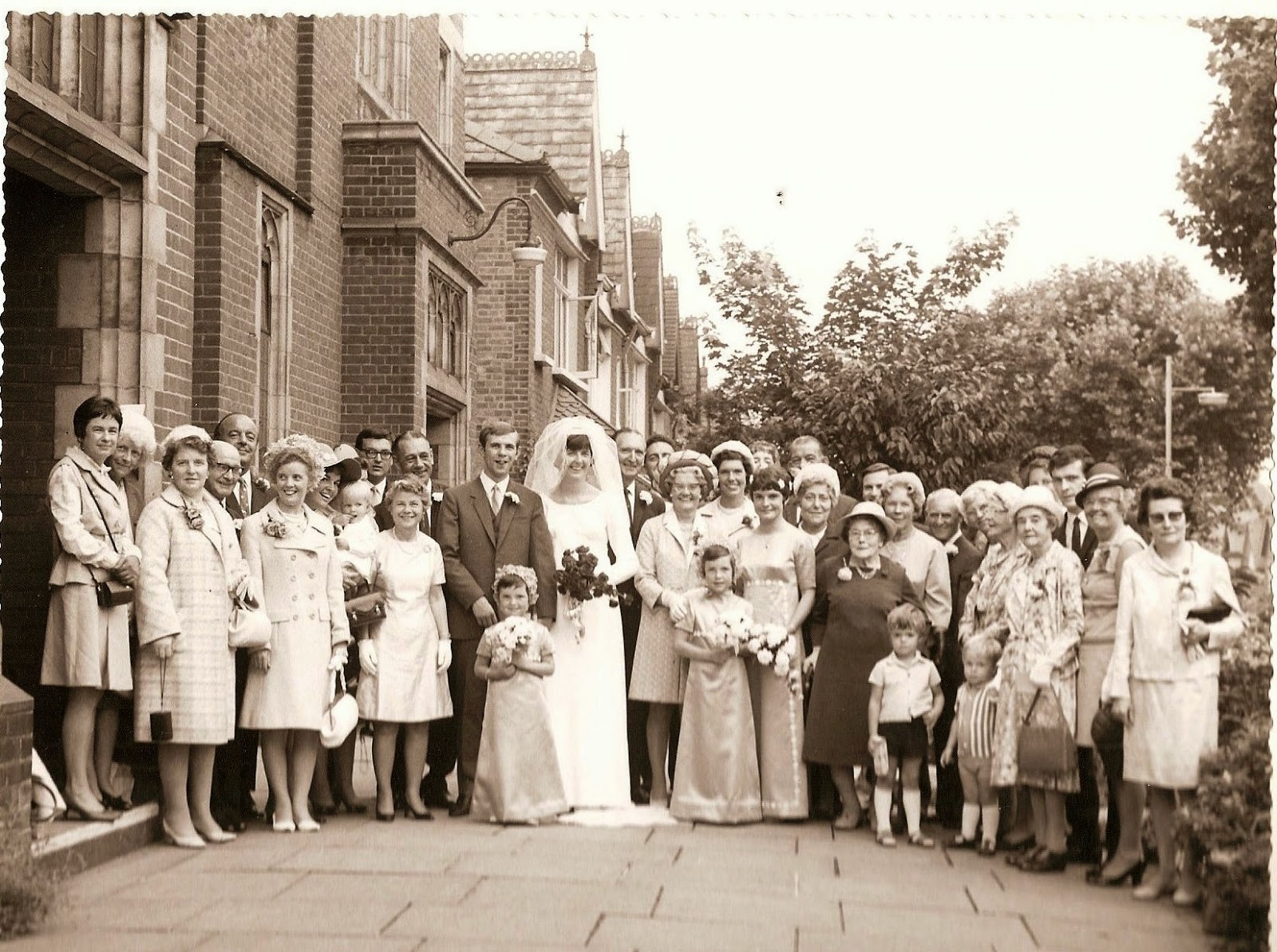
A couple of weeks ago we had a new central heating system fitted in our house – the old one was as old as the house, 60 years this year. We stored a lot of items in our utility room while the system was being fitted and this afternoon I was sorting some of them out. I came across a box containing lots of “treasures”,  mementoes from Pat’s and my past – letters, a scrap book, tickets and programmes from events we had attended a life time ago. And in the box I came across a letter from the hotel that we stayed at for our week’s honeymoon in 1969 – the Keats Green Hotel in Shanklin, Isle of Wight. The week cost us 19 guineas each (about £20) for half board accommodation. Obviously inflation means that prices have increased hugely since those far off days but £20 per week was more or less exactly what we were both earning each week as relatively newly qualified teachers in 1969 – so our honeymoon cost us about a week’s pay. However, our wedding was special so we felt that we should really splash out – and indeed we did! When the hotel offered us the room we had a choice – 19 guineas for a room facing the sea or 18 guineas for a rear facing room.  We broke the bank and faced the sea!  But at the same time we knew that our wedding reception, held in the local church hall (no posh hotel) in Lewisham, south London, was a perfectly normal affair for the time. We weren’t in anyway unhappy that this wasn’t some flashy hotel – we didn’t expect it and neither did our friends. We didn’t have a hen or stag party – no-one expected it and it certainly wasn’t a priority. Pat’s parents had “done us proud”. I didn’t have a new suit, but wore my best (my only!) suit.  I did, however, have my shoes repaired - my mother had a horror that I would kneel at the altar and everyone would see the worn soles and heels!

19 guineas per person per week - and it doesn't seem to
have changed at all over the past 45 years!
I contrast all this with modern weddings and honeymoons. When we were in the Canary Islands a few months ago a group of nine young women stayed in our hotel for a long weekend – they were on a hen party – four days of drinking, dancing and partying. This would not come cheap – flights to the Canary Islands, accommodation in a 5 star hotel, drinks, clubs, clothes – and of course ultimately, the cost of a wedding present. And for the bride (and, presumably, the groom) all the other associated wedding and honeymoon costs. A favourite destination for honeymoons today is Mauritius or the Maldives – places on the other side of the world. Our honeymoon cost us about one week’s wages but I don’t believe that a week (or more likely 2 weeks, given the distance) in the Maldives could be bought for one week’s wages - currently about £425.00 - of a newly qualified teacher today. I’m sure it must cost several week’s wages. But again, these are financial choices that people make. Incidentally, I have just had a quick work out and although it is true that over the years inflation has caused prices to increase that, I believe, tells only a part of the story. I have just booked a room at our favourite 3 star hotel in Devon for a week in August; the cost is a little more than the £425.00 equivalent that I spoke of above, but only marginally. In other words, even today, in these inflated times, a young couple could have their honeymoon at a splendid hotel for, proportionately, about the same price that Pat and I paid all those years ago. The reality is, however, in all the years that Pat and I have been going there not once have we seen a honeymoon couple – presumably they all go off to more exotic and expensive venues – the Maldives sounds much more of a treat than Dawlish., "To hell with the expense" is clearly the motto of the young today (and, in the long term, the pension)!

But, undeniably, the world has changed. Young people have, rightly, different priorities and expectations. They would not, I suspect, be happy with just two second hand chairs as we had for the first two years of our married life. Nor would they be happy with the second hand wardrobes or bare floors that we had for several years until we could afford something better. They would not be happy to sit in the quietly at home (not in the pub or enjoying a meal in Nottingham) in the evenings with no TV or none of the kitchen items – fridge, freezer, dishwasher, washing machine etc. that are today's “essentials”.  In the end, like the expensive cup of take away coffee bought as you get to the bus stop rather than a cheaper homemade cup or the bought sandwich rather than the home made one, or the two weeks in the Maldives rather than the week in some more humble place, or the fitted kitchen or the expensive convenience food bought from the supermarket rather than the cheaper homemade variety, these are all choices and reflect our priorities.

August 9th 1969 before we nipped off to the  church hall and then to Keats
Green - not the Maldives! Sadly, you can't see my newly soled shoes!
Sometimes those choices don’t matter but in the end the costs add up and the real cost of anything is only partly the amount you actually pay. I might pay £2.50 for a cup of coffee in Starbucks or several thousand pounds for a honeymoon in the Maldives but the real cost of those purchases is also measured by not only the impact that it has on my ability to spend money on other things but in addition the subsequent denial of any future pleasure that I might have. A meal out today may ultimately mean a lower pension tomorrow. A cup of coffee might give me a certain pleasure today and have cost me a certain amount of money – but this has to be counterbalanced by its real cost which is the potential loss of other pleasures (such as distant old age pensions) that are affected by paying for that coffee. That is a basic principle of economics which it seems to me is little understood by the younger generations.

Young people have opportunities and consequent choices that people of previous generations never dreamed of. Yes, it is tough for youngsters today and my generation never had to make those choices in quite the same way.  But with those opportunities there comes the responsibility to decide priorities and  make choices based upon a full recognition of the circumstances and the implications of the choice that one makes. Sadly, whilst I recognise the great difficulties and problems that younger people face I’m not utterly convinced that they are prepared to acknowledge the basic implications of the choices and the decisions that they are able to make. It seems to me that many, ostrich like,  simply bury their heads in the sand and deny the consequences of their financial decisions – put in simple terms, enjoy the take away coffee now, rather than worry what is around the corner.

20 May, 2014

Marrow Hill - or having time to stand and stare!

In Jan Mark’s wonderful book of short stories “Nothing to be afraid of” there is the delightful tale entitled “Marrow Hill”. I read this book to eleven year olds on many occasions.  It was a personal favourite and one which year after year generated much amusement, a wealth of comments and perceptive understanding from the children. The Burton family are a happy, busy, boisterous and slightly madcap family who are always “doing things”. Mother and dad are always busy, doing things in the garden, taking the children out on exciting trips, or rushing here there and everywhere. The four children are forever involved in wild escapades, gleeful pranks and bizarre behaviour. The writer of the story watches the Burton children from his bedroom window each time he visits his auntie and he is fascinated by their continual talking, their non-stop games and their apparent ability to exist in what seems to be a chaotic, never stopping whirl of activity, noise and ever increasing excitement and catastrophe.

The madcap Burton family
One day the writer notices that the eldest of the Burton children each afternoon sneaks off from the garden and disappears. Intrigued, the writer decides to see where he goes. The Burton boy walks to some distant allotments and disappears behind an old hut. Following, the writer peeps round the side of the hut and the Burton boy is sitting silently on the earth by a mound of marrows which are growing there. The two boys greet each other and they sit together. The Burton boy pats one of the marrows and says “This is old man Grimshaw”. The writer is confused and even more so when the Burton boy pats another marrow and says “They’re my friends, this is Adelaide Bulk”. He continues giving names to each of the marrows growing there – Laurel and Hardy, Hamish McBagpipe, Henry the Eighth......... . The writer asks if the Burton boy grew the marrows – “Oh no,” he replies, “I just come up here to see them each day”.  The writer is even more confused and says to the Burton boy “Don’t you find them a bit boring as friends......I mean they can’t play football or talk” . The Burton boy looks at the writer and says “Oh no they’re not boring and I know they can’t play football or cricket and they can’t talk”. Slightly exasperated  the writer says, “Well, why do you come here each day and just sit with them, what do they do?”  A blissful smile spread across the Burton boy’s face, and looking at the writer, he said quietly, “Do? What do they do? They don’t do anything”.

I am often reminded of this tale as I watch young families living, what increasingly seems to me, to be an increasingly frenetic life style, just like the Burton family constantly “doing”. In the UK there is daily discussion and comment from all interested parties and every politician about the problems facing young families in the modern world – the fact that both parents increasingly have to work to make ends meet, how the cost of buying a house is too often beyond young parents and so on. There is no denying the problems and pressures that young families face but I often wonder if there is also a self imposed anxiety to “do things”. When I visit my grandchildren they are continually off to “do things” – swimming lessons, music lessons, football training, guides, brownies, after school clubs, birthday parties, “playdates” (what a truly awful Americanism!), school camps, tennis coaching, gymnastics.........the list seems increasingly endless. No opportunity it seems is turned down in the quest for constant occupation, involvement and improvement! I am, of course, delighted that they are so involved and that their parents care enough to arrange and do all these wonderful things – it must be good. But at the same time I often reflect when is the time to, in the words of the poem by WH Davies, “stand and stare”:

What is this life if, full of care,
We have no time to stand and stare?—
No time to stand beneath the boughs,
And stare as long as sheep and cows:
No time to see, when woods we pass,
Where squirrels hide their nuts in grass:
No time to see, in broad daylight,
Streams full of stars, like skies at night:
No time to turn at Beauty's glance,
And watch her feet, how they can dance:
No time to wait till her mouth can
Enrich that smile her eyes began?
A poor life this if, full of care,
We have no time to stand and stare.

And I wonder what will these children grow up into?  They have existed from their earliest days in a world continually amused, entertained, inspired and exposed to one high octane activity after another. All very laudable, and I’m sure good – but does the inner being need something else? When you have spent your whole childhood enjoying this exposure to non-stop activity and high input involvement I increasingly ask myself what then? What do you next move on to – where do you get your next thrill? I can remember many years ago listening to my son and his university friends talking about places they had visited. They had a large map of the world on the wall of their flat and marked on the map were all the places that various of them had visited. One of my son’s friends turned and said, “I need to visit Australia before I’m 20”. I can remember reflecting that at the same age my furthest visit to anywhere had been about 20 miles down the road from where I had grown up. The world, of course has changed – but I ask the same question – when you have done it all, what then – where do you get your kicks?
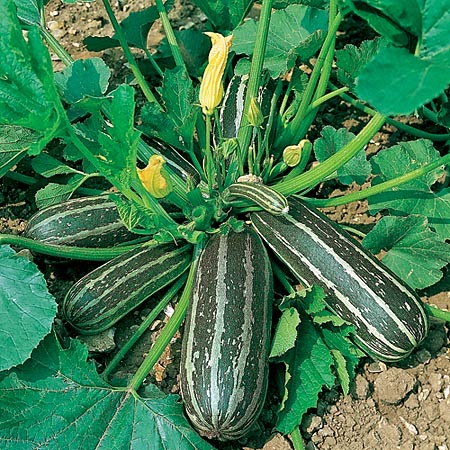
Marrows don't DO anything.  But for the oldest Burton boy
that was their appeal - it gave him time to stand and stare


And at the same time, I see that it is not only the children who have this continual entertainment and involvement organised for them. Increasingly, it seems to me, parents are also keen to keep busy – or rather to ensure that they are personally “fulfilled” by continuing interests and pursuits. Again, surely this is a good thing – I’m sure it is – but as I get older I have the nagging suspicion that for many it is a reflection of a deep rooted anxiety not to face what they see as boring and unnecessary - the reality of everyday life. Much of everyday life is, by its very nature, tedious, boring and invariably hard work and every so often there appears in my inbox some humorous joke or item reflecting on the futility of much of this. Recently, this one popped up and whilst I can sympathise completely with the sentiments the hidden message is one of do what you enjoy not what you have to do. It offers a hedonistic world of lotus eating rather than the world of reality.

Dust if you must, but wouldn't it be better
To paint a picture, or write a letter,
Bake a cake, or plant a seed;
Ponder the difference between want and need?
Dust if you must, but there's not much time,
With rivers to swim, and mountains to climb;
Music to hear, and books to read;
Friends to cherish, and life to lead.
Dust if you must, but the world's out there
With the sun in your eyes, and the wind in your hair;
A flutter of snow, a shower of rain,
This day will not come around again.
Dust if you must, but bear in mind,
Old age will come and it's not kind.
And when you go (and go you must)
You, yourself, will make more dust.

Look on the shelves at the newsagents, read the colour supplements on the newspapers and you won’t have to spend much time before you find articles and advice about how to lead  a more “fulfilling life” – go to the gym, take up cycling, be a “masterchef”, do a  “makeover” on you or your house. Indeed the TV scheduling seems full of such pursuits – all aimed at subliminally passing on the same message “don’t be bothered with the tedious and everyday – fulfil your ambitions, do your thing, live the dream”.

And it is not just the big things of life – we are bombarded with  gadgets and technology to help us to be constantly entertained and distracted from the mundane and ordinary. If I go for a walk through my local country park I pass scores of people with their headphones plugged into their ears – oblivious to the sounds of silence or the birds. On Sunday my wife and I went for a walk through the park. At one point there is a small “sensory garden” - a quiet place filled with plants. We sat and enjoyed the view and the sun for a few minutes. On the next bench to us sat a young couple with a baby in a push chair – both adults had earphones in and were listening, I assume, to music. It all seemed a bit bizarre to me, to be intentionally eliminating one of one’s senses in a sensory garden!  Smartphones, tablet computers, streaming of music and programmes and the like ensure that every waking minute can be filled with exactly what we want when we want it, where we want it – and consequently our  basic humanity is, in a small way, diminished. We are becoming like the lotus eaters of Greek mythology or the Eloi of HG Wells’ “Time Machine” - childlike, lacking curiosity, drive or personal discipline for our every desire is instantly gratified.  And as I write this sentence I look out onto my street. Two young mums are just passing my house, both pushing push chairs with young children sitting in them. The two mums aren’t talking to each other as they walk, they aren’t communication with their children – they are both gazing at their smartphones and appear to be sending text messages as they walk. Much more exciting than engaging in real, everyday, mundane, ordinary life or interacting with their children!

Blaise Pascal
To return to my tale of “Marrow Hill”. One of the recurring themes of any discussions that I had with the children after I had read the story to them was an acknowledgement by many of children that they understood exactly where the Burton boy was coming from. They well understood that he just wanted a bit of space to be himself, to not be continually organised by others and to have a bit of quiet time – time to stand and stare, to do “nothing”. And, taking this a stage further, it was virtually always the more able children who made this point – they saw that there was more to life than simply enjoying oneself and continually “doing”. As I write this I am reminded of the observation by the German philosopher Arthur Schopenhaur who commented a century and a half ago that “I have for a long time been of the opinion that the quantity of noise and business that anyone can comfortably endure is in inverse proportion to his mental powers!”  What would he say today?  

More seriously, however, I firmly believe that a balance has to be struck. Of course, people want to follow their interests and ambitions. Of course, children will benefit from exposure to a wide variety of experiences and opportunities. But there are other things that are equally and perhaps more important than the hedonistic fulfilment of one’s own dreams or the treadmill of non-stop experiences that permeate the lives of many. These are the things that a new smartphone, a year’s gym membership, music lessons, swimming lessons, “playdates” and the rest cannot provide. The gym, the smartphone, the "playdate" and the rest of the trivia, laudable and desirable though much of it might be, are things which are at best simply entertainments or  distractions from the everyday business of living. And yet, it seems to me, these are increasingly the most important things of life for many.
Michel de Montaigne

As Davies said in his poem – we need to the time to “stand and stare” and in doing that we confront and accept our humanity.  We need to know that doing the dusting, rather than walking away from it, is a small and tedious but important part of life. It is what makes us human – not doing the dusting – but being able to recognise what is important. Being so busy and involved, being entertained and distracted by what we want rather than what we need, never having the time, or worse, never having the desire to stand and stare, never having the time, the opportunity or desire to reflect upon ourselves and our lives, never being comfortable with one’s own silence, solitude and company, ensures that we never confront the realities of ourselves, our life and humanity. And that is not just bad for us as individuals but for humanity as a whole. Personally, I'm with two French philosophers on this one, both of whom pointed out the issues that they recognised in their time. In the sixteenth century Michel de Montaigne noted that  "Every one rushes elsewhere and into the future, because no one wants to face one's own inner self". And a century later French philosopher and mathematician Blaise Pascal said: “All mankind's miseries derive from not being able to sit alone in a quiet room!”  Whatever these two gentlemen would say if they were able to witness today's world is anyone's guess but I have absolutely no doubt whatsoever that both these observations are true and relevant to our modern world.