26 August, 2018

The lost age of elegance

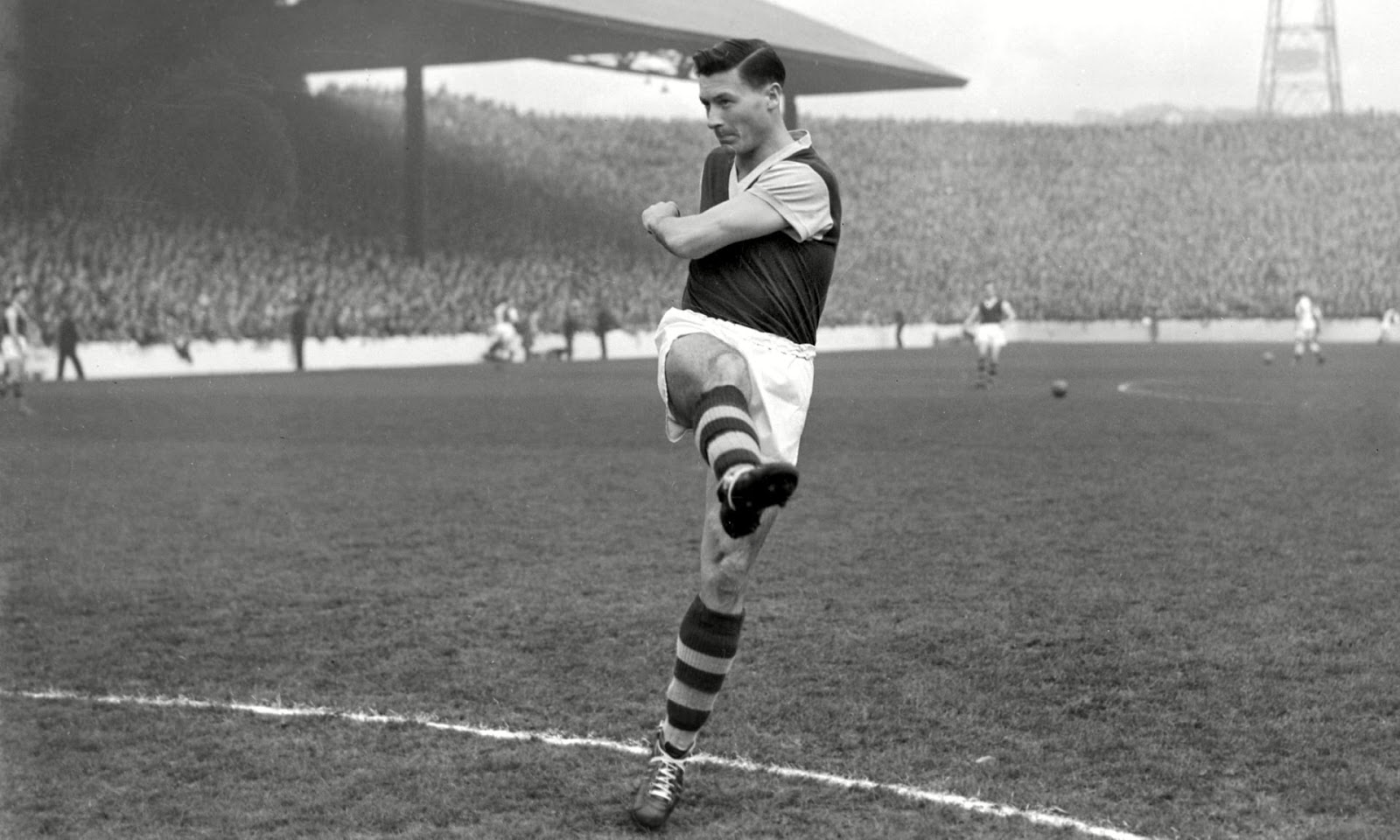
Jimmy McIlroy - an elegant footballer and an elegant man.
Earlier this week the footballer Jimmy McIlroy died aged 86. He was one of the great players of the 1950s. Unlike today’s sporting superstars he didn’t earn millions or live in gated mansion or own a fleet of high powered supercars. He didn’t sport a silly hairstyle or scream obscenities on the pitch when something went wrong nor did he get into drunken street brawls outside night clubs in the early hours of the morning. When he at last retired from the game he earned a living by taking up bricklaying and reporting on football for his local newspaper. McIlroy was appointed MBE in 2011 for his services to football, and Burnley’s Turf Moor ground, where he watched the team for many years after retiring, has a stand named after him.

 I saw McIlroy play on numerous occasions. He played for most of his career at Burnley, an “unfashionable” team but in those days one of the top teams of the land. He also represented his country - Northern Ireland – throughout his career. I have stood at Turf Moor or at Deepdale -  my team Preston North End’s ground - and watched McIlroy whenever Preston played Burnley and admired his skills. In those far off days to see two of the UK's greatest players and sportsmen – McIlroy and Preston’s Tom Finney -  on the same pitch was a rare privilege. It is unlikely I - or indeed anyone else - will ever have the opportunity again to see two such great talents but above all such great sportsmen and gentlemen on the same field of play. Times, in sport – as in life – have changed, and not always for the better.

In the Guardian’s obituary of McIlroy they described him as an “Elegant inside-forward who was a creative force in the remarkable Northern Ireland side of the 1950s........A perfectly balanced, highly intelligent inside-forward with masterly ball control and an ability to make the telling pass, McIlroy was quick enough on the field when he needed to be. But vulgar haste was anathema to him. He was capable of holding and shielding the ball until the right alternative showed itself, and he could beat his man with elegance and ease.....[He was] an elegant cornerstone of Burnley’s First Division title-winning side of the late 1950s and one of Northern Ireland’s greatest internationals”.
Bobby Moore "Captain extraordinary, Gentleman of all time"
receives the World Cup from the white gloved
 hands of the Queen - 

As I read the obituary, nodding in agreement with the analysis of and tribute to the man and his skills I pondered the use of the word “elegant”.......”an elegant inside forward”......”an elegant cornerstone” – and I reflected how that word seems now largely  defunct in our society, language, discourse and especially sport. According to my dictionary elegance  “is beauty that shows unusual effectiveness and simplicity. It is frequently used as a standard of tastefulness”. My dictionary gives a variety of synonyms: “stylish, graceful, tasteful, discerning, refined, sophisticated, dignified, cultivated, distinguished, classic, smart, aesthetic, lovely”. And, as I read these, I again nodded – yes, these well describe the qualities of McIlroy the footballer.  He was not (to use the described antonyms of elegance) in either his football life or his personal life “brash, coarse, crude, unrefined, vulgar, uncouth, unsophisticated, unpolished, uncultured, uncultivated, or graceless”. No, Jimmy McIlroy was a pleasure to watch, he made the game look so easy and strode the pitch like a gentleman at all times. He could glide past the lunging tackles of some lumbering centre half and seemed to do it all without breaking into sweat. In today’s terms, I suppose, he was the epitome of “cool”, always in control, never rushed. When his team scored there was no vulgar display of the affected tribal triumphalism complete with moronic celebrations that we witness at today's football matches. Nor was there the venom or display of anger, frustration, or shrieked obscenity to the opposition or the referee when something went wrong.  Jimmy McIlroy like my Preston hero Tom Finney, was a gentleman both on the pitch and off it.

I suppose the last sportsmen (and I choose my word carefully here to include all sports not only football whose brashness, vulgarity and crudity we see splashed weekly in our newspapers and on our TV sets) that I could describe as elegant and  gentlemanly were Bobby Charlton, Bobby Moore and Argentina & Tottenham Hotspur player Osvaldo Ardiles. No one else comes even close. When England last won the World Cup in 1966 it was at the end of that Final that one of the great and gracious moments of football and sporting history occurred - and which gave an insight into the persona of England’s captain Bobby Moore. And it didn’t occur on the pitch. In the heady excitement of the victory, with a hundred thousand people in the stadium and millions throughout the world shouting and cheering, Moore, like every other player in the pitch, was exhausted and on a high. He climbed the Wembley steps leading his team to receive the Cup – the greatest footballing trophy in the world and approached the Queen.  He held out his hands to receive the Cup but then stopped momentarily. He noticed that the Queen was wearing white gloves – immediately, he bent down and wiped his muddy hands on the table cloth so that he did not dirty her gloves. Such was the man – the perfect embodiment of Rudyard Kipling’s “If”: “If you can keep your head when all about you are losing theirs..........If you can walk with kings and not lose the common touch......” That in a nutshell is elegant: stylish, refined, tasteful! What a far cry from the obscenities, anger, scowling faces and mindlessness that occurs on Premiership pitches today. Moore’s action fits well with any definition of “elegance” both in the way he played and the way he behaved. On the plinth under the statue of Bobby Moore at Wembley stadium are inscribed the words: “Finest legend of West Ham United. National Treasure. Master of Wembley. Lord of the game. Captain extraordinary. Gentleman of all time."  I do not see any player today being described as “Gentleman of all time” - nor do I think I will ever. When, over twenty years ago  Moore died, struck down  so young by cancer, the Guardian sports writer Hugh McIlvanney said of him “Amid the coarsening of spirit that has been manifest in this country over the past couple of decades the wider world not just the world of football grieved, for everyone knew that we had lost more than just a footballer. We had lost a great human being, a gentleman - someone who had all the human qualities: integrity, elegance, endeavour  that  we would all like our own sons and daughters to have”. Amen to that.
Basil D'Oliveira - graceful, gracious and a cricketer
who displayed "gentlemanly elegance"

How we have changed both on the sporting fields and off it. Today, we live – as Hugh McIlvanney said in his memoir of Moore -  in an age of increasing coarseness. I would find it impossible to describe any sportsman today as being “elegant” – modern sportsmen might be supreme athletes, hugely talented, strong, competitive and satisfy many other adjectives – but I fear elegance is not one. Today the Wimbledon tennis courts echo to the grunts, power, aggression and win at all costs competitiveness of muscle rippling men and women – not the elegance and court craft of someone like the supreme Rod Laver of a bygone age. Our cricket fields are populated by the big hitters, the obscene and unsportsmanlike sledging in the slips designed to put the batsman off his concentration so that the intimidating bowling can have maximum effect - its purpose to destroy the wicket and, if not, the batsman. Last week England cricket “star” Ben Stokes narrowly escaped punishment in the court following a drunken brawl outside a night club in the early hours where, it was agreed, he had “lost control” having been drinking heavily. A far cry this from fifty years ago this week in August 1968 when Basil D’Oliveira scored 158 at the Oval against Australia and became a national hero beloved, for his graceful  batting, his golden-armed seam bowling, his geniality, his bearing and, as the Guardian described him at the time, “his gentlemanly elegance”.

Sport is, and always has been, a metaphor for life and a reflection of the society that it inhabits. Look at old films of the vast crowds that went to football matches half a century and more ago and two things strike you. Firstly, everyone is dressed in ordinary clothes – suits, ties, hats. There are no immature, alcohol fuelled “men-children” that we see in the country’s stadia today, each, child like, wearing the shirt of their team and sporting the name of their favourite player. And secondly, the crowd are disciplined not today’s often alcohol fuelled and unpredictable mobs –- needing to be constantly monitored by police video cameras because of the undercurrent of violence and potentially volatile behaviour. Yes, in former days the crowd cheered and enjoyed the spectacle but in a mature manner not as you see today where these “men-children” lose control at the least thing, working themselves up into  a frenzy when a player scores or when an opposition player is guilty of some misdemeanour. And of course the players play to the baying mob who are watching them by developing their own on pitch celebrations and behaviour. And the crowd, so besotted by the occasion and so immature in character do not realise how they are being manipulated by their “heroes”.  Watch the crowd at a big cricket game now and we see what is called “the Barmy Army” – “supporters” wearing fancy dress costumes (why?) to attend what used to be the most graceful of all games. We live in an inelegant and increasingly vulgar world.
Street art in Oviedo, Spain celebrating the
town's proud history

Today’s  penchant for grossness, gracelessness and inelegance, sadly, however, goes far beyond the sports field. Nowhere is this lack of elegance and gracelessness more prevalent than in the media and especially so in social media. Read the posts on things like Facebook or other media platforms and one soon realises that expletives, vulgarity and tastelessness are endemic in modern everyday life and the contemporary mindset. Spend a few minutes flicking through the threads on any newspaper’s chat sites - even those of the "quality" broadsheets such as the Times, Telegraph or (for me) sadly the Guardian - and I guarantee that you will soon be disillusioned. Here people can, and do, show off their true persona in expletive and hate filled posts. People might, on the surface, appear to be respectable, decent and gracious but sadly, I believe, there is too often a darker side displayed within the anonymity of social media. It is often said that a "driver" for social media is that the contributor can "be anyone they want", they can be a different, more exciting person than they are in real life. I don't doubt this analysis but must also conclude that too often that manufactured persona is in fact the real embodiment of that contributor; social media  simply allows their darker side to show through. Before I retired I acted as admissions officer for young graduates applying for a place on a teacher training course. When a new application arrived in my inbox I usually scanned the internet and especially social media sites to see what I could find out about the applicant and if it fitted in with the application form in front of me. Often it did – too often it didn’t. All too often I discovered a side to the applicant's personality and lifestyle that forced me to question what I had read on their application form. The sad and worrying thing I felt was that these people clearly had no qualms about displaying to the world the seemier side of their life - their casual use of expletives, sexual innuendo or worse, aggressive/hateful comments made to anyone who angered them or disputed their posts. It didn’t necessarily stop them getting an interview but it did raise questions about their personal judgement and indeed their suitability for the teaching profession; in the end, issues of taste, graciousness, elegance are all about the personal decisions that we make in regard to both ourselves and others.
Pamplona, Spain - celebrating the town's famous
annual bull run.

The other day we went to Bath for the day. We had a wonderful day in a beautiful city that was once the most fashionable place in England – a place where the great and good of the nation (and further afield) came to take the spa waters and to see and be seen. It is a place of some of the finest architecture in the whole of the United Kingdom and a World Heritage Site – its magnificent Abbey, the Roman Baths, the Assembly and Pump Rooms and superb Georgian residences are quite unforgettable. As I sat watching the world go by in this elegant and graceful place I imagined the people who must have walked the streets before me and pondered their modern equivalents – overweight people displaying huge amounts of tattooed flesh, a man pushing a stolen supermarket trolley filled with toilet rolls each sheet decorated with the face of Donald Trump. And as he walked up and down he called out “When you need a dump s—t on Trump”.  What have we become? Is common decency like elegance also becoming in short supply in the modern world?

It seems to me that people like Jimmy McIlroy, Basil D’Oliveira, Bobby Moore, Bobby Charlton had another quality that fed into their elegance at their respective sports – and that quality was a personal pride – pride in what they did, how they did it and pride in themselves. I see this in short supply today. A walk around any of our major cities (and towns and villages) will soon confirm that people no longer take a pride either in themselves or their environment. We might talk a lot about being “green” and protecting the environment – the everyday reality is different. Being environmentally friendly is not only about not using polythene bags – it’s about taking a pride in one’s environment and part of that is a pride in ourselves. Last month Pat and I spent three weeks touring northern Spain and France. Throughout that time we were again both struck by the obvious sense of personal and civic pride and respect shown by the inhabitants  for their towns and villages. Towns and cities were clean and largely litter free; walk down the street and people talked in subdued tones not the cacophony of noise that fills our own streets and public transport. Walk down any street in contemporary Britain and one can witness at first hand the lack of personal pride that people have in their appearance – anything goes, as long as it  is “comfortable” – the fact that it might be inappropriate, scruffy, lacking in taste or whatever is it seems irrelevant. I read  a few months ago that head teachers were having to send letters to parents asking them not to turn up at school in their pyjamas when bringing their children to school in the morning. Sadly,  social media was awash with posters decrying the schools for trying to insist on some measure of appropriate parental dress. 
A garish plastic robin inelegantly "celebrates" Nottingham's
proud history of Robin Hood

This is not an issue about being “posh” or wearing a tie – it’s about taste, grace and personal pride. My dad was a humble man; a long distance lorry driver all his life. He never passed an exam of any kind but my memories of him from my childhood till the day he died spoke volumes. He wasn’t posh, learnéd and he certainly wouldn’t have considered himself to be elegant. He felt very uncomfortable in situations such as going into restaurant where a knowledge of which knife and fork to use was required. But he did take a huge pride in his world and himself. Each Sunday his two pairs of overalls would be washed and he would stand and iron them ready for the week ahead. Each night his work boots would be polished to a gleaming shine. In my childhood we had no bathroom or running hot water – it all had to be boiled in a  kettle so the last thing he did before going to bed each and every night was to have a good wash and a shave – ready for the morning when the one sink and one tap in the house would be needed for others to wash in before going off to work and school. In the morning he would have a quick wash in cold water and put on his neatly knotted tie before pulling on his bright green overalls and he would be off just after 6 a.m. looking smart and ready for the day. It maybe didn’t make him a better lorry driver, but I think it did make him feel better about himself in his humble job – and still today I can hear him telling me as he did so often “You can tell what sort of a person is by looking at the shine on their shoes”. He was not wrong.  To the day he died, whenever I went to visit him and no matter how ill he was, he would always be washed, shaved, a smart crease in his trousers, tie on and polished shoes on his feet - it was a personal dignity and I suspect how he wanted me to perceive him. In short, it was a form of elegance.  We have become a very inelegant people.
Dreadful cheap plastic owls in Bath rub shoulders with 
some of the world's finest buildings

Here in Nottingham we have “brightened up” our ancient city by erecting tasteless brightly coloured plastic birds as a kind of populist street art. In Spain and other places we see wonderful, elegant works of art reflecting the city’s heritage and civic pride. Even in Bath – a place filled with some of the world’s greatest architecture the local council have seen fit to fill their streets, like Nottingham, with brightly coloured plastic owls to remind the populace of the Roman Goddess Minerva, the Goddess of wisdom and the Goddess associated with the Roman Baths in the town. But in contemporary Bath and wider Britain cheap, garish, graceless plastic birds are the memorial of choice  not something in keeping with the ancient architecture of the place. As I looked at these monstrosities against the back drop of the other elegant buildings of Bath I wondered if they comply with the “World Heritage Site” award that the city is rightly so proud of? Our modern propensity in what Shakespeare called “this sceptered isle” is to plumb the depths of tastelessness and is both spectacular and worrying.

Gracelessness and lack of elegance manifests itself in so many areas of contemporary life. I read this week a report in the New Statesman magazine in which the Washington correspondent of that magazine complained bitterly that it is virtually impossible in Washington or New York to find a restaurant in which one can eat without being bombarded by unacceptable levels of noise so loudly do people talk. I could relate to that; on Friday my wife and visited one of our local restaurants - The Dorset Arms - for a meal. We like the restaurant and love the menu but all too often the meal is ruined (as it was this week) by the loud conversation from the adjacent bar area – people with no awareness of the noise that they are making. Still on the restaurant front can I be the only person in the world who finds the huge cups of coffee served at places like Starbucks and Costa vulgar? What a pleasure it is to enjoy a coffee on the continent where it is served quietly and politely in small cups. Today’s world it seems works on the maxim “never mind the quality feel the width!” Today it is the size that matters not the tastefulness or graciousness - whether it is on the sports field or in our everyday discourse.
1952 - Preston Guild. My dad as he looked every day when he went to work. He stands proudly 2nd from the left in his green overalls, his tie and brightly shining work boots. His lorry in the picture carried part of the Canberra bomber which his company, English Electric, manufactured. He drove the lorry in the Guild procession celebrating the town's industry. 

A few weeks ago I read one of the saddest and unpleasantest reports of the decline in our graciousness as a society. It not only saddened me but angered me – both at what was reported and the fact that no-one seemed to raise an eyebrow at it – it was simply accepted unchallenged and not commented upon. It concerned not a humble lorry driver, footballer or the ordinary man or woman in the street but a person at the very top of the nation's social tree – the UK's Foreign Secretary or to give him the correct title “Her Brittanic Majesty’s  Principal Secretary of State for Foreign and Commonwealth Affairs” . The holder of this illustrious position – the second most important great office of state after the Prime Minister - was at the time Boris Johnson. The Foreign Secretary is charged with dealing with our relations with other nations it is a position requiring delicacy, decorum and diplomacy to ensure that the nation and its interests are regarded highly in the capital cities of the world. Johnson comes from a wealthy family and attended one of the nation’s great schools – Eton – and from there to Oxford where, we understand, he did well. He is allegedly a clever man – although I think one might distinguish between the cleverness to pass exams and cleverness as a human being. In many ways he might tick all the right boxes as a Foreign Secretary -  a skill with languages, a facility with the art of discussion and all the rest. I suspect he could walk with kings and feel comfortable. Except, except.......that whenever he opens his mouth he displays his crudity and total lack of graciousness.

About a month ago he resigned his position at Foreign Secretary following a disagreement with the Prime Minister about the UK’s current negotiations on Brexit. In his resignation speech explaining his reasons for  resigning he described the various plans that the Prime Minister had to reach agreement over the UK’s exit from Europe as “Like polishing a turd”.
"Her Britannic Majesty's Principal Secretary of State for Foreign
 and Commonwealth Affairs the Right Honourable Boris Johnson"
 Sadly he is not "honourable" and now he  is, thankfully no longer 
Foreign Secretary. But the manner of his departure said much
 about this man's lack of decency and his gracelessness.

Now, maybe Johnson thought this was clever or funny. Presumably it is part of his ordinary vocabulary and acceptable within the circles in which he moves. If it is then I for one am ashamed to be British. Does the man have no decency? How can he possibly think it right that someone holding the post that he did as the nation’s representative to the world to use such a crudity? How can he possibly think that it is appropriate that he should utter these words in the nation’s Parliament? And, as  I said above – no one took him to task for this – the newspaper’s printed it on their front pages, social media posts laughed at it, but no one raised an eye brow for such things are now part of the common discourse. I do not believe that if and when Boris Johnson passes away any obituary writer will say of him, what was said about Bobby Moore: "We had lost a great human being, a gentleman - someone who had all the human qualities: integrity, elegance, endeavour that we would all like our own sons and daughters to have".

Such is our world today, when even those born to greatness and having all the advantages of life, as Johnson has had,  and who are awarded the great offices of the land cannot act in a seemly manner and are comfortable in displaying their crass vulgarity and gracelessness to all. Like the man in Bath selling Donald Trump toilet rolls anything, today, goes and neither he nor wider society felt ashamed of it. As a society we in the UK have increasingly lost the capacity to take a pride in ourselves and in what we do, what we say and in how we conduct ourselves. We have lost the capacity to know what is decent and gracious and right. We no longer ask is a thing good or just, or worthy or of good report – we ask only what’s it worth, can I benefit from it, will I enjoy it, is it comfortable, or does it make me look a good bloke down at the pub. Boris Johnson proves the truth of this.

I have absolutely no doubts that my dad, Bobby Charlton, Bobby Moore, Basil D’Oliveira, Osvaldo Ardiles and Jimmy McIlroy would have been mortified to utter Johnson’s words in public and to the world’s media. But that, sadly, is the vulgarity and gracelessness of the age in which we now live - an age where we feel that we can say anything and offend anyone by our words and actions, and where personal pride is at an all time low, immaterial in “the coarsening sprit of the age”. We have lost the capacity to recognise the qualities of elegance as desirable or to think of a sportsman (or, indeed, anyone) as elegant or “a gentleman” for whom “vulgar haste was anathema”.  We are without doubt living in an age of lost elegance.

21 August, 2018

A Gentle Day in Genteel Bath!

Bath Abbey
I haven't blogged for many weeks - the long hot English summer has taken its toll and three weeks spent in France and northern Spain brought its own distractions. But now, although it is still far too hot for me, we are at last seeing the tiny first stages of summer's close - darkness is falling a little earlier, the flowers in the garden are perhaps past their best - and my thoughts are perhaps returning to "literary" pursuits!

Yesterday, Pat and I went on a coach outing to the city of Bath in Somerset. Bath lies about 120 miles away from us so it was a lengthy journey but a wonderful day. It was organised by our local U3A (University of the 3rd Age) group of which Pat and I are both members and specifically by the History Group in the U3A. Each year they have day out to some place of historical significance - this year it was Bath. It was everything that we hoped for. Superbly organised, as always, by the History Group's leader, Carol Williams we all saw enough of this delightful place to whet our appetites for a further visit of our own – perhaps a long weekend or an Autumn break - to take in more of all that Bath offers.

Bath is an ancient city. It is one of the smallest cities in the UK and nestles in the rolling, beautiful countryside of Somerset. From anywhere in the city you can see the trees of the surrounding country so it is a very pleasant place to live and to visit. Although a settlement has been there since prehistoric times it was with the arrival of the Romans 2 millennia ago that Bath really "took off". The Romans discovered the many qualities of the thermal springs that came to the surface in the area and the baths that they established there gave birth to the town's Roman name: "Aqua Sulis" . Aqua Sulis was one of the important garrison towns in Roman Britain and part of the network of Roman roads that crisscrossed the country at that time joining Roman garrisons and occupied towns. The Fosse Way, one of those roads went north east straight across the English countryside to another great Roman garrison at Lincoln - or as the Romans called it "Lindum". Today, that ancient road is one of our main routes - the A46 - and it runs within a few miles of my house here in Nottingham.
Part of the Roman Baths
Since Roman times Bath has blossomed from a garrison town and Roman settlement with some rather splendid baths - reputably with great healing qualities - to being, in Georgian England, almost the cultural capital of the kingdom where the great and the good came to "take the waters" and to see and be seen. It was the chic, "in place",  to be in 18th century England and its architecture and layout today reflects this. It is a town of fine buildings, grand streets and crescents, but at the same time it manages to retain a human feel; it seemed to me to be a very "livable in" place where the buildings and streets complemented the  inhabitants and the business of the town.

To walk the streets of Bath is to walk though the full pageant of English history and to rub shoulders with the movers and shakers of days gone by. The ancient honey coloured limestone makes Bath’s architecture so instantly recognisable and the world famous Roman Baths, the mediaeval Abbey, the Pump and Assembly Rooms, the famous Pulteney Bridge (modelled on the Ponte Vecchio in Florence) and the magnificence of residential architecture of the Royal Crescent and Circus are just a very few of the things that have made this Somerset town a World Heritage Site. Bath has, by far, more Grade 1 listed buildings (50+) per head of population than anywhere else in the country.  
Baths and Abbey together

Add to that the great and the good who have lived here and came to “take the waters” of this spa town and one has a real historical treasure house: Lord Nelson, Prime Ministers William Pitt &  William Pitt the Younger, the artist Thomas Gainsborough, architect Robert Adam,  politician William Wilberforce famous for his campaign to outlaw slavery, the Ethiopian Emperor Haile Selassie, Charles Dickens (he wrote much of The Pickwick Papers here), Jane Austen, the satirical author Richard Brinsley Sheridan, William Herschel (discoverer of the planet Uranus and court astronomer to George III), Beau Nash, Louise XVIII of France...........and countless others;  an endless list of the great and good of English and international history.

As we sat watching the world go by in the afternoon sun a Jane Austen Walking Tour  passed led by a delightful lady in full 18th century attire complete with lace parasol – this was straight out of Pride and Prejudice! And, indeed, a few doors away from the Jane Austen Centre one could enjoy a cup of tea at Mr Darcy’s Tea Room! Who would be next, I mused? – perhaps the outrageous Mrs Malaprop from Sheridan’s play The Rivals, loudly proclaiming one of her awful malapropisms! It was not to be; but behind us, as we sat, the magnificent Abbey – dating back as far as the 7th century - reminded us of our nation’s great religious and cultural heritage whilst at the same time the Roman Baths confirmed that these Mediterranean invaders and immigrants to our island brought with them a culture, ideas and technology that far predate our own cleverness and culture.
The Circus - one of the great rounded Georgian Streets
that have become synonymous with the name Bath

Today, the streets are not busy with the sedan chairs of 18th century when it was the second most important city in the kingdom, after London, and the place to both see and be seen by the great and good of these islands. Nor do the streets echo to the sound of Roman markets and centurions  as they must have done two millennia ago. Now it is the big High Street names, that ply their trade within the Doric columns buildings and Palladian style architecture. But despite today’s modernity – the tourists on the open topped buses, the ubiquitous Costa and Starbuck’s coffee shops, or the  street traders who pass - one, sadly jarring the senses, with his second hand Sainsbury’s shopping trolley filled with toilet rolls each sheet emblazoned with Donald Trump’s face! - Bath still retains its ancient feel and wears its age both well and gracefully. Wherever one looks there is something of interest and taste to see – in short, a gentle, genteel and gracious town – and I couldn’t help feeling that had one of the residents from the past found themselves transported to today’s Bath, they would have seen much they recognised and approved of.

12 June, 2018

“Your representative owes you, not his industry only, but his judgment...."

Philip Lee I may not share his politics 
but I respect his integrity. A nan who stood up
today for what he thought was right -
despite the consequences.
From the day that David Cameron announced that there would be a referendum on whether the UK remained in the EU those who advocated leaving used as one of their main rallying calls that Parliament should “take back control” from the European Union. Once the referendum had occurred and the decision for Brexit became a reality this call for Parliament to “take back control”  then morphed into Parliament “carrying out the will of the people” – i.e. ensuring that the vote on June 16 2016 to leave the EU is carried out;  no ifs no buts. In recent months as the Brexit momentum has stumbled and stuttered we have seen huge pressure being exerted upon the government to force Theresa May to be ruthless in forcing Brexit through – almost no matter what the cost. The “will of the people must be obeyed”  is the call to arms; living in 2018 England feels much as it must have felt in 1790’s Paris when the “will of the people”  had to be obeyed and Madame la Guillotine ensured that all who disagreed with that maxim met a bloody end as the blade fell on their necks and Paris streets ran with blood in the French Revolution’s “reign of terror”.

More words and newspaper and blog and column inches have been devoted to this in the two years since the Brexit vote – much of it by me! – that further debate  and rehearsal of the arguments for and against Brexit seem pretty superfluous; minds are made up, positions taken for good or ill.

However, in this week when Theresa May is facing a number or serious votes about Brexit there is a worrying and associated issue has come to the fore this morning. (Tuesday June 12th 2018). It is one that encapsulates the very delicate and potentially frightening point that democracy and the political process has reached in 2018 Britain and is something that goes to the very heart of the debate about “Parliament taking back control” – the rallying cry so beloved by those favouring Brexit. This morning the tabloid press in the form of the Daily Express and the Sun carried stark and worrying headlines aimed at Members of Parliament – and intended to bully, intimidate and threaten those whom we elect to Westminster to make decisions on our behalf. And following hard on the heels of the tabloid threats a relatively junior government minister, Philip Lee, resigned his position as a justice minister in protest at what he says is “how Brexit is being delivered”. He  says that he is “incredibly sad to announce his resignation as a minister.......so that I can better speak up for my constituents and country....” . Lee is not a trouble maker by nature – in his parliamentary career he has voted with the government and for his party on virtually all issues. In his long statement  Lee emphasises a number of Brexit related points but at the heart is his concern that he wants to do “the right thing” as he sees it:

“......Resigning as a minister from the Government is a very difficult decision because it goes against every grain in my soul. The very word resign conveys a sense of giving up, but that is the last thing I will do. I take public service seriously and responsibly. That is the spirit that has always guided me as a doctor and continues to guide me as a politician.

For me, resigning is a last resort – not something that I want to do but something I feel I must do because, for me, such a serious principle is being breached that I would find it hard to live with myself afterwards if I let it pass. I come to this decision after a great deal of personal reflection and discussion with family, friends and trusted colleagues.......If, in the future, I am to look my children in the eye and honestly say that I did my best for them I cannot, in all good conscience, support how our country’s exit from the EU looks set to be delivered........”.
Edmund Burke - one of the undoubted "fathers" of
democracy - a man who knew all about "doing the right thing".
Whatever one's politics the ideas of Burke are fundamental

Whatever one’s views on Brexit or indeed on any issue that is part of the democratic process Lee’s words  are at this crucial point in the UK's parliamentary history incredibly important; they go to the heart of that process and of how parliamentary democracy works in the UK – and indeed elsewhere in the world. The Brexit decisions that Parliament is currently making are, without doubt, the most important for generations and will effect the nation's well being for generations to come; whatever one's views or whatever the eventual outcome of the Brexit debate it is critical that they are undertaken both correctly and democratically. In this context Philp Lee's words and thoughts hearken back to the famous and compelling words and ideas about the relationship between parliament and the electorate formulated in the mid-seventeenth century by the great Anglo-Irish parliamentarian, statesman and philosopher Edmund Burke.

Burke is regarded as one of the great “minds” underpinning all political philosophy. He was, amongst other things, an MP and is usually thought of as the philosophical founder of modern conservatism (both with a small “c” and a capital “C”). Whatever one’s political or philosophical beliefs Burke is a figure that can’t be avoided, his ideas have become very much part of our thinking in this country and abroad too; they are at the core of how our Parliament works.

Amongst his many pronouncements are:

      ·         The only thing necessary for the triumph of evil is for good men to do nothing.

·         Those who don't know history are destined to repeat it.

·         Nobody made a greater mistake than he who did nothing because he could do only a little.

·         We must all obey the great law of change. It is the most powerful law of nature.

·         When bad men combine, the good must associate; else they will fall one by one, an unpitied sacrifice in a contemptible struggle.

·         The greater the power, the more dangerous the abuse.

But perhaps his most famous and compelling in terms of parliamentary democracy is:

“Your representative owes you, not his industry only, but his judgment; and he betrays instead of serving you if he sacrifices it to your opinion”.

This is at the heart of what Philip Lee is saying; he says  “...I would find it hard to live with myself afterwards if I let it pass. I come to this decision after a great deal of personal reflection and discussion with family, friends and trusted colleagues.......If, in the future, I am to look my children in the eye and honestly say that I did my best for them I cannot, in all good conscience, support how our country’s exit from the EU looks set to be delivered........”.  As I read Lee’s resignation letter the 16th century words of Martin Luther the German priest and founder of the Protestant Reformation flashed across my mind: “I cannot and will not recant anything, for to go against conscience is neither right nor safe. Here I stand, I can do no other, so help me God.”  Quite – Philip Lee’s integrity is in good company. It’s easy to do what the mob want and hard to stand up for one’s principles.
My own MP Ken Clarke.  I've never voted for him but
deep down know that like Philip Lee & Edmund Burke
he will use his wisdom,  expertise and conscience  to act in
my best interests. He won't just follow the mob. I might not
like what he does or says but I know it is done with integrity
and for the overall good.

Lee’s resignation comments  are Burke in a nutshell; that an elected representative is required, indeed bound, to act in the best interests of others – no matter what. He is not a slave to his constituents doing just what they demand but a representative of them – working for them but, more importantly, using his judgement, his expertise, his deeper knowledge of the issues to  ensure his constituents best interests.

What Burke is saying and what is implicit in Lee’s statement is that those who we elect as our representatives are not only there to mindlessly do what we want or expect, or to just do what we say. We have chosen or elected them as our representative over someone else because, we believe, that they are best suited to represent us and as such we expect them to use their wisdom, views or knowledge to their best effect on our behalf. Clearly, no one in their right mind would choose or elect someone who they believed was unable or incapable or unqualified of representing them; nor would they elect someone who they thought was incapable of exercising their judgement and using their wisdom or information to best effect. For example, if I hire a lawyer to represent me in court or I visit the doctor because I am concerned about my health I not only expect him or her to do what I say, but I expect them to use their wisdom and judgement to advise me what is best to do – even when this might go against what I first thought or perhaps really want.

In the case of Brexit, for example, if an MP was elected from, say, a strongly Brexit area of the country (i.e. where  everyone wanted to get out of the EU) but when that MP looked at all the information about Brexit, listened to all the debates etc. he judged that Brexit was a bad idea and not in the interests of those who elected him then, Burke would argue, he must use that wisdom and knowledge to best effect by using his judgement to advise his constituents and, if necessary, vote appropriately. As Burke says in his quote, “he betrays instead of serving you if he sacrifices it to your opinion”.  In other words, if he still votes for Brexit, despite knowing that Brexit is a bad idea and not in the interests of his constituents – whatever their views and because that is what they desire - then he is betraying them and his own position. Put simply he is not being honest with them and his integrity has to be questioned.
Marin Luther -  a man who suffered for his beliefs but in doing 
so changed the world: "...To go against conscience is neither 
right nor safe. Here I stand, I can do no other…"

Now one might disagree with this, it is certainly contentious, but it is one of the pillars on which our representative democracy is built. It is the argument that my own MP Ken Clarke used some months ago in his passionate  speech about Brexit in the Commons. As Conservatives  Ken Clarke’s politics like Philip Lee’s are not mine but I can have nothing but  huge respect for them as MPs  because of what I consider are their sound political philosophy. Too often today – and especially in the case of Brexit – politicians (indeed whole parties) have become tied, in thrall, to the views of the electorate and do not use their qualifications or wisdom or privileged information to make the best decisions on behalf of their constituents. The result is that we are seeing the rise of populism across the world. I suspect Edmund Burke if he were alive today would have absolutely no doubts in saying, for example, that the rise of Donald Trump in America or Brexit in the UK has only been made possible because the elected representatives have not exercised their wisdom, information  and judgement properly to ensure the best outcomes for their electors; they have simply done what they were told by the electorate rather than thinking for themselves and acting on that thought and wisdom.

The Brexit debate in the UK has divided the country as no other in living memory. We have the situation now where many of our MPs of despite the fact that they admit to knowing  that Brexit is a bad idea – indeed even our Prime Minister before the Referendum was in favour of remaining in Europe - are going along with it to save their jobs and cling to power. To its eternal shame the Labour Party is offering no alternative reality to the Brexit argument – terrified that should it suggest that Brexit would be reversed or would not happen under them that they would be howled down by mob. This is the reality of where we are at – and we sit and watch, the living embodiment of Burke’s comment: The only thing necessary for the triumph of evil is for good men to do nothing.
Two of today's intimidating headlines.

When politicians merely reflect public opinion then there is a very great danger of totalitarian states developing. Mindlessly doing the bidding of the electorate, pandering to its every whim, or following the lead of an extremist media becomes self fulfilling. It is why we have representative democracy rather than mob rule;  we expect that our MPs will make wise and good decisions on our behalf because, we believe, they have that knowledge and wisdom that we ordinary folk may not have. We do not expect them to not merely reflect the latest rallying cry or the loudest voice in the mob.

When MPs and others who hold positions of power do not exercise sound judgement and merely follow like sheep they are just the pawns of public opinion and in that case some of Burke’s other comments become equally valid:

·         Nobody made a greater mistake than he who did nothing because he could do only a little.

·         When bad men combine, the good must associate; else they will fall one by one, an unpitied sacrifice in a contemptible struggle.

·        The greater the power, the more dangerous the abuse.

Philip Lee may be right or wrong about Brexit. I’m pretty sure that I would disagree with him on many political issues and on many of his political views. But he is right on this. He is exercising his judgement, wisdom and experience, striving to do the best for those he represents, standing up for what he believes is right rather than doing nothing, and taking a principled stand in the face of what I think Edmund Burke would see as the Brexit extremist’s dangerous abuse of parliamentary democracy. In the end democracy only works if people act with integrity – if they do the right thing – and that is what Philip Lee has done today.  It might, as Burke says, be “only a little” in the face of the clamour and extremist views coming out of Brexit fuelled Westminster – but it is important and necessary that “good men”  are seen not to “do nothing”  to prevent “the triumph of evil”.  When MPs such as Lee bow to the pressure of the mob and the threatening headlines of the tabloid press then we are in real danger as a society.

04 June, 2018

You can't be what you can't see

Simone de Beauvoir - the high priestess
of feminism - one of the very few people
who changed the  world in her own lifetime
Some weeks ago I came home from an afternoon spent with the philosophy group that I lead at our local U3A (University of the Third Age) feeling a little at odds with the world. For several sessions we had been trying to get to grips with existentialist philosophy.  As a group we had found this challenging to say the least and a lot of passionately held views had been voiced. On the afternoon in question, however, we had been looking at the ideas of one of the great existentialist thinkers, Simone de Beauvoir. This blog is not the place to delve into existentialist philosophy sufficient to say that Simone de Beauvoir’s views, expressed in the middle years of the 20th century, really have changed the face of the world. There are few, if any, philosophers who could claim to have had such an impact so quickly on the way that society thinks. Briefly, her views form the back bone of much of today's feminist thought and although this great French activisit and intellectual was a prolific writer it is for her works The Second Sex and The Ethics of Ambiguity in particular that she gained world fame, acclaim and a lasting place in philosophical, social, and above all feminist history. De Beauvoir’s relationship with the existential philosopher Jean-Paul Sartre, their avant-garde life style in mid-20th century Paris and the power and authority with which she wrote and spoke all combined to make her a powerful advocate of and for women. The central premise of her thought turns the existentialist mantra that "Existence precedes essence" into a feminist one: “One is not born but becomes a woman”. With this famous phrase, Beauvoir articulated the idea that (and I paraphrase here!) women are “made” by the world into which they grow and their “role” is largely dictated by social constructs and because of their relationship with men.

I am very well aware that in writing the last sentence I run the risk of falling foul of many justifiable criticisms by women in general and feminists in particular – indeed that was why I returned from the philosophy meeting feeling rather at odds with the world: I felt as if I had been “mugged” by several feminist members of the group who took exception to what they perceived as my “oversimplification” and “stereotypical” male comments and prejudices. If there was any solace for me it was the fact that I was not alone – indeed, some of the women members of the group were also similarly chastised for expressing views such as “Well, I enjoy being as woman and don’t feel dictated to by men at all”. Don’t get me wrong – the group as a whole and each of us as individuals were in total agreement with de Beauvour’s analysis – it was just that some very passionate views came to the fore and suddenly, from my perspective, rational and thoughtful inquiry was sidelined in favour of emotive comment and sometimes angry personalised criticism.

Simone de Beauvoir’s ideas gave the intellectual underpinning and undoubted “weight” to the feminist movement dating from the 1960s and is today perhaps even more relevant than ever in this ever changing world. At their base, these ideas identify how women can understand themselves, their relationships, their place in society, and the wider social construction of gender. Further, de Beauvoir suggested three strategies to aid and guide women in their quest, namely: women must go to work, women must pursue and participate in intellectual activity (leading to change for women) and, finally, women must strive to transform society into a society – de Beauvoir says a socialist society – which seeks economic justice as the key factor in women’s liberation. Looking from our 21st century perspective I would think that few in modern western societies would have reason to disagree with those goals but at the time that de Beauvoir made her views public this was revolutionary talk.
Chelsea Clinton - an astute young woman. 
Born with many advantages but who has,
I think, made her own mark.

In these early years of the 21st century hardly day or a week goes by without some report of the shifting nature of our modern world. Our increasingly diverse societies, changed expectations of individuals and groups, the decline in the old order – the Church, the class system, the "establishment" – mass migration, globalisation, the step change in the economic life of nations which mean that old family certainties are breaking down as women wish to have, or need to have, earning capacity and careers outside the home, the impact of social media and the internet mean that society is changing at an ever increasing pace. Suddenly, it often seems to me, and as someone in their eighth decade, that the old certainties are no longer there; as Bob Dylan reminded us “The Times They Are a Changin’ – how much more true is that today than when he penned those immortal words over half a century ago! Now, we have great quasi-politico/social movements often finding their voice through the internet and social media: the #metoo movement, the Occupy, the Black Lives Matter campaign, various forms of the LGBT  movements, BME  ideas.......and a thousand other campaigns, movements, ideologies, and political belief systems that would have been quite unthinkable only  a few years ago. They all demand their rightful place in the sun where their needs and rights are established and sustained and the feminist movement in general and Simone de Beauvoir in particular are at the heart of this.

It is exactly a hundred years since the suffragette movement won their first big victory by forcing the political establishment of the UK to allow some women of property to vote in an election and as a result the first woman, Constance Markievicz, was elected an MP. She didn’t take her seat, however, since she was elected as a  Sinn Féin politician. Like her fellow Irish Republicans she did not go to Westminster  but was also the first woman in the world to hold a cabinet position (Minister for Labour of the Irish Republic, 1919–1922). We have come a very long way since then but for women and for many other underrepresented, disenfranchised or minority groups, I would suggest, not nearly far enough. It came as a surprise – a shock even - to me a week or two ago when I read, as I did some preparatory reading for my philosophy group, to learn that it was only in my life time when women were allowed for the first time to sit in our House of Lords.  In this context the story of Margaret Haig Mackworth – known as Lady Rhondda - is illuminating. After her father's death, Lady Rhondda inherited his title and  tried to take his seat in the House of Lords, citing the Sex Disqualification  Act 1919 which allowed women to exercise "any public office". The Committee of Privileges, however, voted strongly against her plea. Lady Rhondda had earned a reputation as a suffragette and had become notorious in her south Wales home area for blowing up post office boxes to highlight the suffragette cause. She was supported for many years by Lord Astor, whose wife Nancy had been the first woman to actually take her seat in the House of Commons, but Lady Rhondda never entered the Lords. She was, however, nothing if not a fighter; despite failing to take her seat in the Lords, in 1926 she was elected as the Institute of Directors' first female president in and in 2015, the annual Mackworth Lecture was launched by the Institute of Directors in her honour. It was 1958, less than a month after Lady Rhondda died aged 75 that women were at last allowed to take their seat in the Lords and an unbelievable 1963 (I was by then in my late teens, so this is not ancient history!) before hereditary peeresses were also allowed to enter the Lords. To mark her role and long campaign for this simple and just recognition of what now we might call basic "human rights" her portrait now hangs in the Members’ Dining Room of the House of Lords. But to me it is a just, if sad, recognition of something that should never have happened in the first place. For, me just to think about it makes me cringe, at how society can so easily posture and hold beliefs that are so obviously contrary to basic humanity and justice. And the worrying thing is that we cannot assume that in our modern world our contemporary society would never act so - of course we could and do. Just like our forefathers we make assumptions about people, we dislike change and fairness and justice quickly go out of the window when privilege, greed and power raise their heads. Society doesn't like its cage to be rattled - especially if that means sharing what we have with someone else! Everyone is "for" minorities or the disadvantaged until it means that we have to give something up; to give one example, we all want affordable housing for our children, our key workers, the disadvantaged and the like.............but please can it be built somewhere other than at the end of my garden!
Lady Rhondda - she never saw her dream realised
but has left an indelible mark on her country.

Today we might look back on Lady Rhondda’s story with unbelieving eyes that something so grossly unfair and unjust was once considered acceptable but it serves as a reminder, perhaps, that the things that we take for granted today might well be tomorrow’s unacceptable practices and beliefs. Sadly, it also underlines the fact that all societies, to some degree or other, display a tendency to be unwilling to share with others what those in power already have. And their inability to cope with proposed change consistently institutionalizes the static and rejects of progress. Finally, it underlines the fact that although much progress has been made – there is certainly a long way to go. Change is slow, and although we live in a rapidly changing world I suspect that the dreams and demands that women might have for (say) equality of pay with men or a removal of what is seen as the “glass ceiling” preventing women rising up the career ladder of their chosen profession will sadly not be easily won or quickly obtained. The ideas of Simone de Beauvoir set the ball rolling and fundamentally changed the mind set – but sadly, I am of the view that women still have an uphill fight and that there is still a very long way to go to achieve what they seek.

I thought back to that existentialist philosophy afternoon when I read this weekend a comment which, like the best, is both simple and perceptive pointing out in a few words what might take a philosopher several volumes to say.  The quote was used by Chelsea Clinton the daughter of two of the world’s great “shakers and movers” – ex-US President Bill Clinton and his wife the powerful US politician Hilary Clinton. I’ve often thought it that it must be very difficult for a child growing up as the offspring of famous and powerful people – after all if you succeed then people argue that you had all the advantages and if you don’t succeed then you might be condemned as someone who failed to make the best of the wonderful opportunities that you were born with. Chelsea Clinton, a bright young woman, I understand, has carved out her own career far removed from that of her parents and in her thoughtful article she referred to a quote from the late US physicist and astronaut Sally Ride who commented that “You can’t be what you can’t see” .
Sally Ride -  a trailblazer who opened the path
for others to follow

As I read this I was struck with what a simple but so profound comment it was. I don’t have the context in which Sally Ride said this but I don’t think that matters. I suspect she may have said it in relation to her role in the US space programme as a female physicist and astronaut – she became the first American woman in space in 1983. Maybe (I believe) she was saying that if girls and young women don’t have women scientists and astronauts like her to look up to – to “see”- then how can they themselves easily imagine or aspire themselves to be one. To have a goal you have to have something to aim for and if that goal is not obvious, visible, realistic then it is likely that your ambition or desire may remain just an unfulfilled day dream, a step too far, something unheard of in society as a whole. To return for a moment to de Beauvoir she argued that what girls and young women are presented with from their earliest times is a perception of woman via motherhood, homemaking, caring and so on and this largely defines their future goals and roles – in short, and as de Beauvoir said, “One is not born but becomes a woman” one learns it by the experiences that you have and the opportunities that you perceive.

I don’t believe that this is peculiar to women – it applies in much the same way with men or with any other member of society – we learn to be and become what we are – we “become what we see” to paraphrase Sally Ride’s comment. This lunch time and in today’s Guardian I learned that the University of Cambridge is under scrutiny and some criticism because, allegedly, it takes very few entrants from black minority backgrounds. Now, there might be many reasons for this – the University might argue that insufficient people from that background get the very high academic qualifications required for entry or it might be (as I think has been suggested by the University) that it depends on the courses one is considering. But, as my wife pointed out as we ate our lunchtime sandwich while watching the TV news it might also be a factor that if you are black and considering university you might not wish or feel confident enough to attend a university where everyone else appears to be white. So the whole thing becomes self perpetuating – and spawns the belief that black youngsters are not good enough for or “don’t do” Cambridge. I have no way of knowing if that is a valid point but just maybe it’s another perspective on “You can’t be what you can’t see”  ....... “Cambridge University isn’t for people like me” a young black student might say rather than “I want to be like him/her.....they are my black role model......they’ve done it and got to Cambridge so I can be part of that too.” Trailblazers in any walk of life are crucial – they are heroes and show new opportunities but, more importantly  perhaps, they mark the path for others to follow.

I have a personal view that an important element in all this is how opportunities and goals can be presented to young people – be they girls or boys. We live in a world where the media is all powerful – 24 hour news, global advertising, social media – an endless list of entities all striving to grab the attention and the mind set of people – especially the young and vulnerable. I never cease to be horrified at how advertising of all kind seeks to manipulate the minds of those that it is aimed at: the fashion industry striving to manipulate the minds (and often bodies) of women, the way that in the UK the betting industry seeks to promote itself and insert itself into the mindset of young men, the way, as Christmas approaches young children’s minds are considered fair game by toy manufacturers as they seek to sell the latest must have toy. The list is endless and the common factor is that all these companies and organisations know that it is very easy to influence the mind given the right opportunities; it’s an inversion of Sally Ride’s comment – it is “You can be what you can see” – buy this perfume, dress, car, toy, hairstyle, mobile phone...... – and you will be the successful, good looking , envy of all your friends, the person that you see in our advert! When the advertisers try to sell us an item they are in fact trying to sell us a life style, holding up a kind of perverse mirror image of what we can be if only we will buy into their product. And the worrying thing is that they know it works.
Constance Markievicz - the first
elected woman MP

So, given that I wonder why in our TV programmes, our adverts, our magazines, our Hollywood blockbusters and so on we are not further exposed to these life style “opportunities” – girls becoming spacewomen, black boys being seen as High Court Judges, maybe a Muslim Prime Minister in our Parliament. I know that we are already a long way along this path – we’ve had a black man as the President of the most powerful nation on earth, and goodness gracious me, I think many would like him back rather than the present incumbent – but it seems to me there is still a very long way to go. I do  not believe, however, that this is an option that we can consider and then reject. If we don’t grasp this idea and go along this path of what I will call the "positive promotion" (of, say women in previously unheard of professional  roles) then, not only are we denying people (young women) the opportunity to attain their dreams or fulfil their ambitions simply because the court of public opinion deems otherwise, but we are wasting so much talent and human resources that in these fast moving and shifting times we ill afford. In denying or restricting  the talents and dreams of a significant portion of the population – whoever they - we are also in the longer term likely to deny our own futures - economically, politically, socially and ethically society will stagnate and turn in on itself. A society that fails to change is a society doomed to die - it's as simple as that. And in our society the role of women is one of the important issues that demands addressing - it is not an "optional extra" - it is a moral imperative and essential for society's and every individual's economic, social, cultural, welfare and sake.
Nancy Astor - the first woman
elected and to take her seat in the
House of Commons

I want my two teenage granddaughters to grow up knowing that they have realistic options and goals to aim for, that they can see what they might want to be and know that anything and everything is possible, that in existentialist terms they have the freedom to choose, the ball is in their court. I want them to have a fair and just "crack of the whip". I don’t want them to get an easy ride just because they are girls but nor do I want them to feel that because they are girls this is not for them. I want them to earn society's praise and financial and social rewards fairly and equally with everyone else - and these not to hindered limited just because they happened to be born with certain physical characteristics. I don't want them to be judged worthy or unworthy because of those same physical characteristics or for society to make judgements as to their wider ability or worth with physical characteristics as a deciding factor.   They might not achieve their goals but I want them to feel that it is reasonable that they work towards them and not be put off by simple gender prejudice or societal constraints. I want them to be able to read great novels like Pride and Prejudice which through fiction and imagination give one view of womanhood and society but I also want them to read others that set out a different and other equally attainable and desirable paths to a different set of goals, values and outcomes. In short, I want them to know what the options are and not to feel, what I suspect many young women have felt over millennia, that they can’t be what they want to be because they can’t see, or even imagine someone like them achieving such a dream or ambition. As Sally Ride said "You can't be what you can't see".