16 February, 2014

"Auld Lang Syne" and Empty Buckets.

The man himself
It’s a long time since I last blogged – not that there has been nothing to blog about but there have been other preoccupations. A lovely week spent in the sunshine of Tenerife, a granddaughter’s birthday party to attend, writing the minutes of meetings that I had attended have all gobbled up the time. And in what was left we have followed the tales of disaster and mayhem as floods, high seas, winds and storms batter Britain. Luckily, we in Nottingham have got off very lightly (so far!) but to see on TV places that we know well – Dawlish, the Thames Valley, the Somerset levels – under water and storm damaged has been a salutary but chastening experience - timely reminder of the knife edge that we live on. How clever we humans think we are until nature takes its course!

But this weekend I woke up to the news that one of the great sportsmen of the world – the footballer Tom Finney - has died at the age of 91. I have oft blogged about Finney – he was the name and the legend that I grew up with. Arguably the greatest footballer ever to play for England, maybe the greatest the world has ever produced. A true sportsman and a gentleman he filled my every weekend as I grew up in Preston in the 1950s until he retired in 1960. Week after week I would walk with my friend, now long dead, "Nebber" to Deepdale the home of Preston North End Football Club, each of us with our blue and white hand knitted scarves joining the blue and white throngs of other supporters filling the narrow streets of terraced houses.  Tony Clarkson or "Nebber" as we called him (because he always wore a flat cap) and I would walk the 10 or 15 minute walk from our houses in Caroline Street and along Skeffington Road with thousands of others, all going in the same direction, all of us to see our heroes but most of all  to see Finney weave his magic. Finney was a one club man – he never left his home town club. Preston were a top team in those days but no Manchester United or Arsenal. The club's story was largely one of  mid table mediocrity, occasionally challenging for honours but sometimes  struggling to stay in the top division . Finney never won any great titles or medals – he had a glittering career, but little silverware to show for it. It was the price he paid for loyalty. But that is only a small part of the story.  He was the ultimate loyal servant to both club and country. He was blessed with exquisite balance, skill and tactical intelligence, he played the game with a grace – or indeed good grace – given to very few: he was never booked, sent off or even ticked off by a referee. If fouled by an opponent – and he so often was – he simply shrugged, got up from the floor and carried on. If ever there was a career in football which proved that trophies are not the only, or even any, measure of greatness, it was that of Finney. The championship of the Second Division in 1950-51 was the only winner’s medal he ever won either for club and country and to this he added a Cup Final loser’s medal in 1954. But the admiration of numberless fans in the post-war years was of considerably more significance.
The great, the good and the not so good of the modern
game (Manchester cityand Chelsea) yesterday  pay their respects

His loyalty to Preston was tested when an Italian, prince Roberto Lanza di Trabia, made him an unimaginable offer to play for his team, Palermo, in Sicily. The Italian had seen Finney play for England while they were touring Italy in 1952, and was so impressed he offered him a £10,000 signing-on fee, wages of £130 a month plus a bonus of up to £100 a game, a Mediterranean villa, a sports car and unlimited travel to and from Italy for his family. At the time, Finney was earning £14 a week with Preston (reduced to £12 in the summer close-season) plus a bonus of £2 for a win and £1 for a draw. Finney was tempted – indeed he later admitted that he wanted to go, it was an opportunity not to be turned down – but the rules at the time allowed Clubs to retain their players and Preston refused to let him leave. Finney’s response was typical, he simply got on with life and continued to give of his best. What a far cry from today’s players who, to coin a modern phrase, "throw their toys out of the pram",  sulk, disrupt team morale, tweet, go to the press and exhibit all the other spoiled child characteristics.
Sir Tom at the side of his statue outside the Preston ground
-"the Splash" set in stone

Born within a stone’s throw of the Preston ground he was a small lad who would never have made it in today’s physique obsessed and brutal game where athleticism, power and strength rather than skill, guile and intelligence are the criteria for success.  Despite his slight stature and frequent bouts of ill health he gained a trial with Preston when he was 14. He stood just 4ft 9in tall and weighed less than 5 stone when he was offered a contract to join the ground staff, but his father insisted that he first learn a trade. How strange and unacceptable that would seem to today's young football "wannabes"! So, he signed, as an amateur part-timer, and became an apprentice plumber – an occupation that would run parallel with (and outlast) his football career and lead to his nickname,” the Preston Plumber”.

The iconic photo - "the Splash"
In one respect Finney was lucky, he joined a Preston side famed, as they had been for half a century, since they had been nicknamed the “Invincibles” for their quick skilful football. The old Invincibles had won the League and the Cup double in the late nineteenth century and been unbeaten in both these  competitions.  It made them the first team to achieve the English "double". Preston also won the Cup without conceding a goal. Of the seven teams to have since completed the double in England, Preston remain to this day the only one to have done so unbeaten. This historical and statistical fact was perhaps important as far as the young Finney was concerned for Preston, above all clubs, and since those far off days of glory, played “in the Scottish style”. The Preston team had for years been built upon Scottish players – the town was, after all the first footballing town of any significance on the road south from Glasgow  and Preston’s footballing style, developed first in the era of the Invincibles, was based upon the skilful, Scottish type of passing game where the ball was passed to feet in short sharp,movements. No booting of the ball up the pitch and chasing it! This was “football science” and it won games and won Preston a lot of fans for it was attractive to watch and brought results. It was into this footballing culture and skilful team that the young Finney came – and he added his own very great skills. Apart from his natural balance, unquestionable ball skills, intelligence, temperament, and footballing nous there was one other critical attribute the young Finney possessed - and something that not only set him apart from other great players of his generation but which would also, in the modern world of soccer, make him virtually unique and worth millions - he was two footed. And this meant that he could play virtually anywhere in the team. His natural position was outside right but, being equally skilled with both feet, could play just as well at outside left. He was world class anywhere on the forward line and for much of his later career spent his time as a deep lying centre forward. When playing for England he invariably played at outside left - the right wing position being given to the one sided Stanley Matthews. In May 1947 in Lisbon England routed Portugal 10-0. Matthews was irresistible on the right, but Finney, playing at outside left, was in such devastating form that his opponent, the Portuguese captain and right-back Álvaro Cardoso, walked off the field in the first half, demanding to be substituted. He never played for his country again!

Tom, the elder statesman in the Preston crowd.
The outbreak of war and his apprenticeship  postponed his footballing career and it was  August 1946 before he made his Preston debut as a  24 year old. Only twenty eight days later he was playing for England.The rest, as they say, is history – he blossomed to become the great player he did. He was twice named footballer of the year, was awarded an OBE in 1961, a CBE in 1992 and knighted in 1998. After his retirement from the game he built up his plumbing business and became part of the life blood of his beloved Preston North End. He became president of the club, and served his local community by becoming an ambassador for the town, a magistrate and chairman of the local health authority. One could not but feel this was a life well lived.
Am I on there somewhere? - I've certainly stood there and
watched him take a corner


His brilliance inspired and often carried the team – whether it was Preston or England. The great Bill Shankly, the famous manager of Liverpool and an established player for Preston when Finney joined the club, said of his great friend: "Tom Finney would have been great in any team, in any match and in any age … even if he had been wearing an overcoat." It was classic Shankly hyperbole, but none, like me, who saw him play would disagree. Another Shankly quote was made in the era of the great George Best. Shankly was asked if Best was a better player than Finney. Shankly’s reply, his thick Scottich accent tinged with  wry Liverpool scouser humour was spot on: “Yes", said Shankly,"Best is quicker, but then again Tom is 55 now so he has lost a touch of speed”. Shankly, like all the other greats of the game, was correct- Finney was quite simply the best. This weekend’s papers are full of comparisons – that Finney would be in any side that comprised the greatest of the all time greats, that the great Lionel  Messi is his footballing heir, that only Duncan Edwards, who died so young and so tragically at Munich, could in any way be equated with him as an England player – and so it goes on. Tommy Docherty, who played with Finney at Preston famously said a year or two ago that the great Lionel Messi is a wonderful player and he could pay him no higher praise than to say that Messi, at his very best, is a sort of immature Finney!
How many times did I lean over that wall to
shake his hand?

But all these comparisons of his footballing skills miss the point for those like me who regularly watched him. There was an extra quality that even in those far off days was unique. He was loved - not only for his football skills but for the way he played the game, for his gentleness and for his quiet humility. How many times did Nebber and I stand over the players' tunnel waiting for the team to come out lead by Finney. And, as they emerged onto the field and the scent of embrocation wafted out of the tunnel and into the crowd, people would lean forward to shake his hand and wish him well. And he always responded - not  seeking glamour or celebrity status, a thing unknown in those days,  but because it was the right thing to do. These were his people, he was their son. How many mornings in the school holidays did we stand with our autograph books or our well thumbed copies of "Charles Buchan’s Football Monthly" outside the Preston ground and wait for him to emerge after training. And he, always having the time to sign his autograph, to rub his hand through the hair of hundreds of little boys and ask if they were coming to Saturday’s game. His signature a neat script not some meaningless indecipherable scrawl scribbled down without even looking. And then he was gone, smartly dressed, suit or blazer and tie, shoes shining and his boots slung over his shoulder walking off down Lowthorpe Road and around the back of the ground and onto Deepdale Road and so home. No Ferrari to jump into, no gated mansion with high walls and security lights to hide behind. No, Finney, like other greats of the sporting world in those days, was a man of the people - someone who we recognised as one of us. For us little boys he was the perfect role model, and since he was so ordinary, he walked the same streets as us, lived in a house like ours, caught a bus like us, and had time for us he was something to which we could all realistically aspire. Unlike today's top sportsmen who are remote, who live lives alien to those of the ordinary man, who appear only on TV or who have come from far off countries to play in the local team for a year or two and then move on Finney was real and in being real, something we could imagine ourselves becoming - if we worked hard and were like him! He, and others of his kind, gave us all a dream and a compass by which to grow up. And, boy, did we want to be like him! This desire to be Finney (or one of the other top stars of the day) was not about wanting celebrity status or money for these two dimensions were largely unknown to such as footballers - indeed to anyone in those days. If fame and fortune came it was an "extra" - not the reason. It was the desire to be like him - or Lofthouse, or Trautmann, or Matthews, or Docherty, or any of the other footballing greats of the 1940s and 50s - as a person and a footballer. I have often said to younger people in more recent years that in those days (and, indeed, still today) I would have given my right arm to pull on  a Preston shirt - and I'm sure that thousands up and down the country felt the same way about their local club or sporting hero. But modern youth looks askance when I have said that - they see it in largely opportunistic, mercenary terms playing for a club for the maximum amount of money and then move on when more money or greater stardom beckons. To them it is about quick stardom and access wealth not human qualities such as pride or loyalty. 

 1956 - in Ealing London with
my dad and his friend Bert - my mother
and Bert's wife in the background. We
went to see Preston at Chelsea
on the day of "the Splash"!
I watched Finney perhaps hundreds of times, I saw some of his great goals and watched him play in different positions. I was at Chelsea in 1956 when the iconic photo “The Splash” was taken of him sliding through a puddle – but still in complete control of the ball. If you look at the photo carefully you can just see the Chelsea defender hidden in the spray trying to take the ball from Finney but such were his prodigious skills that he could control the ball and avoid the lunging tackle whilst dancing through he puddle -  a true footballing great, one of only a very small handful. The conditions that day would have meant the cancellation of the game in the modern world - modern players playing the modern kick, thump and run game are incapable of the sort of control required. Throughout his career Finney and his peers played on pitches that today's players would find unplayable and not conducive to their very limited skills. The ball that Finney magically controlled week in week out was a heavy "cannon ball" which soaked up the water on a wet pitch not the plastic covered lightweight, perfectly balanced ball of the modern game. And, not  unimportantly, it had  a lace. This meant that the ball, no matter how skilfully laced up was not a perfect sphere so it did not always roll true. If you ever went to head one of these balls you always hoped that the laced part would not come into contact with your head - it was extremely painful! Put all this together, unbalanced ball, muddy pitches, heavy ball, heavy boots and Finney's (and those of other greats from the past) skills become even more awesome.  But, on that long off day at Chelsea Preston won the game 0-1. The result, however,  is long forgotten  and unimportant – it is just another statistic. What, however, is not forgotten is Finney’s contribution  – and that photo which has become part of footballing legend and mythology.

I was only about ten when I went to that game. We were in London because my dad, occasionally, as part of his work, acted as a chauffeur for the aircraft test pilot Roland Beaumont. At that time dad’s company (English Electric) were building the P1 Lightning fighter plane and it was being tested at Boscombe Down near Bournemouth. When tests flights were taking place every few months dad was Beaumont’s chauffeur taking the pilot from his home in Chichester to the test site at Boscombe or up to meetings at the Ministry of Defence in London or bringing him back to Preston where the plane was being developed (at Wharton). Dad would often be away all week or maybe longer while the test flights were under way. In 1956, dad took me and my mother with him from Preston to London - dad was due to begin chauffeuring stint for Beaumont and we travelled in style down to London in the very posh car (a large comfortable, leather seated, Humber Hawk, I think) that was used to chauffeur the pilot. We didn't own a car so had never travelled so grandly! We stayed with my mother and dad's war time friends in Ealing in London while dad went off  to work at Boscombe ferrying Beaumont. My mother had lodged with this couple, Carol and Bert, during the 2nd World War when she and Carol were nurses at a military hospital in nearby Uxbridge. When my dad returned to England in 1943 injured with a badly broken arm he was in Uxbridge hospital and it was there he met my mother. And that weekend in 1956 I went  with dad and Bert to Chelsea. North End were in town and we went to see Preston play. I never suspected that I would witness one split second of that game on that bright afternoon that would become a footballing moment of history. Indeed, I don't remember it at all - it was a split second event - but some clever news photographer took the picture of Finney sliding through the puddle and it made instant headlines in the sporting press. I never suspected that half a century later that picture would be made into stone and stand outside Preston's Deepdale ground as an eternal reminder of this great man.

Tom's final appearance and after match speech

 I was there, too, with Nebber on that April 30th evening in 1960 when Finney played his last game for Preston -  against Luton. That end of season game was a nothing encounter – neither team had anything to play for.  But the ground was filled to capacity,  all there to see Finney’s last appearance. At the time the local newspapers showed people who had travelled from Arsenal, Newcastle, Wolves, Sunderland, Manchester  and throughout the UK to see the great man’s final game. I can still remember the coloured scarves in the crowd – not just the colours of Preston or Luton fans but the gold of Wolves supporters, the red of Arsenal, the black and white of Newcastle, the tangerine of Blackpool, the claret and blue of Burnley – all had come to see the end of an era. The Brindle Brass Band (for whom my Uncle Ken sometimes played) regularly provided pre-match and half time entertainment at Deepdale playing and marching up and down the pitch  and as always, when Preston ran out of the tunnel and onto the pitch the band struck up with the familiar strains of "Margie, I'm always thinking of you, Margie....." Preston's unofficial anthem. But then the two teams stood in a circle in the centre of the pitch linking arms. The Brindle struck up again.........and everyone, players and fans sang “Auld Lang Syne”.  Nebber and me like 30,000 others, linking arms, we two uncertain of the words, but knowing that this was the right thing to do. And at the end of the match, on that balmy April evening, we stood on the pitch watching Finney give his farewell speech, thanking the people of Preston for their support and good wishes – each of us, even Nebber and me as callow teenagers, knowing that we would never see his like again. And then, spontaneously, the crowd erupted into "For he's a jolly good fellow......." as the great man left the field.  The result of the game was totally unimportant (indeed, I have just had to Google it to remember!), nobody cared that he had never won any silverware, it was all about the man and the sport.

Nebber and I are on there, listening to Tom's speech.
We stand at the back along the top of the photo
That night, as on all the other occasions, we had watched him, in awe. When Finney got the ball the whole crowd became expectant. He had the knack of making lesser colleagues great players and it was jokingly commented that when playing for Preston or England he should claim income tax relief – for the ten dependants that he had in the rest of the team! When Finney got the ball we all knew what he was going to do – or at least we thought we did - but such was his magic that it was always a surprise and something to be treasured. He would cut in from the wing, towards the penalty area, the ball jinking at his feet, the full back, back peddling, unsure what to do. Would Finney suddenly put on a burst of speed that carried him past the full back and into a scoring position, would he find a colleague with an inch perfect pass, would he mesmerise the defender with his deft footwork and leave the poor player looking at the space where he and the ball had been a micro second before, or would he in the blink of an eye unleash a shot that would find the goal? These were all skills that Finney had in abundance. But there was one more trick up the sleeve – and something that he became a master at: he would approach the penalty area, ball at his feet the full back watching and waiting unsure what to do. Finney would hold the ball, tempting the full back to make a move, waiting, waiting, waiting as he slowly drifted closer and closer to the penalty area. Once there he would show the defender just enough of the ball to make him think he had a chance of getting it. The defender would lunge in but sometimes Finney was gone – too fast, and had left the defender standing. But, if the defender was quick his lunging tackle to get the ball would almost certainly  bundle Finney to the ground and the crowd, as one, would shout “Foul” – and the referee usually agreed and pointed to the penalty spot. We all knew what Finney was going to do, tempting defenders to foul him – and so did the defenders  - but we, the crowd were never bored with it and the defenders never learned to counter it! And as I sit writing this the words of the song we so often sang as we stood by the pitch each week springs into my mind:

The Splash decorated with marks of remembrance
on Tom's passing
‘Finney passed to Wayman,
Wayman passed it back,
Finney took a flying shot
And knocked the goalie flat!
Where is the goalie,
The goalie’s in the net,
Hanging on the cross bar
With his shorts around his neck’!

Finney was quite simply the best.

Finney, the modern Deepdale in the background
 standing in the streets that I used to walk along with
thousands of others each Saturday afternoon
And as I read of Finney’s passing in the newspaper I noticed another footballing item alongside. I shook my head with sorrow and no little anger as I read the latest utterances from the half witted and arrogant Jose Mourinho, manager of Chelsea – a boorish man who has the gall and conceit to call himself “the special one”. A man who is all that Tom Finney was not.  Mourinho’s latest offering on the subject of sporting greatness is that Arsene Wenger, manager of Arsenal, is a specialist in failure. Mourinho said: “......the reality is he's a specialist in failure because, eight years without a piece of silverware, that's failure. If I did that in Chelsea I'd leave London and not come back."  Clearly this man knows little about sport if he equates success with the acquisition of silverware. Of course, sport is competitive that is its essential nature but not to win is not failure, sport has many other, more important, dimensions. And, to walk away when you do not win is the action of a coward and not a sportsman. Given Mourinho’s reasoning Finney, too, was a failure – he won nothing over many years. Finney, however did not walk away, he inspired and brightened the lives of millions and he was loved for it.

We live in a world today where winning is the name of the game - we binge upon winners and losers – our schools are put into league tables recording their “success” or “failure”, our hospitals, too, are ranked  - the number of deaths, the relative costs of surgery – you name a criteria and there will be  a winner or loser for it. Our TV shows increasingly are about competition – “The X Factor”, “The Apprentice” and the rest. Our children are encouraged to scramble for top school grades. No longer is a GCSE the mark of a successful education, no longer is grade A good enough – it now has to be an A*. Our governments constantly remind us that as a nation we have to be winners and have the highest GDP or the lowest interest rates if we are to succeed. We have, in all walks of life jumped onto the winners and losers bandwagon. It increasingly defines us. So besotted are we with winning and unable to  countenance losing that I have just heard today that an English athlete at the Winter Olympics has been receiving abusive and threatening text messages because she was disqualified from an event and so missed a chance of a medal. She "failed" the nation. But not everyone can be a winner or an A*, there can only be one hospital at the top or one nation with the highest GDP or one football team to be the champions  and the rest,  the vast majority, are by definition “losers”. That is not to applaud losers – the winners should be praised – but society and sport has lost the ability and awareness that there are other factors other than winning, medals or silverware – and these things are always more important. Results are soon forgotten – other things, of more substance, long remembered.
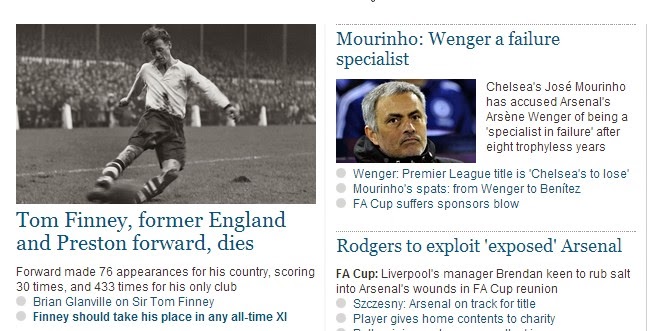
Mourinho - all that Finney was not

I once read a quote which I liked – not about football but about teaching. It said  “Kids don't remember what you try to teach them. They remember what you are.”  I’m sure that is right. I look back and can remember little of what I was taught at school or what I studied for at exam time - but boy, can I remember the teachers who influenced me for good or ill: Mr Seed, Mrs Barge, Mr Williams, Mr Parkin, Mr Sharples, Dr McEwan, Mr Wolstenholme, Miss Bolton, Jack Balmer, Bill Middlebrook, Mr Calderbank........ I can remember their inspirations, their idiosyncrasies, their kindness, the way in which some of them instilled fear or pride, their humour, their anger when things went wrong, their praise when things went right, their enthusiasms, their insight or apparent cleverness, their advice, and so the list goes on. They are what I remember, not the exam scores, not the certificates passed and now long lost, not the educational successes and failures of  myself and the friends who were once important to me.  And in sport it is the same, people will long remember the game or the person or the event, but the actual score or the competition will slowly slide into oblivion.

Finney's autograph - so often collected and swapped with
friends for other stars of the day
In that context two of this weekend’s comments about Finney are supremely apposite. One from Bobby Charlton, the player who perhaps, more than any other, took over Finney’s mantle as the supreme footballer and sportsman of the nation. On hearing of Finney’s passing Charlton commented that his one abiding memory of his (Charlton’s) England debut was that  "He [Finney] passed to me ......and I had never been so proud”. And Dave Whelan, now owner and Chairman of Wigan Athletic, described Finney as the perfect gentleman. He went on to explain that as the opening match to every season Blackburn used to play Preston in a pre-season game ( I remember them well!). “It was my first match back after two and a half years following a broken leg and I would be marking Finney the finest player there has ever been. He never took me on at all. I took the ball off him three times in the first half and when we were coming off I went to him and said: ‘Tom, you’re not taking me on.’ I’d played against him before and I knew he was, a phenomenal footballer. He said: ‘You’ve had some bad luck, son, and I’m not going to take you on, I want you to get through today’s game and get back into the first team.’  I’ll never forget him saying that to me. He was a total gentleman.”

There’s more to football, sport and life than winning and silverware but I do not think Jose Mourinho could understand Charlton’s or Whelan’s comments or Finney’s response to Whelan. When his time comes Mourinho will not be mourned as is Finney today. Mourinho’s medals and cups are just statistics, they are not of the stuff of legend and of great sportsmen. Finney was loved in his time and is mourned greatly at his passing because of what he was and what he represented. Jose Mourinho, unfortunately, will not be mourned and loved in the same way - his successes, such as they might be will simply be statistics on a page becoming increasingly dusty and irrelevant as the years pass. In fifty years time people will, say "Jose Who"? In listening to the man I am reminded of the old saying "An empty bucket makes the most noise".

The teams at Deepdale on the day following  Finney's death  paying
 their respects. Each Preston player has Finney's name on his back
I'm reminded also of two quotes from the famous American football coach Vince Lombardi - a man so committed to winning that he has become the icon of competitive sport. But even Lombardi knew there was more to life, sporting or otherwise, than just winning silverware:"You show me  a man who belittles another and I will show you a man who is not a leader. You show me a man who who is not charitable, who has no respect for the dignity of another, is not loyal and I will show you a man who is not a leader". Finney knew how to be a leader, he ticked every one of Lombardi's boxes; Mourinho hasn't a clue. And secondly, "After all the cheers have died down and the stadium is empty. After the headlines have been written and you are back in the quiet of your room with the championship cup in the drawer then the enduring thing is how you played the game and the dedication of doing the best that you could........" Sir Tom Finney understood this well, he let his skills, his sportsmanship and his humanity and humility talk for him. He played the game - both of football and life - supremely well.  Mourinho and others of his ilk - Alex Ferguson, John Terry, Luis Suarez, and the rest simply rattle their empty buckets in public.


24 January, 2014

"War is Peace"

A report from the Ministry of Defence this week suggests that military chiefs are worried because, they argue, the changing ethnic makeup of British society is negatively influencing the willingness of the electorate to approve of military action in various parts of the world. The Guardian reported this as follows:

“A growing reluctance in an increasingly multicultural Britain to see UK troops deployed on the ground in future operations abroad is influencing the next two strategic defence reviews, according to senior figures at the Ministry of Defence. As well as a general feeling of war weariness, sources say they have sensed a resistance in an increasingly diverse nation to see British troops deployed in countries from which UK citizens, or their families, once came.

The MoD is still taking stock of the surprise decision of the House of Commons last summer to reject military intervention to punish President Assad of Syria for the use of chemical weapons against rebel forces. Senior figures believe the rejection of that action was not just the by-product of a political battle between Labour and the government, but revealed deeper-seated long-term trends in British society.”

This report comes hard on the heels of the comments last week by Robert Gates the former US defence secretary who suggested that British military capability has been dangerously eroded because of government defence cuts, with the result that the UK was no longer in a position to be a “full-spectrum” defence partner of the United States.

As I thought about all this a number of things flashed briefly into my mind.

I thought first of a small incident in Canterbury Cathedral last week. As Pat and I walked around this majestic building that encompasses so much of our nation’s history I noticed a marble plaque on the wall. The plaque was a memorial to a long dead soldier from the Canterbury area. He had died in action in Afghanistan in the late nineteenth century. Only that morning I had watched the TV news and heard a report of more military casualties in that country and I muttered to Pat, as we stood in the Cathedral, “Nothing changes -  over a century later and we are still fighting in that part of the world – haven’t we learned anything?”  I assume that the soldier concerned was fighting a war that he felt was worth dying for – but I wonder if his views would have changed if he had known that over a century later his modern colleagues would still be giving their lives in that same region? And how would he feel – indeed, how do the parents of those killed in the present conflict feel - when they hear that the government is now talking of pulling out, the outcome of the war unresolved - because it is politically expedient, votes are at stake and the electorate is wearying of it. It leaves one to ask “What was all that  all about then?” or “What were we doing there in the first place?” or, more pointedly, “What did my son die for when we can now walk away from it as easily as we walked into it?”  It all seemed a good idea at the time to dance to George Bush’s tune and descend, gung-ho, into that far region – it no longer now seems to be so attractive.

The second thing that came into my mind as I read the report was simply to silently cheer. Just maybe, if the report is correct I thought, public opinion will limit the mindless sabre rattling of not only ours but the world’s leaders. Sadly, however, I don’t believe for one minute that that will be the end result for as I silently cheered I also heard the poignant and cutting Pete Seeger song “Where have all the flowers gone.....?” and its depressing refrain “When will they ever learn......?”  We have never learned the lessons of war and there is no likelihood of it happening now. We cannot, for there at too many vested interests. But, having said that, if Robert Gates’ analysis and MOD report are correct then I, for one, am delighted.

It may well be that the ethnic composition of our population is indeed increasingly having an effect upon our actions as a nation – I certainly hope so. But I also hope that it is perhaps more widespread than that. Apart from my lifelong belief that I do not, nor does anyone else have, the moral authority to intentionally take another’s life I would be very reluctant to support any military action against another nation for one simple but compelling reason. Having visited many other nations in my time I find that the ordinary people of other nations are, on the whole, pretty much like those in this country. In writing this I am reminded of the comment by the French seventeenth century philosopher and mathematician Pascal: “Can anything be stupider than that a man has the right to kill me, or I him, because he lives on the other side of a river and his ruler has a quarrel with mine, though I have not quarrelled with him?”

It is politicians, big business and monarchs who make war, not ordinary people – they are too concerned with the everyday problem of ordinary life. Unlike, perhaps, previous generations we do not now, I believe, view “foreigners” as a threat, for they are not entirely unknown to us. In nineteenth century England Napoleon Bonaparte was used to frighten children as “the bogeyman”, in 1914 the ordinary man could be fed propaganda and posters depicting the German as a terrifying monster - for in those days the "evil Hun" was as much a mystery to the ordinary man as a Martian alien might be to us - it was unknown and to be feared.  I do not believe that the same thing would work so easily today for today we have travelled, we have seen other countries and their  peoples and we know that the Frenchman and the German, the Russian and the American, the Indian and the Chinese are just ordinary people as we are.  Why on earth would I want to bomb India or France or America or Australia or Italy or Germany...........?  All that I have received when I have visited these, and many other places, is kindness and the knowledge that their peoples have the same hopes, fears, aspirations, prejudices and ambitions as myself. So, if a more multicultural society and a society that is more aware because of foreign holidays, TV programmes and contact with people of other nations can rid our country of jingoistic tendencies and influence government action then “it’s a jolly good thing” say I.

All this should give me heart for the future. Sadly it doesn't and I reluctantly fear that Pascal’s comment from four centuries ago will still not have sunk into the consciousness of men and, more importantly, their leaders even if we wait another millennia.

In this centenary year for the outbreak of the Great War it is worth remembering that that conflict grew out of a multitude of factors – political alliances, national greed, the twisted minds and ambitions of various monarchs (many of them related!), the drum thumping of jingoistic politicians out to make a name for themselves, the opportunism of big business and capitalism and, most of all, the military minds of Europe. They all played their part to make war inevitable. The price, however, was paid not, by the the kings, queens, business leaders, generals and politicians but by the ordinary people of the warring nations. It was them that gave their lives in their millions and in the years after the war suffered the inevitable consequences of lost loved ones, life destroying injuries and economic hardship whilst monarchs, free wheeling business men, the swaggering generals and opportunist politicians enjoyed the parties, the glamour and the good life of the roaring twenties . Today is no different – conflict in the Middle East, in Afghanistan and in every other part of the world is still rooted in the actions of some or all of these groups but it is the ordinary soldier or civilian who suffers. We might dress it up to make it more palatable and sellable to the electorate by calling it a war for the nebulous notion of democracy but in reality, just as in 1914, it is about the desire for power, wealth and greed – be it for oil, land or simply influence – by the few at the top.

The MOD report records the disturbing suggestion from military that future conflicts may not involve troops on the ground – because, it hints, the electorate would find this an anathema. A greater use of “air and naval activity”  is suggested. In other words, another, less controversial way will be found to kill people. We can already see this occurring as unmanned drones are used to target villages and personnel from thousands of miles away. This sterilisation of war is a frightening, unwelcome but inevitable development. It is a move to make war and killing acceptable to those at home since it seems targeted and has fewer emotional implications. It brings fewer moral repercussions since it is not face to face fighting with all that that brings. It can be easily forgotten about, it is largely hidden from the public gaze, someone else is doing it - it’s not it in my backyard! It makes war little more than a deadly video game – a modern equivalent of the attitude that permeated the military top brass in 1914 that it was all a game, an extension of the playing fields of Eton.

The military cannot refute war and all the machinery of conflict. Even if we reached the point of perfect world harmony they would still make a case for the military – just as in Orwell’s 1984”  where perpetual  war was the status quo and history re-written and a policy of “double think” enacted on the populace to justify it. So too, today, the lives and careers of the military depend upon conflict. A population that increasingly rejects it is not what they want. War is the raison d’être of the military. Without war there are no fine uniforms, jangling medals and silly hats to wear, there are no illustrious careers and fine statues erected to people like Bomber Harris, there is no reason for strutting about in glorious parades or for the officers’ parade ground bullying which is dressed up as the instilling of discipline. War, sadly, will continue as some technological game, unseen by the majority just as in 1984  it was fought on the  arctic wastelands and deserts of the world. No soldiers will return in body bags from Afghanistan to upset the electorate, no soldiers will return, as in 1914, with their tales of horror. But generals, admirals and air commodores will play their games, justify their industry and tell us how a fine army is essential if we are to keep our place in the world. Men in deep hidden rooms will, without any moral compunction and over their cups of coffee, press buttons and guide drones that will obliterate people thousands of miles away. The terror of the battlefield may, increasingly, be a thing of the past but this sterile and deadly silent war will continue whilst on the side lines the hi-tec producers of armaments, the jingoistic politicians, the corporate businessmen, the royal families and the high ranking military, all of them anxious for a share of the spoils, will nod in approval as, just as in 1984  they tell us they are making the world “free”.  

Much as I would like to believe that the Ministry of Defence report heralds the end to war I sadly conclude that we simply have a situation now that George Orwell would have recognised all too well when he used the slogan “War is Peace”. Just as in 1984  our leaders today cannot and will not allow there to be no war or for the military machinery to be dismantled for if they do then they are redundant - it would be like turkeys voting for Christmas.


20 January, 2014

Dickens in Broadstairs

Last week Pat and I spent a lovely few days in Kent – the garden of England as it is often called - visiting friends and relations and generally enjoying that part of the world.

The house that was Dickens' inspiration for the
home of Miss Betsy Trotwood in David Copperfield
On Saturday we meandered along the Kentish coastline stopping off at the various seaside resorts for a walk around and a bit of fresh air. It was very fresh, a bright day but with a blustery and chilly wind blowing! At lunchtime we found ourselves at Broadstairs - a place that I had never visited before and which was a joy. A traditional resort with spectacular views across the town and the sea and a very pleasant atmosphere. We parked the car on the Esplanade overlooking the sea and walked back into the town centre to look for lunch.

Outside the Royal Albion Hotel
The short walk back to the town was pleasant, indeed, and as we made our way we were reminded of Broadstairs’ past and its links with the great English writer Charles Dickens. Dickens first visited Broadstairs when he was about twenty five – he was already famous having written ‘The Pickwick Papers’ – and over the remainder of his life spent extensive periods in the town. As we walked we passed a house, now a museum, which, we were informed had been the inspiration for the house of Miss Betsy Trotwood in Dickens’ “David Copperfield” – the first book by Dickens that I ever read. As we stood outside the house words from my teenage reading of Copperfield leapt out at me: “Barkis is willing” the famous message that Barkis gives to David to pass on to Peggotty, the maid of David’s mother. It took me back to reading the book a life time ago. And, then, a few minutes later we were standing outside the Royal Albion Hotel looking at the lunchtime menu. At the side of the door was a plaque informing us that the Royal Albion had been a favourite spot for Dickens – he had visited it many times on his visits and indeed had written part of the great novel “Nicholas Nickleby” whilst
there.

As we sat in the hotel enjoying our warming bowl of soup and tasty sandwich it had clearly changed much from Dickens’ day. I’m sure that he would found it very strange but he would, too, have recognised the range of people all enjoying the atmosphere, the drink and the food. No doubt he could have penned some penetrating words that got to the very essence of the place and the people frequenting it!

As we sat in the hotel bar enjoying our lunch I looked around me. Here we were in a place once frequented by one of the world’s very great writers and who had sat, perhaps, in the very spot where I was sitting, as he enjoyed a drink or a meal and perhaps wrote a few words of one of the works that would define the English language and the nation. As I gazed at the walls there were posters decorating them – not about Dickens - but humble Southern Railway advertisements from a past era and they perversely reminded me of  something Pat that had read out to me at breakfast time. It was an item from her newspaper about the university town of Cambridge – one of the world’s great academic centres. 

The poster that caught my eye
Apparently there has been considerable dispute in the town because the town council has, in its infinite wisdom, decided to abandon the use of apostrophes in street names and places. So, for example, St Paul’s Court will be in future known as St Pauls Court or Christ’s College on Christ’s Lane will henceforth be known as Christs College on Christs Lane. The move has rightly been branded “deplorable” and condemned as “pandering to the lowest denominator”, by many in the ancient city. The reason and justification given by the council is that they are following government directives and that the use of apostrophes can be confusing and potentially dangerous in this age of technology. I assume by that they mean that a misplaced apostrophe might cause (say) and emergency services vehicle to go to the wrong place. Mmmmm?
And another - not only advertising
 but teaching a bit of history

I thought about this dumbing down as I read one of the Southern Rail posters in the bar. We were implored in the poster to use the train to come to “Sunny Broadstairs”. And how was the place described on this humble advert from yesteryear? Broadstairs, we were delightfully advised, was “The Children’s Elysium”. Oh, how Dickens would have enjoyed that – maybe he wrote it! I can almost hear Dickens saying it as he described a journey to Broadstairs......... “we travelled through the Kentish fields to that children’s Elysium, Broadstairs.....”  “Elysium” – a place of perfect happiness and contentment, the Elysian Fields of Greek mythology. “Elysium”- a place where the righteous and the heroic can live a blessed and happy life indulging in whatever they enjoy! And the poster showed that, too, with groups of children all happily digging in the seaside sand, doing what children do on  a beach. What a wonderful use of language, what pictures it conjures up – the language of Dickens and Shakespeare all combined into one simple railway advert.

What hope for children's spelling?
Companies spend billions advertising
 their products. It clearly sells beans -
but it also sells poor spelling and a
lack of respect for words to
young minds.
But it all begs a question. Would we ever see a word like “Elysium” used on a poster today? When was the last time that you heard or saw that word, or similar, used on the latest TV commercial? Do we need any further evidence that our language has been dumbed down? The poster (and others) that I peered at as I sipped my soup reminded me of the assassination of the English language that has been carried out throughout the UK in recent years. Basic punctuation such as apostrophes are banned or simply forgotten, companies are allowed to incorrectly spell words as part of their advertising (think  Vodafone or the truly awful ToysRus with the R reversed) or a personal anathema - computer driven mail that is composed in such a way that all the conventions of letter writing are abandoned. I can’t count the number of times that I have contacted companies who have sent me letters addressed to Dear Mr Tony Beale to explain why this is incorrect and is there no-one at their company aware of the conventions of letter writing? The really worrying thing is that they appear incapable of understanding my point. All in the name of progress, technology or increasing company profits! Of course, companies like Heinz will assert that when they spell beans as beanz they are using the creative nature of language and that they are encouraging people to interact with language. They will tell you that their advertising is not powerful enough to influence people in how they spell and use words. This is arrant nonsense - "creativity" has absolutely nothing to do the quality and correctness of an item, skill or idea. And,  having spent forty plus years in a classroom it is easy to spot how children (and indeed adults) are influenced by what they see around them. From the earliest days children and later adults model themselves upon the norms of the day - they wear the clothes that are in fashion, pick up on the gestures, modes of speech, outlooks of the pop star or the film icon. In a school they reflect the mores, organisations and outlooks of that school, indeed, of the individual classroom or teacher. It is easy to spot, for example the children who are in the class of a "noisy" teacher, or a disorganised teacher, or a quiet teacher or an aggressive teacher - the class will all too often develop those same characteristics. It is just the same with language - set a good example and the rest will largely follow. If society doesn't care about punctuation or the quality of language then we should not be at all surprised that we increasingly turn out generations who are less bothered about it. An epidemic of ignorance is fast developing in the UK - and, I suspect, in the USA too - all because we are increasingly uncaring or dismissive of the value of correct prose, punctuation, vocabulary or speech.

"Dyslexia rules K.O!"
Don't blame teachers for poor literacy skills in
children - blame society's couldn't care less attitude
 and the philistine approach of  big business towards
the written and spoken word.

I reflected on the situation in Cambridge. Two of the great addresses in Cambridge, indeed the world, are those that relate to two of the very great colleges King’s and Queens’ Both have an possessive apostrophe, but placed differently and for good purpose. King’s College was that college founded by King Henry VI in 1441 and so is singular since there was only one king involved - it was his college.  Queens’, on the other hand, was founded by Henry’s wife Margaret of Anjou in 1448 and was re-founded in 1465 by Elizabeth Woodville the wife of Edward IV. Thus, two Queens were involved and so Queens’ is plural - two queens have "ownership" of it and the possessive apostrophe is placed differently. Some may say this is unimportant or pedantic – presumably the local council in Cambridge would take this line – but it is crucial. The correctly placed apostrophe is critical to the history of the establishment and it is upon such details of punctuation that great and precise language is based. Dickens would have recognised that. To reject the apostrophe in the manner that Cambridge Council have done demeans the history and the language of the nation. We and Cambridge City Council should be ashamed as we allow our language and indeed our cultural/historical heritage to be trivialised and butchered in this way.
The Fort House - Dickens' favourite, his "airy nest"

And, having had lunch we meandered back along the Esplanade to find our car. Looking out over the sea. I stopped to take a photograph of the town and in the distance standing above the other houses was a distinctive property – Fort House. Dickens spent many holidays at Fort House and it was there, above the harbour, in that "airy nest", as he called it, that he wrote David Copperfield. The house was owned by a captain of one of the two coastal forts guarding Broadstairs and has for many years been called Bleak House – many suggest that it gave Dickens the idea for “Bleak House” in his great novel of the same name. That may not be true but what can be certain is that the house held a special attraction for him and was the residence he "most desired" in Broadstairs, his “most favourite” of watering places". Our little trip to Broadstairs had left us with very much the same feeling.
Looking back over Broadstairs - the Fort house
on the distant headland

Finally, as we drove out of Broadstairs we spied something else which left me a little sad and, I believe, says much about our modern world and our values. We passed a large school, a secondary school and the name of the school? - "The Charles Dickens School". It is surely right that the local school is named after the great man. But then we noticed something else. In common with most secondary schools in the UK it has developed  specialisms. In the case of the Charles Dickens School, the specialisms that it has developed, worked towards and promotes are maths and computing! How sad and perverse that in the town so much loved, visited and used by Dickens that English is not the developed specialism. I would have thought it almost an imperative to recognise and sponsor this in the local school. Maybe it's a reflection of the age in which we live where computing and the needs of the gradgrind, number crunching accountant take preference over the literary and cultural life and education of the nation. It's perhaps not inappropriate to reflect that  Dickens named the notorious headmaster in "Hard Times" Thomas Gradgrind - a fierce man and the ultimate utilitarian with no time for things of beauty or culture and who dedicated his life to the pursuit of profitable enterprise. Clearly, Thomas Gradgrind is a metaphor for modern Britain where we are constantly told that we need schools today that specialise in the real world - maths and computing and the like - not airy-fairy places that encourage literature, music or art and where children are taught and encouraged  to use words such as "Elysium"!


07 January, 2014

A Twitch on the Thread.

Phil (left) and Don Everly
This morning’s (Monday Jan 6th 2014) Guardian has two half page obituaries – for Phil Everly of the Everly Brothers and for Eusébio da Silva Ferreira more famously known  as Eusébio the great Portuguese soccer player.  It is a sad start to 2014 and in my view a small link with a better and simpler time has been broken. When I heard of these two deaths over the weekend it was a “twitch on the thread” recalling my own teenage years of the late 50s and mid 60s when Phil & Don Everly and Eusébio were not only household names but inspirational to a whole generation and beyond.

As I read of Phil Everly’s death on Saturday I immediately thought back to my own teenage years – at the time when the Everly Brothers were at the height of their fame. They are inextricably linked with my own past. When I was about 12 I got a job delivering newspapers and saved what I was paid so that after a few weeks I could buy a fishing rod and some basic fishing equipment. I can still remember the day when I went to Mr Seed’s hardware shop just down the road from where I lived in Preston to buy my fishing gear. The weeks of that summer and several years after that were filled with endless (and usually totally fruitless) trips to the River Ribble in Preston or to the Lancaster Canal in the hope of catching some super fish. Despite my lack of angling success I still recall those days with love. 
Eusébio in full flight

But as I became a little older I began saving again – this time for a record player. All the teenagers of the late 50s and early 60s were getting them and I wanted one too. My auntie chipped in and when I was 15 I went to the local shop on New Hall Lane and I can remember paying what seemed at the time a huge amount of money - about £12 - for a Dansette Record Player. I carried it home and it sat for the next 4 or 5  years in the corner of our living room and was played to death – first with rock and roll from the Everly Brothers, Elvis Presley, Eddie Cochran, Buddy Holly and the rest and later with the early records of the Beatles. When I went off to teacher training college in 1965 my Dansette  went with me and sat in my room at college. It was part of my history and marked my changing life and musical tastes as the Beatles, the Stones, the Animals, the Beach Boys, Simon & Garfunkel, Bob Dylan, Joan Baez, the Walker Brothers took over from the Everlys, Buddy Holly, Brenda Lee, Chuck Berry and Eddie Cochran.
Exactly like my old Dansette

But it had a specific connection with the Everly Brothers.  On that first day when I bought the record player in 1960 I didn’t have a single record to play on it  so I went out and bought one. I walked into the record shop in Preston and paid, I think, 17/6 (about 85p), and came out the proud owner of the LP I had long wanted: The Fabulous Style of the Everly Brothers. In the months and years that followed as my record collection grew so too did my collection of Everly Brothers recordings – Ebony Eyes, Cathie’s Clown, Walk Right Back, Crying in the Rain............ . The Everly Brothers more than any other pop stars of the time summed up my teenage years. When I read of Phil Everly’s death at the weekend it seemed to me that just a small piece of my own life died with him. I’m sure that many of my age across the world will feel the same.

The sound of the Everly Brothers was unique and instantly recognisable. But it was the words too. Looking back from these early years of the 21st century they might sound twee and outdated to modern ears, but, as I commented to Pat yesterday as we listened to the old songs on our modern stereo system, “They don’t write songs like that anymore” . It is, perhaps, not an inappropriate social comment to observe that what the Everly’s sang about – young love, broken hearts, teenage hopes and fears in many ways moulded people of my generation. It told us how to behave and what to expect when setting out on the course of young love! I contrast this with today’s offerings – Lady Gaga, Miley Cyrus and the rest which send very different messages about lust, promiscuity and sex. And there is another aspect which the great Art Garfunkel referred to when he spoke about the Everly Brothers: “the brothers' harmonising taught me” said Garfunkel "that every syllable can shine......They were Kentucky guys with beautiful, perfect-pitch harmonies and great diction. All those vowels and consonants, those s's and t's, every one of them killed me....". He was not wrong – listen to the Everly’s (and indeed to other singers of that era like Buddy Holly or Brenda Lee) and even though to English ears we can recognise their American accent every word is clear, every syllable and consonant formed. The hidden message we were getting when we listened to them was reinforcing the importance of clarity of speech. Listen to the Platters sing one of their greats such as “Smoke Gets In Your Eyes”  and every word is beautifully formed and crystal clear – the grunting of rappers and pop stars  of today is largely indecipherable. 
The first record I ever bought

When Pat and I put on TV today we invariably put on the sub titles – especially if we are watching an American film or a British drama. We don’t need the sub titles because we are deaf but rather because it is so often impossible to understand what the actors are mumbling so poor is their diction. Of course, they might argue that this is “real speak” – they are  reflecting how society today speaks - but that seems to me to be a chicken and egg situation. If the great and the good, the celebrities and stars, the shakers and movers, the actors and the singers speak badly then what have we lesser mortals got to copy? As I have quoted in blogs before we have, as a society, become increasingly inarticulate and uncaring in our use of language and its resultant implication. Only this morning I received an e-mail which said: “Ill be sendin are letter soon”  Forget the missed apostrophe in “I’ll”, forget the missed “g” in “sending” but clearly the sender is unaware if the difference between “our” and “are” – or he doesn’t care. Whichever way there is an increasing lack of value placed up clear pronunciation, vocabulary and the written word. This inarticulacy then leads to a shortcoming of thought and has profound implications.  As Tony Judt so well said: "Poor expression belies poor thought. Confused words suggest confused ideas. There is now a glib popular articulacy based upon shoddy prose, speech and quality of argument and when words lose their integrity  then so do the ideas they express." The Everly Brothers were never guilty of this.  The legendary Nashville guitarist Chet Atkins was one of their earliest supporters."One thing that impressed me when I met those kids was that they were so intelligent," Atkins said - "Don and Phil used correct English and I just thought they were a cut above ... intellectually and educationally." The man is right.
Pat off to the end of term ball at
Christmas 1966 -with my Dansette
player just visible on the table!

The music from that time in the late 50s and early 60s was captivating for most of us because it was beyond our reach, heard in snatches on crackling  Radio Luxembourg or on a juke box in a cafe or, for increasing numbers of us, on our Dansette record players - that was what made it so precious. These sounds, which came mostly from across the Atlantic, were beguiling and slightly exotic. They spoke of a largely unknown and exciting world – far off America - and teenage years and young love - but we could all relate to it.  When the Everlys sang in their Kentucky “twang” “Whenever I want you all I have to do is dream.....”  or when Buddy Holly’s Tex-Mex music told us in his “...well, I guess it doesn’t matter anymore.....”  or Eddie Cochran’s mid western tongue promised us that “... there are three steps to heaven....”  we all imagined and dreamed and knew what it was about.  No doubt the quality of today's recordings are technically far superior, but at the time, and still today, I preferred to have music in my dreams, not in my face. To listen to the Everlys sing something like “Devoted to You” or "Crying in the Rain"  and be able to hear and understand the words sung and sentiments espoused with clarity and sincerity – even if the accent is from the mid-west or Texas or Kentucky – was part of our growing up. It was a kind of rite of passage on the way to adulthood.


The words and the sentiments were the important thing – no need for the obscene “twerking” of Miley Cyrus or the bizarre videos of Lady Gaga or the Neanderthal grunting of rappers or baseball capped youths – it was the words, the ideas, the thoughts and the musical harmonies that mattered.
The second LP I bought!

And, in the UK, it was the Dansette record player that made much of this possible. Dansette was the brainchild of a family long involved in the production of gramophones and radios. Morris Margolin had come to London in the 1920s – a refugee from Russia. He had established a small business in the East End selling gramophones and radios but it was not until the mid 1950s that things took off. His grandson Samuel was offered a new lightweight and compact record changing system from a company in Birmingham. Samuel saw the potential – the increasing interest in recorded “pop” in the post war years and especially the growing teenage culture and rock and roll music gave Samuel an idea.  The record changer could be easily fitted into a small suitcase size box with a speaker. Samuel travelled along the south coast of England visiting stores and shops to drum up trade. He was not wrong. The new record players sold like hot cakes – in 1952 you could have your own portable music machine for just £11 guineas. By the time I bought mine it had gone up a bit and there were several models to choose from – some with legs which were small pieces of furniture, others like mine which had a carrying handle and could be easily transported. And transported they were – to parties, to new homes, to youth clubs and in my case to a new life in Nottingham  when I went to teacher training college. Over those years the music changed; the Everly Brothers gave way to the Beatles, the Beach Boys and the Rolling Stones - but throughout my three years at college my Dansette was played and played and played and it all began with that first LP –The Fabulous Style of the Everly Brothers – the first record to play on my Dansette. And so, when I read of the death of Phil Everly, I was reminded of another oft quoted pop lyric: “The day the music died.........”

And the same thought would also apply to the other of today’s obituaries  - that of Eusébio. A wonderful football player,  a great sportsman and an even greater human being. Still regarded as one of the game’s true greats – he always features in the top ten and always near the top. Born in very humble circumstances in Mozambique he was spotted as a player with potential and enlisted by the great Portuguese side Benfica.  During his professional career, he scored 733 goals in 745 matches.

Eusébio on a Portuguese stamp
He helped the Portuguese national team reach third place at the 1966 World Cup, being the top goalscorer of the tournament with nine goals. He won the Ballon d'Or award in 1965 and was runner-up in 1962 and 1966. He played for Benfica for 15 years and is the team's all-time top scorer with 638 goals scored in 614 official games. There, he won eleven Portuguese League titles, five Taça de Portugal titles, a European Cup and helped them reach three European Cup finals. He was the European Cup top scorer in 1965, 1966 and 1968. He also won the  Primeira Liga top scorer award  a record seven times. He was the first ever player to win the European Golden Boot, in 1968, a feat he replicated in 1973.

Although well known before it was at the 1966 World Cup in England that made Eusébio part of football’s mythology. He was the competition’s top scorer but it was his great skills and his sportsmanship and demeanour that won the hearts of all that watched. The World Cup of 1966 was probably the first to receive TV coverage in the modern sense so millions throughout the world could see the games – and they took Eusébio to their hearts. Reading one of the obituaries today it was commented that England triumphed over Portugal in the World Cup because Eusébio was "nullified" by the English defender Nobby Stiles. There is truth in that but it only tells a small part of the story. Great player though Stiles was he was a destroyer rather than a skilled footballer - he spent the whole game in bringing Eusébio crashing to the floor with a number of tackles which today would  cause Stiles to be dismissed from the pitch. Those of us watching knew this was the case and accepted that it was the task Stiles had been given - to stop Eusébio using his great skills - but we were even more impressed by the reaction of the Portuguese. He never once retaliated, never once showed any dissent, never once complained, never once did his lip curl or his lips mouth the obscenities that are now part and parcel of the sportsman's common vocabulary. He simply got up of the floor, smiled and got on with the game - how different now is the world of Wayne Rooney, John Terry, Ashley Cole and the rest. And we all recognised that this was sportsmanship of the highest order and although we were pleased that Stiles' success in sticking to the game plan had worked we also knew that Eusébio was the long term winner. We all knew that Eusébio had shown Stiles up to be what he was - a ferocious brawling and unpleasant bulldog whose only way of winning was to resort to such tactics. Although England won the World Cup and players like Bobby Moore and Bobby Charlton were, and rightly, still are national heroes and treasures, it was the smiling, quietly spoken, hugely talented and humble Portuguese Eusébio that won hearts from the first kick of the Competition.
Scarves and flowers adorn his statue at the
Benfica stadium

Just as the Everly Brothers beguiled English teenagers with their promise of young love and teenage excitement, so too this unassuming but delightful and sporting black man had an air of mystery and enchantment. He was from a far off place – Mozambique – he was nicknamed the Black Panther and the Black Pearl.  His skills were awe inspiring – his shot so fierce he was said to be able to strike a ball harder than anyone in the world. His timing was perfection and as he could accelerate over a 100 yards in less than 11 seconds – even with a ball at his feet – so  he was as fast as a world class sprinter. Portugal finished third in the 1966 World Cup and as he left the pitch was seen to cry – I suspect everyone else, too, shed a silent tear with him.  Although we all wanted England to win we also wanted him to be a winner – he had been instinctively taken to the hearts of people across the world as a graceful, and charming sportsman.

Two years later Eusébio returned to England to play for Benfica against Manchester United in the final of the European Cup at Wembley. I remember the game well; Pat and I were by now engaged and we sat in the lounge at my landlady's where I lived in my last year at college to watch the game on her TV. It was the end of May 1968 and we were involved in final exams at the end of our teacher training course - we were about to enter the world of the classroom!   The score was 1 – 1, extra time was looming and then Eusébio broke through the United defence and powered down on goal. He unleashed a right foot pile driver which had goal written all over it. Somehow, however, the United keeper, Alex Stepney, got to the ball and stopped what was a certain match winner. Eusabio’s reaction? – to stand and applaud Stepney. One of the great footballing and sporting moments and something that was instantly recognised as such. There have been better saves in big matches, but there has never been a better reaction to a save. As the United goalkeeper made to throw the ball to a colleague, Eusébio, ran up to him and patted him on the back. It was a wonderful gesture. And Eusébio wasn’t done, as Stepney threw the bail upfield instead of tracking back to defend, the Portuguese forward stood there applauding him. Who was this man? He had done his bit. He had shown his appreciation, he had patted Stepney on the back. And now, just in case that was not a generous enough gesture he was clapping. This was serial sportsmanship – from a man of honour. Kenneth Wolstenholme, commentating, was as star-struck as anyone, ‘What a sportsman. Eusébio! When he could have won the match, to applaud Stepney like that!’ reported Wolstenholme, the doyen of football commentators. But it perhaps wasn’t so surprising to the millions that had watched Eusébio in the World Cup and had seen his progress at Benfica. It was just typical of a man who always played in the Corinthian spirit that, even at a critical moment of such an important match, he could still find time and the sportsmanship to put an arm around Stepney's shoulder to praise him for the save that in the end denied his club the victory. From that point on the game drifted away from Benfica and United ran out 4-1 winners. 


Nowadays football, as all sport, is shaped not by the sportsmanship and Corinthian ideals and beliefs of men like Eusébio but by conceited, unpleasant, grubby and inferior men. Eusébio’s own countrymen Jose Mourinho and Christian Ronaldo spring to mind as do England’s own foul mouthed thugs Wayne Rooney and John Terry. Sadly the list is endless.  When Eusébio at last retired he hinted at how his sport had changed. On his retirement in 1980 he became an ambassador for both Benfica and the Portugal team and although he remained enthusiastic about the prospects for football, especially in Africa, he felt that he had played during the sport’s greatest era, against players who, like him, had learned their skills in the streets with balls made from rolled-up socks or newspaper. “I respect the football of today,” he said, “but the football of my time was better. Football today is just commercial.” . In 1998, a panel of 100 experts assembled by FIFA named him in its International Football Hall of Fame as one of the sport's top 10 all-time greats. "Look, there are only two black people on the list: me and Pele," Eusébio said, "I regard that as a great responsibility because I am representing Africa and Portugal, my second homeland." Here was a man who cared and who wanted to project the best in himself, his sport, his club and his country. I far cry all this from today’s players.
The cortège passes in front of Benfica fans

And, for all those reasons,  smiling, sporting and skilful Eusébio da Silva Ferreira was loved and respected.  Although Portugal has produced many great players it is why today on the TV I have seen thousands turn up at the Benfica stadium to pay homage to the man and the footballer. His country has declared three days of national mourning to honour him. 

I wonder, will Wayne Rooney, John Terry, Miley Cyrus or Lady Gaga's passing in half a century be celebrated and marked with such affection and respect as was Eusébio's or Phil Everly's? We live today in a largely graceless and charmless world and too many of those who are in positions of power or influence are themselves both charmless and graceless and lacking in any real talent. Sadly, these people, be they celebrity cooks whose main skill appears to be the serial use of four letter words or the use of cocaine, footballers whose behaviour both on and off the pitch becomes more bizarre and offensive as each week passes, talentless pop stars whose actions and lyrics are both offensive and musically inept, public figures who have lost their ability to inspire and act in the public good. In short they are all the product of a media industry whose one criteria is commercialisation and money.

Eusébio and Phil Everly, were of a simpler time when talent meant something and when how you behaved, how you spoke, how you played, the what you said and how you projected yourself was of importance. Today's sportsmen rely upon power, athleticism, aggression and competitive instinct to win games. It has not always been thus - skill, grace, subtlety and sportsmanship were more the watchword in past ages. And in the world of entertainment the same is true; where once timing, use of the voice, thoughtful words and actions, harmony or simple musicality were the hallmark of a performer now it is largely "in your face" shallow or meaningless lyrics supported by video technology, obscene gesture and musical poverty that passes for entertainment. 
Outside the Benfica stadium. Will our current stars
get this send of in half a century - I think not for they
will not be loved as was Eusébio
When I heard the news and read the obituaries this weekend I thought back to those years of my life and remembered the people, places and events that were so important to me then - things which, although I perhaps didn't realise it at the time, became fundamental in making me what I am and what I believe in today.  So many of these are inextricably linked with the music and the football of the time - and especially with the Everlys, Buddy Holly, Eddie Cochran and with great players like Eusébio, Bobby Moore or Bobby Charlton. I cannot think of these heroes with out also thinking of personal friends - one or two of whom have already passed away - or Bolton Palais Dance Hall on a Saturday night, or happy hours watching my own football team Preston North End, or the three wonderful years I spent at teacher training college. "Memories", as the old song goes, "are made of this".  The passing of people like Phil Everly and Eusébio da Silva Ferreira  breaks another strand in that thread to a better time when although we might not have been so materially well off as today the world was, perhaps, a safer, more sincere, simpler, less cynical, more thoughtful and, I believe, pleasanter place.