Showing posts with label local history. Show all posts

03 July, 2011

‘I went down the Perimo on my bike last night, Sir.........’

The sun is shining and the first BBQ of the year beckons (late this year) – so I have fought of the temptation to produce another rant type blog! That may well appear in the next few days – there is much to make me angry! But for today, pleasanter things.
My first classroom - near to the 'Depot'!
I began my  teaching career in the village where I now live some 43 years ago. In those days of the late sixties the world seemed a much simpler place – and, certainly, schools and teaching were  very different  propositions to what they are today. My first class – it was an all boys junior school housed in the original 1870 'Board School' building on the Village Green -  had 43 ten year olds in it. There was a huge range of ability – from some outstandingly bright boys (I still have absolutely no doubts it was, in terms of ability, the brightest class I ever taught) to boys who really struggled. Many of the boys were from very old established village families, others the sons of professional people – especially lecturers at the near-by teacher training college. It was just the same picture at the village’s Junior Girls’ School where my wife to be also started her teaching career. Quite a few of those children that we taught are still village residents and now middle aged themselves – one of them is our painter and decorator another is the village builder. I suppose all villages are like this.

The 'Perimo' 

When I began teaching in the September of 1968 I quickly began to learn the 'language' of the boys. They played on the 'rec' (short for 'recreation ground'), They went down 'the lines' – the railway track that lead to the recently redundant village railway station – closed under the Beeching  axe  of the 60s . They went to 'fifty steps' – a bridge over the railway line that had fifty steps – 25 on each side – and lead to an area of woodlands and streams – a great adventure playground. It took me many weeks to work out and find out about these places  to understand what they were telling me when I asked what they had done over the weekend. But of all the places one that figured largest was 'the depot' and 'the perimeter'. – or 'perimo' as they called it.  Many of the boys had parents who worked at 'the depot' and the encircling 'perimeter road' was where they would ride their bikes at high speed -  a private road around 'the depot' where there was generally little traffic.
Inside the Depot

From the air
The 'Depot' lay on the edge of the village -  a huge area but, in fact, not very obvious. From the main road pretty invisible because of high trees  and accessible only via the 'perimeter' a road with a private road sign. The long, perfectly straight road was a military road and along its side ran the fence of the depot – high and topped with barbed wire. Very intimidating. Inside could be glimpsed rambling buildings, aircraft type hangars and the like. A set of double gates were always closed with men on guard. Whenever one walked past nothing seemed to be happening. No-one ever prevented the use by the public of the private perimeter road but the depot itself always looked slightly daunting and mysterious. Obviously people worked there – many of the boys' parents did -   but it was rare to see anyone inside apart for the security staff on the gate. The depot itself covered a vast area – to walk all the way round the perimeter road was a walk of several miles – it was an ideal place for someone to learn to drive – dead straight and with no other traffic and it was not unusual to see any number of learner drivers taking their first jerking drives along the road!
Government  'sale' adverts
 But once every few weeks the Depot – and indeed the village came to life. I  noticed this when I had been teaching about a month. The school lay on the road which lead to the Depot and one day I suddenly realised that this normally quiet toad was very busy – lorries, vans, cars and the like constantly rumbled past my classroom. This went on for several days and then all returned to quietness again. In the morning they were going in the direction of the depot and later in the day came back. What was going on? Of course, the boys soon told me – the Depot was having a sale! As the lorries and trucks rumbled past in the late afternoon it was very obvious – military equipment – army jeeps, great camouflaged items of unknown use and who knows what else was lying in the back of vans and lorries. The depot was an Ordinance Depot and had been so since the early years of the 2nd World War. Residents of the village had had no idea of the government plans - they were kept secret - but in December 1940 the plans were not secret anymore and an area south of the village  was levelled off & destroyed forever. Initially between 60,000 & 100,000 people were employed in the building process. Over 200 buildings were erected along with roads, paths & a branch line to Ruddington railway station. The local people could only speculate exactly what the site was going to be used for but consequences of war could not be ignored & acceptance set in for what was going to be a permanent fixture for nearly 41 years.
'Wanna buy a lorry?'

The site was divided into two parts, one used as the munitions factory & the other used to store supplies. Both areas were separated by fencing which also ran around the perimeter of the site. With its two underground reservoirs, a heating plant, a sewage plant, several generators  a telephone exchange two canteens, a surgery, a laundry, a bakery and a mortuary the depot was almost completely self sufficient. . The whole site employed several thousand people and  was under tight security with security staff working 24 hours a day, seven days a week.
Inside the depot today - the
Rushcliffe Country Park
At the end of the war the site was decommissioned and from that date used for auctioning redundant ex-military vehicles & equipment. It finally closed in 1983.  The auctions were known nationally & were held every eight weeks. Each auction lasted about a week & were so popular that they were advertised in the national press & dealers came from all over the country. It was often said  that you could buy anything from a tank to 50 million razor blades – all ex-government stock!
needs no explaining!
After the site closed the area seemed to lay redundant. I well remember this period – we had recently come to live in the village and had a dog and two small children. It was a popular walk with the dog to go round the perimeter – still surrounded by the high wire fence but to all intents and purposes unused. A kind of ghostly relic. And perhaps because of the air of mystery it was not unusual for stories to begin to circulate. At the height of the cold war when demonstrations such as those at Greenham Common were taking place there was a local concern as to exactly what the government might be ‘hiding’ at the depot. Although to all intents and purposes closed and derelict – was it? Or were cruise missiles and the like being stored there? All perhaps fanciful but none the less of local concern and myths circulated. Indeed, even when the site was eventually demolished there was the lingering suspicion that something nasty might still be lurking in the underground storage facilities! 
The 'Perimo' today and the
railway crossing where
Thomas the Tank Engine chugs
 each weekend!
What was less fanciful occurred in 1984 just after the depot finally closed its doors. This was the period of the miners’ strike against the Thatcher government and Nottinghamshire was a focal point in the dispute. Although Ruddington itself was not a mining village and was some way from those villages, which are largely in north Nottinghamshire, the depot was used to provide a base for the large numbers of police who were drafted into the area. I well remember at that time going for our regular Friday night drink in one of the local village pubs – usually a  quiet event – but for the period of the strike the village pubs were inundated with policemen from all over the country – especially the Met in London. Loud, aggressive, high on testosterone and alcohol. Loudly proclaiming how much money they were making 'on overtime' with the dispute and how they were going to knock sense into the miners the day afterwards. It was for me a bit of a turning point – I had until then been pretty 'middle of the road' but it suddenly made me realise that overall politics, politicians, the police and government are a pretty nasty combination.
The children's playground

But then in the early 90’s all changed. The decision was at last taken to dispose of the old Depot and to turn the whole area into a country park – the Rushcliffe Country Park. Work began in 1989 and the park was finally completed in 1993 at a cost of £3.5 million. It is a vast  open parkland  space covering approximately 210 acres.  The old Depot buildings were reduced to rubble and the rubble used to landscape the site. Almost 140,000 trees were planted & a 70,000 cu. metre lake created. Some areas were raised to provide a sense of rolling countryside. Several miles of paths, a car park, a railway heritage centre a wooded area, a children’s playground, a study centre, wood sculptures, a habitat to encourage a range of wildlife and a near-by business park.

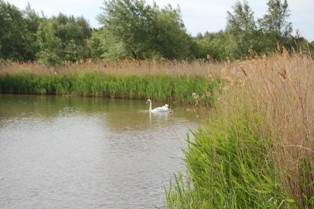
The swan family - rulers of the lake
The lake which is, I suppose the centre piece of the Park, is a haven for wild life – huge carp lurk beneath its surface and fishing is strictly forbidden. The edges are filled with a vast selection of ducks, moor hens and other water fowl. In the middle of the lake are tiny 'islands' where it is common to see birds sitting. On one of these a cormorant is often clearly visible standing like a statue, his wings outstretched as he dries them in the sun. Occasionally a heron might be spotted also standing perfectly still waiting for some movement on the surface heralding the sign of a small fish dinner! A family of swans have made the lake their home for many years and each year new families of cygnets are guided up and down the lake. They are clearly 'the rulers' of the lake - monarchs of all they survey. Indeed one of the memories that we have concerns the swans. We were walking around the lake on day when a dog jumped into the water. He swam out towards the swans and would take no notice of his owners’ calls to return. As he got nearer the swans the pen shepherded the cygnets away but the cob turned to face the dog who was by now well out of his depth. The cob did nothing until the dog approached. The poor dog was by now tired and, I guess, completely disorientated and the swan calmly swam up to him and forced the dog’s head under water - clearly intent on drowning this threat to his family. Crowds on the bank watched in horror. The dog’s owners were, of course, distraught. As the dog bobbed to the surface the cob backed off. Again the dog approached – low in the water, clearly exhausted and again it was forced under by the swan. When it emerged again the dog - I think by pure chance – found itself facing away from the swans and began to paddle in the opposite direction. Fortunately this was in the direction of the bank and the horrified owners. It was several minutes later before a very bedraggled dog, clearly exhausted and distressed, shambled up onto the bank. Its owners quickly put on its lead! Many parts of the Park are 'lead free' areas – around the lake is not one of them and the owners should have known better. I suspect they would not make the same error again.
In the bleak mid winter -
the frozen lake
 
The Country Park has, without a doubt, changed the face of the village. Instead of the forbidding old Depot we have a bright, 'useful' and enjoyable Country Park from which not only villagers benefit  but also people from a very wide area. Special events are regularly held – charity marathons and the like – indeed as I walked to my newsagents this morning the village was filled with road signs directing visitors to a 'special event' being held at the Park – a 'Rush4health Day'  to promote a healthy life style within the  Rushcliffe area. As I sit in my back garden this afternoon writing this blog I can vaguely hear in the distance an announcer speaking through a loud speaker to the people at the 'Rush4health Day' and every few minutes I can hear the sound of a steam train chugging along blowing its whistle – clearly the visitors are enjoying 'Thomas the Tank Engine' at the Heritage Railway! Many hundreds, perhaps thousands will be enjoying a day out.
Below the waters
huge carp lurk

The railway line and sidings
in the old depot - still in use by
 the Heritage Railway
It is easy to criticise government and local authorities such as Nottinghamshire County Council – indeed, I do it with great regularity and increasing venom. But in this case, Notts County Council, Rushcliffe Borough Council and the village’s own Parish Council have much to be proud of. But above all this the staff who work the country park are superb  -  it is rare for my wife and I not to make some comment as we walk around about some new wood sculpture, some thoughtful planting, the way that different areas of the park have a different 'feel'. Indeed this morning, as we walked we commented that a piece of fencing that had lain unfinished for a few days had been nicely finished off.  A new path had been laid and the fencing was obviously the last piece of the 'jig saw' – and this morning it was complete – and this is one of the joys – the Park is so well maintained by its staff, many of whom are volunteers.

One of the wonderful wood sculptures
For me one of the 'beauties' of the Park is that it is uncommercialised. There is a small refreshment kiosk near the children’s playground which seems to be open at the weekend and where an ice cream or a cup of tea can be purchased but there are no burger bars or gift shops or amusement arcades and the like – it is simply a place to come and enjoy for what it is.    In some areas you might be in some remote part of the countryside miles from anywhere and surrounded by tall grasses, but within a few minutes’ walk you might see a great stretch of open  parkland in front of you filled with Sunday afternoon visitors many of whom have brought garden chairs and a picnic! The list is endless – and that is probably its reason for success – there is something for everyone. A young family can come to enjoy the playground, look at the swans, play football on the grass and it doesn’t cost a thing unless they decide to splash out and buy  an ice cream. Equally, the dog walker can enjoy a quiet stroll and the serious walker has plenty of opportunities to stretch his or her limbs and stride out all day if they wish. For my wife and I, we can set off from our home and have  a 'short walk' around what we call 'the bottom path' and cover about a mile and a half and be back home for coffee in half an hour – as we did this morning. Or, if we are feeling fit we can go 'round the loop' and past the lake and over the railways lines –and come back rather exhausted having covered about three miles. Or, if we are feeling supremely fit (not so often these days!) we can go down the railway lines as well and this will mean a walk of about four miles by the time we get home. And we can do it in high summer or on Christmas Day – all for free! So much more useful and less intimidating than the old, ghostly 'Depot' – and in my book certainly much more use to mankind than a munitions dump! A few weeks ago we walked through the Park and over the railway bridge. We gazed down on the lines and sidings. In the distance were the railway sheds and the rolling stock, now used and maintained by the Heritage Railway Trust and manned by local enthusiasts. This branch line had been built to service the original war time Depot and it suddenly made me realise how easy it would have been for the military to transport anything in or out of the Depot without anyone knowing both during and after the war. The cynic and conspiracy theorist in me reflected on how little we know of what might go on under our very noses. Perhaps cruise missiles did indeed lay stored under the Depot - I wonder if they were all removed!
And another
Who would think you were only
 minutes from a busy village centre

A few years ago the local history society (http://www.ruddington-history.org.uk)  produced a wonderful book called 'From Bombs to Butterflies' to tell the story of the Depot and the Park – fascinating reading and a fascinating glimpse into local history and the place that a small Nottinghamshire village had in the war effort.


06 June, 2011

"You need to know where you’ve been to know where you are at the present and to plan where you should go next."

In  a recent blog fellow blogger John Evans  quoted Henry Ford: "I don't know much about history, and I wouldn't give a nickle for all the history in the world. History is more or less bunk. It is a tradition. We want to live in the present, and the only history that is worth a tinker's damn is the history we make today".  John  countered Ford’s blinkered view of the world  with that of American author/historian  David McCullough who said "A nation that forgets its past can function no better than an individual with amnesia".

School gates in Eyam - 'Ring a ring a roses...'
For many years now the history curriculum in schools has been a bit of a battle ground.  Government  initiatives, a constantly changing national curriculum, curriculum ‘squeeze’ as more and more subjects claim a place in the classroom, different perceptions and beliefs as to what constitutes 'history' and sadly,  perhaps a falling off of interest in the young who want to be in the present rather than in the past' These have all combined to increasingly marginalise the subject. Confusion about what constitutes history is not a new phenomena. I was recently watching the DVD of Vera Brittain’s autobiography 'Testament of Youth' – a book I love. I was reminded of Vera’s horror in her Oxford interview in the early years of the twentieth century. She was disappointed and angry to discover that 'Modern History' (which she hoped to study)was not at all 'modern' - it was actually the study of times that ended at least half a century before!


Simon de Montfort,
 Earl of Leicester
 - on his tomb it says
'Pioneer of representative
government'
History’s  marginalisation is sad for I have so often, over the years, wondered how people with little historical perspective, knowledge or understanding make sense of the world. Last week my wife and I had a day in Derbyshire and stopped in Eyam . How could you possible understand Eyam if you did not have at least some knowledge of the seventeenth century and the great plague. As you walk past the primary school in the centre of the village, for example, the lovely gates are decorated with metal figures and writing – the words of 'Ring a ring a roses....'    With no knowledge of history the significance of this would be completely lost on you. They would be simply pretty gates for kiddies showing a nursery rhyme! If you watch a film such as one of my favourites 'Once Upon a Time in America' – it would be impossible to get full value for money unless you were aware of the history and background of prohibition in the US. If you watch the Prime Minister speaking in Westminster  your viewing and understanding will I believe be diminished if you don’t know a little of how our Parliament works and how it came to be so. I often drive through Leicester and pass the De Montfort Hall and the De Montfort University - I wonder how many others pass them  by and never know the great historical significance the name has not only for Leicester and our own country but for democracies all over the world?

Of course, thousands with no historical knowledge of seventeenth century history will visit Eyam and will just see and enjoy a picture postcard village – but they will have missed its whole point. Millions perhaps will watch 'Once Upon a Time in America' and simply enjoy a violent gangster movie. And a large portion of the population will watch the state  opening of Parliament each year and see only  a quaint bit of theatre when the door to the House of Commons is slammed in Black Rod’s face and he  hammers on the door to call the members to listen to the monarch.

Nye Bevan - found the  way forward
by looking back!
For if you don’t 'know' any history you have no basis, perspective or context  in which to place the things that you see or hear. Everything, therefore,  must be experienced at a very superficial level because there is little or no other understanding. And that, it seems to me, is not only crucial but typifies much of the modern world – the emphasis upon the obvious, the instantaneous and the present  which brings with it a shallowness because there are few reference points upon which to base  judgements or to explain what you have seen or heard or experienced.  I am aware this sounds a bit like the grumblings of a grumpy old man – well, I suppose it is. But I firmly believe that one of the problems that we have as a society  at all levels – political, the media, the world of music or science or economics or any other facet you care to mention - is the lack of context and history. The headline grabbing newspapers, political spin,  celebrity culture, fashion are all  things of the moment - instantly consumed and even more quickly forgotten. "Today’s headlines are tomorrows fish and chip papers"  someone once said – very true.   And, because it is true it allows things of little moment -  like New Labour - to suddenly blossom, achieve star status but then  fade into disrepute with even greater speed as its short comings are realised. It allows someone like Tony Blair to be heralded as the salvation of the world and yet a year or two little to be despised and derided. It allows people to become famous overnight for perhaps rather dubious qualities but, like Hans Christian Anderson’s  Emperor in his new clothes to soon be seen as "naked as the day he was born"! It allows a government policy to be hyped and promoted as the panacea for society’s ills but a few weeks a later to be recognised for what it really is – an ill thought out 'quick fix'. Or to put it another  way, how can I judge if a book is 'good' if I have never read others? How can I know that an opera singer is good or bad if I have nothing to compare him or her with? With no history or context it is easy for the poor, the bad or the worthless to be accepted as good or worthy or of value - because people don't know any better.

But history gives a context. It perhaps allows us to make more valid judgements because of the perspective it gives us.  It is not about dwelling in the past but in using the experience and knowledge of the past and its people and events to understand our modern world and its problems. It allows us to make sounder judgements as to the worth of a policy or a person.  A  good example could be seen in this morning’s Guardian where economics editor Larry Elliott put forward the hypothesis that America’s economic problems reflected the problems that have beset former great empires in their death throes:  "America" said Elliott "in 2011 is Rome in 200AD or Britain on the eve of the first world war: an empire at the zenith of its power but with cracks beginning to show". He went on to say: "The experience of both Rome and Britain suggests that it is hard to stop the rot once it has set in, so here are the a few of the warning signs of trouble ahead: military overstretch, a widening gulf between rich and poor, a hollowed-out economy, citizens using debt to live beyond their means, and once-effective policies no longer working. The high levels of violent crime, epidemic of obesity, addiction to pornography and excessive use of energy may be telling us something: the US is in an advanced state of cultural decadence" Now I don’t know if Elliott is correct – although having argued the same point myself in a number of contributions to the Guardian over the past few  months - I am tempted to agree with his premise. What can’t be disputed, however, is that a knowledge of history allows him to make this judgement.
The steel mills and mines of Ebbw Vale which
gave Bevan his bearings

The whole point of what I am trying to say was summed up beautifully by Michael Foot the Labour politician. Foot,  government minister, leader, orator and former Labour  MP for Ebbw Vale,  often related a story about the great Nye Bevan who had been the Labour MP for Ebbw Vale  prior to Foot. Bevan 'the father of the National Health Service'  often went for walks in the hills above the town and sometimes got lost in the mist (some of it caused by  the vast  steel and mining industries of the area). "When I got lost" said Bevan "I would look back to the town and see the glow from the furnaces and the pit heads sticking up through the mist. This allowed me to work out where I was and where I needed to go next. You need to know where you’ve been to know where you are at the present and to plan where you should go next. When I’d got my bearings I could stride on."


History isn’t just about looking back it’s about knowing where to go in the future.

Stalin like Mao and others
 got rid of historians
  to develop his totalitarian state
It is also worth saying that a study of civilisations soon reveals that another sign of decline  and the rise of totalitarian regimes (think Stalin, think Mao, think Hitler and many more) is that history has become 'old hat', historians ridiculed, and then history is re-written. George Orwell recognised this when he wrote his prophetic 'Ninteen Eighty Four'. To deny history is to deny civilisation - and when a society marginalises its history - be it a great civilisation or a tiny remote tribe - it is in great danger of losing its soul, its character, its raison d'etre. It becomes a vacuum and into that space steps something else.

It is a great sadness to me that history has suffered a bad press in recent years and is so under threat in our schools. The study of history, be it a knowledge of great events or people , be it a study of the movements and trends that have influenced peoples, be it political or social or economic history should, in my view, be one of the few compulsory subjects for it is one of the bastions of civilisation that not only gives people a context for the world – so that they can enjoy a film or a visit to a pleasant village like Eyam – but it is also one of the major ways in which our democracy and society can be protected from those ideas and people that would overturn it.  


02 February, 2011

Historical Facts!

Bradgate Park, Leicestershire
My wife has just been reading the Village Newsletter, produced by the Parish Council. It mentions that the long retired village blacksmith, Oliver Blood, is 85. The Bloods are a family with long historical connections with the village and indeed the family have documentation recording a 'trip' to America (I suppose it was called the colonies then) in 1648. I’m not sure the word 'trip' would rightly describe such an adventure in those days – it must have felt like they were stepping off the edge of the world! Thinking of the long association that the Bloods have in our village it makes me realise that Oliver’s long ago ancestors  probably knew James Peacock, one of the subjects of my blog yesterday.

This set me thinking. A week or two ago, our esteemed Secretary for Education – Michael Gove – announced that children need to learn 'more facts' in schools. They should study 'history' in an ordered narrative of historical facts. The educational world in England has been here many times before over recent years, as each successive Education Secretary has had another dream and the following morning made it education policy. I have no problem with Mr Gove liking his facts but I do object to him foisting them on the rest of us and on schools in particular. The problem is, of course, what are the facts we should know? Who selects them? What is a useful fact to know and what not? Judging from Mr Gove’s other utterings we can probably safely assume that his facts are to do with dates of battles won, Kings crowned and the like. This is all jolly exciting – cavaliers and roundheads, knights in shining armour and the like. But exciting and glamorous though it might be I’m not sure it is as important as the things that actually impinge on people’s lives or that have formed the world in which everyday people live. Don’t get me wrong – I love facts, I love the great canvas and pageant of history. But there are other meaningful things for children to study in schools and better ways to approach their learning of these facts.

The ruins of Bradgate House
- birthplace of lady Jane Grey
Oliver Blood’s family history explains much of why our village is like it is. James Peacock’s life (see yesterday’s bog) still affects the village today three centuries after his death. Jesse Boot and William  Booth (see yesterday’s blog) have greater permanence and resonance in Nottingham than 'the great fire of London' or analysing the causes of the first world war. Of course the two areas – local and national history are inextricably linked, but it seems to me that good history teaching starts (as all good teaching starts) with what you know or are aware of and not something abstract and far removed. The stone photographed in yesterday’s blog is a good example – commemorating James Peacock’s endowment to the village but at the same time recording by default the great 1870 Education Act which ultimately meant education for all.

When Pat and I got up this morning there was a weak winter sun, but the promise of a chilly but bright day (as it happens it hasn’t worked out, as I write this it is cheerless and bleak!). A trip out in the car and then  a walk seemed a good option and Bradgate Park on the outskirts of Leicester was the venue. By 10.15 we were parking the  car on one of the many car parks.

We have spent many, many happy hours at Bradgate over the years – summer picnics with the kids, dog walking, winter sledging, rock climbing – it’s a lovely place to visit. Mile after mile of open countryside, heathland, streams, deer, dry stone walls, rocky outcrops, forest land. It is beautifully maintained  by Leicester County Council and the National Trust.

Sheltering form a biting wind!
The Park has much history associated with it. In the 11th century the area was given by William the Conqueror to one Hugh de Grandmesnil as a reward for his assistance at the Battle of Hastings. Eventually it passed to the Grey family in the late 15th century and it stayed in their hands till 1928 when it eventually passed into the care of the Leicestershire community 'to be kept in perpetuity  and preserved in its natural state for the people of Leicestershire'. When the Grey family took over the land they built a house – Bradgate House – and it was there that Jane Grey was born. The famous 'Lady Jane Grey' known as the 'Nine Days’ Queen' was a grand-daughter of Henry VII and a cousin of Edward VI. When Edward died, aged only 15, in 1553 he nominated Jane as his successor in opposition to Edward’s half sisters Mary and Elizabeth. Four days later, she was proclaimed Queen but within days Mary had gathered an army and Jane was soon locked up in the Tower of London awaiting execution in February 1654 aged 16. Jane was no fool despite her early demise. She was regarded, perhaps as the most learned woman of her day and was skilled in several languages. And her execution was widely recorded as one of the great events of British history because of the bravery and demeanour she displayed right to the end. But, the rest, as they say, is history!
Bradgate

As Pat and I set off for our walk, we fought the elements – a breathtaking chill wind to struggle against – but eventually a mile or so down the path we reached the ruins of the Grey’s old house. Then it was back to the car, this time the wind behind us so easier. Despite the weather the Park was busy with other hardy souls – one couple in shorts! But in that short walk we had almost stepped back in time – links with William the Conqueror, with Henry VII, with Mary and ultimately Elizabeth 1st.   There were many other links. For example, when  William awarded the land to Hugh de Grandmesnil it was a hunting park – not just for pleasure. This was a training ground for Norman knights to  ride on horseback as they hunted and so practice  similar skills of balance, using their swords and spears etc. that they would need in battle. The same use was made of the New Forest in Hampshire.

All this from a chilly walk through the countryside – the whole spread of our national history put into a local context. A walk round my village would give another similar spread. No list of facts here. No analysis of cause and effect. But it starts from the known and then travels to the unknown.  Once you ask the question 'who did that ruined house belong to?' other questions and information becomes important. That’s history in context – not Mr Gove’s version of history as an abstraction.

In the Wheatsheaf Inn
But it didn’t end there. Cold and windswept we sought out a warming drink and a little way down the road stumbled on the Wheatsheaf Inn at Woodhouse Eaves. A typical beamed English pub -  a super place to take a foreign visitor. A warming cup of coffee and a sit by a roaring fire soon made us feel better. Of course, a historian would have fun with the pub sign showing the harvest sheaf – it’s an  instant entry to the study of farm labour in years gone and would eventually, perhaps, lead to some of Mr Gove’s facts when we got as far as thinking  about the profound changes that came to the English countryside with the coming of the Enclosure Acts  of the eighteenth and early nineteenth centuries.

But, oh dear – we appear to have come full circle as far as the news is concerned. The Enclosure Acts were the brainchild of Mr Gove’s  Tory predecessors . They enclosed the 'common land' and so removed it from the use of ordinary people. Now where have I heard that before............? Got it! In the news over the last few days. The government are planning to sell of great tracts of the nation’s woodland to private individuals – to make a few millions and save them the problem of employing all the people who currently manage the areas. Of course, the concern is that it will also mean large areas will no longer be available for the use of ordinary people – possibly places like Bradgate Park – the enclosure of the forests! Oh, why am I so cynical!

Loughborough Carillon
And so homeward bound.  The car heater on and the clouds gathering.  Not a lot of promise for a pleasant afternoon. On the way we passed through Loughborough. Filled with history, if you care to look.  Difficult to know where to start. But the obvious one is the fine history of bell manufacture. We passed within yards of the bell museum and in the distance I could see the carillon in the centre of the town. Bells have been made in Loughborough since the fourteenth century. Bells made here are used throughout the country and the world – as far as California and the Washington National Cathedral.  The largest bell in the world – 'Great Paul' – made the journey from Loughborough and hangs in Christopher Wren’s St Pauls Cathedral. Again linked with one of our nation’s great events – St Paul’s was built amid the destruction of Great Fire of London.

And, finally, a pleasant lunch at 'The Packe Arms' at Hoton – a pub which has become our 'local' (although it’s a few miles from Ruddington) and is named after the Packe family who lived in the nearby Prestwold Hall. Way back in 1653 Christopher Packe, a London  draper and a follower of Cromwell, purchased the manor of Prestwold and in 1654  he became Lord Mayor of London. This latter day Dick Whittington went to the House of Lords and from then onwards 'made his fortune'. His descendants lived at Prestwold Hall and one of them, Charles James Packe, was closely involved, amongst other things with the growth of the railways in the area. When the first railways were being established in the Loughborough area Packe worked closely with both George Stephenson (he of 'Rocket' fame) and Stephenson’s son Robert. One of the results was the line that passes close to Bradgate Park and which is now part of the Great Central Railway. He also renovated the local pub and in his memory the pub is known today as 'The Packe Arms'- and over the door are the initials 'CJP 1831'
The Packe Arms, Hoton
So a simple pub lunch, a walk in the country, a drive through a  local town generated lots of local history and at the same time so closely intertwined  with the great events and great names of our country – Wren, Fire of London, Henry Tudor, Lady Jane Grey, Elizabeth 1st,  Stephenson, the Rocket, the Enclosure Acts, William the Conqueror,  the industrialisation of the country, Cromwell.   A far cry this from lists of Kings and Queens, dates of battles,  and the facts so beloved by our Secretary for Education. In fact come to think of it why does he call himself Secretary for Education – what he proposes has nothing to do with education!  So much more sensible to start with the local than with Mr Gove’s shopping list of facts that he decides we should 'know'! But of course using local  starting points is not so easy to teach in the nice order and narrative that the government want. 'This year we’ll do the Tudors and next year we’ll do the Stuarts' doesn’t seem to fit when you’re using context and local history.

Close by Bradgate Park thunders the M1. Thousands daily hurtle along the motorway and pass this area of the east midlands without a thought that it has so many links with the nation’s past and its people and places have had so much impact on the great events of the nation. It doesn’t have the fame or the glamour of London, or Stratford, or Windsor or York or Canterbury. But it’s every bit as rich and important in the history of Britain. It just takes eyes to see and time to explore.
Lady Jane Grey's birthplace