Showing posts with label Ruddington. Show all posts

03 July, 2011

‘I went down the Perimo on my bike last night, Sir.........’

The sun is shining and the first BBQ of the year beckons (late this year) – so I have fought of the temptation to produce another rant type blog! That may well appear in the next few days – there is much to make me angry! But for today, pleasanter things.
My first classroom - near to the 'Depot'!
I began my  teaching career in the village where I now live some 43 years ago. In those days of the late sixties the world seemed a much simpler place – and, certainly, schools and teaching were  very different  propositions to what they are today. My first class – it was an all boys junior school housed in the original 1870 'Board School' building on the Village Green -  had 43 ten year olds in it. There was a huge range of ability – from some outstandingly bright boys (I still have absolutely no doubts it was, in terms of ability, the brightest class I ever taught) to boys who really struggled. Many of the boys were from very old established village families, others the sons of professional people – especially lecturers at the near-by teacher training college. It was just the same picture at the village’s Junior Girls’ School where my wife to be also started her teaching career. Quite a few of those children that we taught are still village residents and now middle aged themselves – one of them is our painter and decorator another is the village builder. I suppose all villages are like this.

The 'Perimo' 

When I began teaching in the September of 1968 I quickly began to learn the 'language' of the boys. They played on the 'rec' (short for 'recreation ground'), They went down 'the lines' – the railway track that lead to the recently redundant village railway station – closed under the Beeching  axe  of the 60s . They went to 'fifty steps' – a bridge over the railway line that had fifty steps – 25 on each side – and lead to an area of woodlands and streams – a great adventure playground. It took me many weeks to work out and find out about these places  to understand what they were telling me when I asked what they had done over the weekend. But of all the places one that figured largest was 'the depot' and 'the perimeter'. – or 'perimo' as they called it.  Many of the boys had parents who worked at 'the depot' and the encircling 'perimeter road' was where they would ride their bikes at high speed -  a private road around 'the depot' where there was generally little traffic.
Inside the Depot

From the air
The 'Depot' lay on the edge of the village -  a huge area but, in fact, not very obvious. From the main road pretty invisible because of high trees  and accessible only via the 'perimeter' a road with a private road sign. The long, perfectly straight road was a military road and along its side ran the fence of the depot – high and topped with barbed wire. Very intimidating. Inside could be glimpsed rambling buildings, aircraft type hangars and the like. A set of double gates were always closed with men on guard. Whenever one walked past nothing seemed to be happening. No-one ever prevented the use by the public of the private perimeter road but the depot itself always looked slightly daunting and mysterious. Obviously people worked there – many of the boys' parents did -   but it was rare to see anyone inside apart for the security staff on the gate. The depot itself covered a vast area – to walk all the way round the perimeter road was a walk of several miles – it was an ideal place for someone to learn to drive – dead straight and with no other traffic and it was not unusual to see any number of learner drivers taking their first jerking drives along the road!
Government  'sale' adverts
 But once every few weeks the Depot – and indeed the village came to life. I  noticed this when I had been teaching about a month. The school lay on the road which lead to the Depot and one day I suddenly realised that this normally quiet toad was very busy – lorries, vans, cars and the like constantly rumbled past my classroom. This went on for several days and then all returned to quietness again. In the morning they were going in the direction of the depot and later in the day came back. What was going on? Of course, the boys soon told me – the Depot was having a sale! As the lorries and trucks rumbled past in the late afternoon it was very obvious – military equipment – army jeeps, great camouflaged items of unknown use and who knows what else was lying in the back of vans and lorries. The depot was an Ordinance Depot and had been so since the early years of the 2nd World War. Residents of the village had had no idea of the government plans - they were kept secret - but in December 1940 the plans were not secret anymore and an area south of the village  was levelled off & destroyed forever. Initially between 60,000 & 100,000 people were employed in the building process. Over 200 buildings were erected along with roads, paths & a branch line to Ruddington railway station. The local people could only speculate exactly what the site was going to be used for but consequences of war could not be ignored & acceptance set in for what was going to be a permanent fixture for nearly 41 years.
'Wanna buy a lorry?'

The site was divided into two parts, one used as the munitions factory & the other used to store supplies. Both areas were separated by fencing which also ran around the perimeter of the site. With its two underground reservoirs, a heating plant, a sewage plant, several generators  a telephone exchange two canteens, a surgery, a laundry, a bakery and a mortuary the depot was almost completely self sufficient. . The whole site employed several thousand people and  was under tight security with security staff working 24 hours a day, seven days a week.
Inside the depot today - the
Rushcliffe Country Park
At the end of the war the site was decommissioned and from that date used for auctioning redundant ex-military vehicles & equipment. It finally closed in 1983.  The auctions were known nationally & were held every eight weeks. Each auction lasted about a week & were so popular that they were advertised in the national press & dealers came from all over the country. It was often said  that you could buy anything from a tank to 50 million razor blades – all ex-government stock!
needs no explaining!
After the site closed the area seemed to lay redundant. I well remember this period – we had recently come to live in the village and had a dog and two small children. It was a popular walk with the dog to go round the perimeter – still surrounded by the high wire fence but to all intents and purposes unused. A kind of ghostly relic. And perhaps because of the air of mystery it was not unusual for stories to begin to circulate. At the height of the cold war when demonstrations such as those at Greenham Common were taking place there was a local concern as to exactly what the government might be ‘hiding’ at the depot. Although to all intents and purposes closed and derelict – was it? Or were cruise missiles and the like being stored there? All perhaps fanciful but none the less of local concern and myths circulated. Indeed, even when the site was eventually demolished there was the lingering suspicion that something nasty might still be lurking in the underground storage facilities! 
The 'Perimo' today and the
railway crossing where
Thomas the Tank Engine chugs
 each weekend!
What was less fanciful occurred in 1984 just after the depot finally closed its doors. This was the period of the miners’ strike against the Thatcher government and Nottinghamshire was a focal point in the dispute. Although Ruddington itself was not a mining village and was some way from those villages, which are largely in north Nottinghamshire, the depot was used to provide a base for the large numbers of police who were drafted into the area. I well remember at that time going for our regular Friday night drink in one of the local village pubs – usually a  quiet event – but for the period of the strike the village pubs were inundated with policemen from all over the country – especially the Met in London. Loud, aggressive, high on testosterone and alcohol. Loudly proclaiming how much money they were making 'on overtime' with the dispute and how they were going to knock sense into the miners the day afterwards. It was for me a bit of a turning point – I had until then been pretty 'middle of the road' but it suddenly made me realise that overall politics, politicians, the police and government are a pretty nasty combination.
The children's playground

But then in the early 90’s all changed. The decision was at last taken to dispose of the old Depot and to turn the whole area into a country park – the Rushcliffe Country Park. Work began in 1989 and the park was finally completed in 1993 at a cost of £3.5 million. It is a vast  open parkland  space covering approximately 210 acres.  The old Depot buildings were reduced to rubble and the rubble used to landscape the site. Almost 140,000 trees were planted & a 70,000 cu. metre lake created. Some areas were raised to provide a sense of rolling countryside. Several miles of paths, a car park, a railway heritage centre a wooded area, a children’s playground, a study centre, wood sculptures, a habitat to encourage a range of wildlife and a near-by business park.

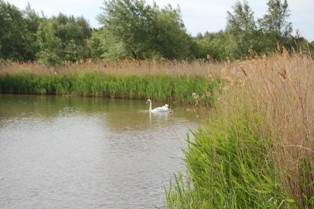
The swan family - rulers of the lake
The lake which is, I suppose the centre piece of the Park, is a haven for wild life – huge carp lurk beneath its surface and fishing is strictly forbidden. The edges are filled with a vast selection of ducks, moor hens and other water fowl. In the middle of the lake are tiny 'islands' where it is common to see birds sitting. On one of these a cormorant is often clearly visible standing like a statue, his wings outstretched as he dries them in the sun. Occasionally a heron might be spotted also standing perfectly still waiting for some movement on the surface heralding the sign of a small fish dinner! A family of swans have made the lake their home for many years and each year new families of cygnets are guided up and down the lake. They are clearly 'the rulers' of the lake - monarchs of all they survey. Indeed one of the memories that we have concerns the swans. We were walking around the lake on day when a dog jumped into the water. He swam out towards the swans and would take no notice of his owners’ calls to return. As he got nearer the swans the pen shepherded the cygnets away but the cob turned to face the dog who was by now well out of his depth. The cob did nothing until the dog approached. The poor dog was by now tired and, I guess, completely disorientated and the swan calmly swam up to him and forced the dog’s head under water - clearly intent on drowning this threat to his family. Crowds on the bank watched in horror. The dog’s owners were, of course, distraught. As the dog bobbed to the surface the cob backed off. Again the dog approached – low in the water, clearly exhausted and again it was forced under by the swan. When it emerged again the dog - I think by pure chance – found itself facing away from the swans and began to paddle in the opposite direction. Fortunately this was in the direction of the bank and the horrified owners. It was several minutes later before a very bedraggled dog, clearly exhausted and distressed, shambled up onto the bank. Its owners quickly put on its lead! Many parts of the Park are 'lead free' areas – around the lake is not one of them and the owners should have known better. I suspect they would not make the same error again.
In the bleak mid winter -
the frozen lake
 
The Country Park has, without a doubt, changed the face of the village. Instead of the forbidding old Depot we have a bright, 'useful' and enjoyable Country Park from which not only villagers benefit  but also people from a very wide area. Special events are regularly held – charity marathons and the like – indeed as I walked to my newsagents this morning the village was filled with road signs directing visitors to a 'special event' being held at the Park – a 'Rush4health Day'  to promote a healthy life style within the  Rushcliffe area. As I sit in my back garden this afternoon writing this blog I can vaguely hear in the distance an announcer speaking through a loud speaker to the people at the 'Rush4health Day' and every few minutes I can hear the sound of a steam train chugging along blowing its whistle – clearly the visitors are enjoying 'Thomas the Tank Engine' at the Heritage Railway! Many hundreds, perhaps thousands will be enjoying a day out.
Below the waters
huge carp lurk

The railway line and sidings
in the old depot - still in use by
 the Heritage Railway
It is easy to criticise government and local authorities such as Nottinghamshire County Council – indeed, I do it with great regularity and increasing venom. But in this case, Notts County Council, Rushcliffe Borough Council and the village’s own Parish Council have much to be proud of. But above all this the staff who work the country park are superb  -  it is rare for my wife and I not to make some comment as we walk around about some new wood sculpture, some thoughtful planting, the way that different areas of the park have a different 'feel'. Indeed this morning, as we walked we commented that a piece of fencing that had lain unfinished for a few days had been nicely finished off.  A new path had been laid and the fencing was obviously the last piece of the 'jig saw' – and this morning it was complete – and this is one of the joys – the Park is so well maintained by its staff, many of whom are volunteers.

One of the wonderful wood sculptures
For me one of the 'beauties' of the Park is that it is uncommercialised. There is a small refreshment kiosk near the children’s playground which seems to be open at the weekend and where an ice cream or a cup of tea can be purchased but there are no burger bars or gift shops or amusement arcades and the like – it is simply a place to come and enjoy for what it is.    In some areas you might be in some remote part of the countryside miles from anywhere and surrounded by tall grasses, but within a few minutes’ walk you might see a great stretch of open  parkland in front of you filled with Sunday afternoon visitors many of whom have brought garden chairs and a picnic! The list is endless – and that is probably its reason for success – there is something for everyone. A young family can come to enjoy the playground, look at the swans, play football on the grass and it doesn’t cost a thing unless they decide to splash out and buy  an ice cream. Equally, the dog walker can enjoy a quiet stroll and the serious walker has plenty of opportunities to stretch his or her limbs and stride out all day if they wish. For my wife and I, we can set off from our home and have  a 'short walk' around what we call 'the bottom path' and cover about a mile and a half and be back home for coffee in half an hour – as we did this morning. Or, if we are feeling fit we can go 'round the loop' and past the lake and over the railways lines –and come back rather exhausted having covered about three miles. Or, if we are feeling supremely fit (not so often these days!) we can go down the railway lines as well and this will mean a walk of about four miles by the time we get home. And we can do it in high summer or on Christmas Day – all for free! So much more useful and less intimidating than the old, ghostly 'Depot' – and in my book certainly much more use to mankind than a munitions dump! A few weeks ago we walked through the Park and over the railway bridge. We gazed down on the lines and sidings. In the distance were the railway sheds and the rolling stock, now used and maintained by the Heritage Railway Trust and manned by local enthusiasts. This branch line had been built to service the original war time Depot and it suddenly made me realise how easy it would have been for the military to transport anything in or out of the Depot without anyone knowing both during and after the war. The cynic and conspiracy theorist in me reflected on how little we know of what might go on under our very noses. Perhaps cruise missiles did indeed lay stored under the Depot - I wonder if they were all removed!
And another
Who would think you were only
 minutes from a busy village centre

A few years ago the local history society (http://www.ruddington-history.org.uk)  produced a wonderful book called 'From Bombs to Butterflies' to tell the story of the Depot and the Park – fascinating reading and a fascinating glimpse into local history and the place that a small Nottinghamshire village had in the war effort.


01 February, 2011

Lean and Mean

Tuesday morning. My wife, Pat, has gone off to work. She works one day a week in the office of a local primary school – the William Booth School, named after the founder of the Salvation Army who set up his first 'mission' yards away from where the school now stands. On her way she will pass over Trent Bridge and the site (now a hair dresser’s, I think) of the first chemist shop owned by Jesse Boot's father, John, where the now multinational business Boot’s started life. The school is also only a mile or so away from another primary school named after Jesse Boot – Jesse Boot Primary – to remind local town folk of the generosity and good deeds of the Boot family.

I thought about this over breakfast while I read the Guardian. Following a report yesterday that there had been a demonstration outside the Boot’s Chemist in Oxford Street, London. There were a number of letters from readers in the Guardian. The London demonstrators were highlighting the fact that Boots, a company born and bred in Nottingham, was reducing its tax burden by registering its office in Switzerland. The police broke up the demonstration by using tear gas – the first time, I understand that this method has been used to break up demonstrators in mainland Britain. This is, perhaps, a worrying sign of things to come as the government and big business continue their divisive 'get rich quick policies' that mean the rich get rich and the poor get poorer. The government’s claim that we are 'all in this together' has an increasingly hollow ring as the gap between the 'haves' and the 'have nots' widens in our society. I fear that there will be more demonstrations – and rightly so.

John Ralfe, the former head of corporate finance at Boots has calculated that, "the UK has lost about £100m a year in tax as a result" of the Boot’s tax loophole accountancy. Other national companies have followed and continue to follow the same route.

Last week, Pat and walked around the magnificent grounds of Nottingham University - one of our nation’s premier universities which has its roots firmly in the funding provided by Jesse Boot a century ago. I reflected on this too when I noticed, on my bookshelf at home my M.Ed thesis which I completed on a part time basis Nottingham University. I had, and have much, to be grateful for to Jesse Boot and his father John Boot. So too, have many people in Nottingham and so too have generations of students from all over the world who have come to this city to study.

James Peacock's philanthropy
still in evidence almost 400 years
 after his gift to the village
And, after breakfast, when Pat had gone to work I walked to the village to get the daily shopping. I passed the old school on the village green and noticed the inscribed stone in the brickwork. I read that this 'free school' had been built on the funding of James Peacock, a seventeenth century resident of the village who made his fortune in London but didn’t forget his roots. He provided an endowment so that the boys of the village could be educated. Even today, the endowment still purchases a dictionary and a Bible for all the 11 year olds leaving the school to go on to their secondary education. The school was, of course, taken over by the local school board with the coming of the great 1870 Education Act, but it was building on a foundation already laid in the village due to the generosity of James Peacock. As I continued my walk I passed near to the James Peacock Infant School - I could hear the children playing in the playground. And thinking about these things I began to wonder what is wrong with our society when multi-national companies are not fulfilling their obligations to the communities in which they grew up and operate and are making a fast buck by relocating to tax havens. They are not suffering – but society is.

I’m so pleased that Jesse Boot did not adopt the same position as his multinational successors. I’m so glad that James Peacock didn’t – doubly so, for I spent my first years of teaching in the school on the green – it paid my mortgage and kept my family. And when my own children went to the school they too benefitted from James Peacock’s community spirit, altruism, generosity and integrity.

I am not naive. Businessmen are in business to make a profit. That, I am, sure was just as true in the eighteenth and nineteenth centuries as it is now. But there are differences. Politicians now call for accountability – for example in schools or in the health service – and yet in the face of what is allegedly the worst recession in living memory they are unable or unwilling to clamp down on this massive tax evasion and make companies like Boot’s 'accountable'. It is the same with the pay and bonuses of bankers. Politicians are unwilling to bring them 'to account'. 'But', I hear Michael Gove say, 'we have many people queuing up to show their philanthropic zeal and fund academies.' Correction, to fund academies in order that they get a place in the House of Lords and thus gain privileged access to those in power. And the circle is squared when the politicians and those in power – Hoon, Blair, Mandelson, Smith et al leave politics for plush jobs in, or consultants to, the boardrooms of the multinationals. No, gone are the days when honest philanthropy was just that – it came with no strings attached. Gone are the days of ethical action. Gone are the days of altruism.

We are a rich country – but could be a little richer if those with the money and the power fulfilled their financial, moral and social responsibilities. If Boot’s and other companies paid their tax and if politicians ensured that they did then the national conscience would be a little easier. The straits would not be quite so dire if the billions of pounds given to the banks had been put directly into the economy to increase purchasing power rather than provide bonuses and bulging balance sheets for the banks.

Sadly, I do not completely blame the bankers or Boot’s or other similar companies. Given a similar situation most of us might have taken the same route – it’s called greed and is a fundamental part of the human condition. No, the blame lies with the inherent integrity and ethics of government and those in power who are unwilling to address the issue – why bite off the hand that feeds you? Our politicians are no longer the honourable people that we expect – they swim with the sharks. It lends a horrible truth to the latest ‘banker’ joke I heard: 'Why don’t sharks attack bankers? Answer: Professional courtesy!' We mock the Italians and Berlusconi – we are no different. Our prime minister, until last weekend, employed a man as his media advisor of undeniably questionable background and sees no reason to distance himself from the highly questionable people on the Oxfordshire Set (see previous blog!). Tony Blair, and even the virtuous Gordon Brown moved regularly in these circles. Peter Mandelson loved it – he had no shame in praising what he called ‘the filthy rich’. Our present government appoints a man to advise on cost cutting, (Philip Green) who gives barrow boys a bad name, a man who openly directs £1.2 billion into his wife’s bank account to save him from paying the due tax. The list is endless – the use by government (and within government) of people who you would never, in your right mind, buy a used car from, people who, in years past, would have been regarded with suspicion and called 'spivs' - is both breathtaking and depressing.

The old Endowed Boys' School
on Ruddington village green.
Thanks to James Peacock
No, we have sunk a long way in these early years of the 21st century. Jesse Boot’s and James Peacock’s altruism (and of others like – Joseph Rowntree or Robert Owen) laid the basis of the society we have today. It allowed people like me to 'make good'. To play a part in that society. To hopefully contribute to the future wealth and well being of that society. What we have in 2011 in our country is a wealthy and political class of mean minded sharp operators – plying their trade just within the boundaries of the law and with two life ambitions – to increase their bank balance and promote their advancement. And they do this with the blessing of those in power – of whatever political persuasion.

Of course, people like Boot, Owen, Rowntree and the like were just as interested in making a profit as the business leaders of today. But they went about it differently – and for a very good reason – they were the owners of their companies. They had a vested interest in its future and its continuing success, it was their company and their life’s work. So, they invested in the work force because they knew that happy, well fed, enthusiastic employees were also productive employees and that meant profits. It also meant, by default, that communities benefitted. In Nottingham, until a few years ago it was accepted that working for Boot’s was a definite 'plus'. Apart from any remuneration, security of job etc. there were perks. One of the most often quoted was that the company would fund night school class attendance for employees – it didn’t matter too much what they were studying, but they were studying. I can remember attending classes on car mechanics and hi-fi where a number of the other participants were funded by Boot’s. Jesse Boot knew that employees who want to improve themselves will also want to improve their work place and their company – and for Jesse Boot that equalled increasing profits for him. Joseph Rowntree and Robert Owen had the same philosophy - and they helped generate the wealth of the nation that we still enjoy today.

But now we have different business leaders. Our companies are not run by the men who own them and built them up. They are run by accountants and 'entrepreneurs' like Philip Green or Stuart Rose whose raison d’ĂŞtre is to make the business 'lean and mean'. To maximise immediate profit rather than ensure long term success. All that matters is the next balance sheet so that share prices will rise, the shareholders and stock market speculators will be happy as they cash in their 'chips' and they, the CEOs and the like will get their next bonus. After a year or so they move on or the company is gobbled up by someone bigger – but everyone is happy if that happens – bonuses all round and further rising share prices. Everyone’s a winner – except the ordinary worker, the local community. And in this culture, philanthropy and altruism have no place. There will be no legacy for future generations from Stuart Rose’s 'M & S' or Philip Green’s 'Top Shop'. It's a kind of quick fix, here today gone tomorrow capitalism and economics where long term development and the greater good has no place.

In his book '23 Things They Don’t tell You About Capitalism' (Chapter 2) Ha-Joon Chang makes this point well. He calls these people who now run businesses 'professional managers' and their incentive is increasingly the maximisation of profits by cutting costs – wages, development, job security measures and the like. In the very short term it works – in the longer term it doesn’t – but by that time the professional manager has moved on with his stock option bonus in his pocket. He had no long term allegiance to the company, its employees, its history, its community. And, of course, neither did its shareholders – they too have moved on. Against this background Boot’s decision to relocate to Switzerland to avoid paying tax makes absolute sense. Who wouldn’t do it? But as a nation we are the poorer. Tax is not paid and the nation and local communities miss out. Companies like Boot’s are indeed very lean and very, very mean.

Jesse Boot and James Peacock were men of Nottingham. We have a third famous son – Robin Hood. He allegedly proudly boasted that he robbed the rich to help the poor – I’m afraid he would have got short shrift in modern Britain. The likes of Philip Green, Michael Gove, David Cameron, Geoff Hoon, Jacqui Smith, Tony Blair, Peter Mandelson, Gordon Brown, George Osborne, Nick Clegg, Vince Cable – the list is endless – would, together with the bankers and the CEOs of companies like Boot’s, like so many latter day Sheriffs of Nottingham,  advise Robin of the error of his ways – 'No, no, no', they would proclaim, 'you’ve got it wrong - it’s rob the poor to help the rich!

And now – it’s mid afternoon. Pat will soon be home from work at William Booth Primary School. It’s just occurred to me that the awful irony of the whole situation is that if the descendents of Jesse Boot’s Trent Bridge Chemist shop, the modern Boot’s, and the CEOs of other tax evading companies, continue to get their way and walk away from their responsibilities towards the exchequer and ultimately the community then we will all be needing the support and ministrations of the descendents of William Booth – the Salvation Army to meet our daily needs for food and succour!