As the ferry
glided out of St Malo harbour at the end of last week I looked back at the
receding coastline of France. It was the end of a lovely holiday and although I
was ready to return to the reality of home – we had been away for almost three
weeks – my overwhelming feeling was of regret at leaving this wonderful country
and its people. For almost three weeks
we had meandered through the French landscape and its towns and villages. We
had sat on beaches on each of its three coastlines – the Mediterranean, the
Atlantic Coast and the English Channel. We had covered well over two thousand
miles as we journeyed along empty country lanes and speeding motorways, we had walked
around timeless villages, eaten wonderful meals, admired the quirkiness of French
life, gazed into village shop windows or walked around swish town centres where
French chic was so obvious, we had sat and enjoyed our jambon baguettes each
lunchtime and bedded down at night in a series of super B&Bs – and been lucky that for
the whole of our time there the sun shone.
 |
| Our wonderful B&B at Hendaye |
Every
country, I am sure has its problems – and the average Frenchman, I know, would
soon disabuse me of my few rose coloured views gathered in only three weeks of
sun, sand and sightseeing. But my overwhelming impression was of being in a
country that seemed, on the surface at least, to be largely at ease with
itself. There was a sense of continuity and tradition which in turn seemed to
engender a timeless atmosphere. Loud and noisy it was not – there appeared,
outwardly at least, to be certain gentleness where people made time to “stand
and stare” rather than the mad cap, busy, busy rush and bother atmosphere that
seems to permeate so much of our British way of life. As I reflected on many
occasions during the holiday one of the most obvious contrasts related to the
very beginning and the very end of our holiday.
 |
| Narbonne |
The day
before we left England we stopped off in Sussex – only a few miles across the
Channel from France – to attend a family function. It was a depressing overnight
stay in one of the resorts along that stretch of coastline: dismal streets, a
succession of bleak sad looking shops (which mostly appeared to be betting
shops, cheap bargain establishments and cheap booze shops), glum looking down
at the heel people and sea front hotels or once grand houses converted into dull
windowed, shabby flats and bed sits complete with wheelie bins, peeling paintwork and cracked tiles looking out across
the Channel. When we arrived at our hotel and pulled onto the tiny rear car
park an agitated receptionist rushed out and told us “You can’t park there – we
are having a delivery. You’ll have to park on the sea front.” We asked if we could just bring our bags in
to save having to carry them from some distant parking spot – this was reluctantly allowed
and then I did battle with the local one way system and set off to find a car
parking spot not too far from the hotel. It took one back to the oft portrayed
image of the English seaside resort of a bygone era – stern landladies, shared
toilets, a once a week bath in tepid water, badly cooked food and throughout it
all “kiss me quick” hats and sticks of rock trying to convince everyone that
they were having a good time. It was a depressing start to our holiday making
one feel that much of our nation has lost all pride in itself or its environment.
I don’t blame resort – I often get the same feeling here in Nottingham – but somehow
I expected more of a holiday venue. But in contrast, at the end of our holiday we
stayed for a few days near Dinard – just across the Channel from the English
coastline. What a difference – bright and well maintained building, smiling
people, shops which were a joy to wander round, a wonderful market and a sea
front to rival anywhere in the world. During one afternoon we wandered past a
wonderful fountain commemorating the author Jules Verne who had connections
with that part of the world. We sat at the end of lovely street leading down to
a secluded beach and then ate our evening meal in a sea front cafe where the
waiter practised his English as we practised our French. It was a far cry from
the depression of the English south coast only a few miles over the horizon
where, it seemed to me (as with much of the rest of today’s England) we
have, as a society, given up on national
and personal pride, where we are content that our towns and cities have become
hollow boarded up shells or concrete retail parks and where cheapness, bulging
wheelie bins and tat try to outdo each other as we race to the bottom. I am
tempted to agree with the old adage that it is not buildings that make slums
but people!
 |
| Carcassonne from the motorway |
But on to
brighter things.
Our ferry
trip to Santander in northern Spain was pleasant – and for the Bay of Biscay
tranquil! We stayed overnight in a splendid hotel right on the Santander beach
– and promised to return. Next day a meander along Spain’s northern coast, a visit
to the stunning Guggenheim Gallery of Modern Art in Bilbao and then on to the
French border where we put down roots for a couple of days at the lovely town
of Hendaye. No English resort this. Bright, cheery, spotlessly clean, a car
park to lift the heart and friendly smiling faces. We enjoyed the beach, ate at
an open air restaurant by the marina but best of all enjoyed the warm
hospitality of one of the best B&Bs we have ever stayed in. A beautiful
room with everything that anyone could possibly want (including a balcony
overlooking the garden) and jolly hosts who welcomed us warmly. They spoke
little or no English but between the four of us we got along famously. Madam’s breakfasts
were a treat to behold and enjoy while Monsieur would race out when we returned
home each evening to ensure that I was able to park the car safely on his drive.
Nothing was too much trouble and as we left we promised to recommend their home
to any others coming their way. We will return to Hendaye – it’s not one of the
big names of the area. No St Jean-de-Luz, San Sebastian or Biarritz this – we
had no great expectations of the place – but it is a real jewel; gentle,
picturesque, homely and welcoming. In short it is right up there in the list of
wonderful places we have visited on the planet.
 |
| Narbonne Plage |
From Hendaye
we travelled along the base of the Pyrenees stopping off along the way when the
fancy took us. We parked in Pau and bought coffee and baguettes for lunch and
then enjoyed the splendour of Pau’s Boulevard des Pyrenees – looking out over
the distant mountains from the city walls and from the beautiful and
beautifully maintained Chateau de Pau. After Pau we meandered through the
Pyrenean landscape and finally came to rest for the night in a remote village
B&B at Mancioux. Next morning we made our way towards Carcassonne. We
enjoyed coffee in the lovely working market town of Auterive with its
delightful market by the side of the river - and by lunch were sitting enjoying
our baguettes on a motorway Aire looking down on Carcassonne. Surely few motorway stopping points anywhere
in the world can enjoy such a view as this one. A French family – several generations
plus two dogs - squashed onto the picnic table at the side of ours took out
their table cloths and set out a meal fit for a king – making our baguettes and
orange juice seem paltry! Only the silver candlesticks seemed to be missing! The
French know how to do a picnic!
 |
| Hendaye Plage |
And by mid
afternoon we were sitting in the sun by the side of the Canal du Midi at our
destination Argens-Minervois – a small village in the heart of the Minervois
area which would be our base for the next few days as we explored the region.
The beautiful city of Narbonne was a joy, Narbonne Plage - beautiful but very
hot, Carcossonne everything that we hoped for and more – imposing, majestic and
sensitively and beautifully maintained.
The tiny villages and hamlets of the Minervois silent and serene in the
late summer sun and the landscape timeless and beautiful. An ex-colleague of
mine who retired to the Minervois region said to me that she has to keep
reminding herself that “this isn’t a holiday and she actually lives there” – having
been I can understand that feeling. We travelled along the Mediterranean coast
and back into Spain stopping off at resorts like Port Vendres and each evening
returned to Argens to eat outdoors on the banks of the Canal du Midi.
And then it
was on the road again – to stay with friends at Villeneuve-sur-Lot for a few
days. The great river Lot runs at the
bottom of their garden and we sat in soaring temperatures seeking shade under
the trees. Villeneuve is a homely working market town –– but pretty and, as
always, beautifully maintained. As with all the places we visited one sensed a
pride in the area. The bridge over the river brightly decorated with hanging
baskets gave views down the river reminding us of the Arno in Florence as the backs of ancient houses hung over the waters. The
many ancient buildings witness to the age of the town. Our friends took us to
visit the village of Pujols overlooking Villeneuve. This really was picture
postcard stuff – almost too pretty to take in. We sat enjoying a coffee under
the flowers and sun of the market square before heading back home to the shade
and lunch.
After Villeneuve
it was off on the road again – this time to La Rochelle, a place we had long
wanted to visit. En route we stopped at a supermarket to stock up on items and
buy petrol. We laughed with surprise when we saw the row of commercial washing
machines at the entrance all spinning round doing the washing of French
families as they shopped in the supermarket. Since by this time we had a boot
full of dirty washing it passed our minds to strip off and get all our washing
done as we walked naked round the store! Maybe that was one step too far – we
would not have wanted to break the Anglo – French entente cordiale or cause a
diplomatic incident! As we ran up towards La Rochelle we travelled for mile
after mile through the great vineyards of the Bordeaux region stretching to the
horizon almost as far as the eye could see.
We had so often only previously seen these as names on wine bottles in
our supermarkets but now we were seeing where the contents of those bottles had
originated! We stopped for lunch on the coast at Blaye and sat under the chateau
walls to enjoy our lunch and then in mid-afternoon enjoyed a walk around
another gem, Talmont – a village set amongst the mud flats and oyster beds
which looked as if it had been there providing the French with their beloved
fruits-de-mer since the beginning of
time. As we drove along the edge of the great Gironde estuary – one of the
great waterways and estuaries of the world - I was reminded of the great but tragic
story of the Second World War Cockleshell Heroes (see blog: http://arbeale.blogspot.co.uk/2011/07/wooden-ships-and-iron-men.html) and thought about these brave men
paddling their little canoes through those dark waters as they made their way
at night to the port of Bordeaux to attack the German fleet. Perhaps we actually
passed one of the fields where the men lay in the day time hidden from the
watching eyes of German sentries. Like so many places in France it is history
made real – but more of that later!
 |
| Throw on another steak! |
And so we
arrived – not at La Rochelle but at Fouras a little resort south of the city.
We knew nothing of Fouras but thought that it sounded a pleasant spot to base
ourselves for a few days and not so expensive as La Rochelle itself. Wow – what
a surprise, it was wonderful! A superb B&B and the resort truly stunning.
Each morning we ate breakfast at Madam’s bulging table so beautifully laid out
with delicious food that it seemed a crime to spoil her hard work in setting it
out for us. A wonderful fortress looking
out over the estuary, a superb beach, the town market an absolute joy, a good selection of cafes and
restaurants and lovely quiet streets and beautiful houses . Would we ever want to
leave? – we didn’t! Indeed we have already said what a lovely holiday it would
make to spend a week or so in Hendaye and the same in Fouras – the perfect seaside break and
recipe for a relaxing and peaceful time.
We walked around nearby La Rochelle enjoying the busy atmosphere of the big
town and the French chic on display in the shops. We spent a lazy afternoon
when we crossed Le Pont de Re and the meandered around the Isle de Re and we spent yet another day wandering
the market of Fouras and in true tourist fashion having a ride on a little
train around the town and its environs. We enjoyed walking around the fortress,
watching the men play boules by the town’s bandstand and yes, sitting on the
beach - as Pat said at the time – her idea of
a perfect Sunday afternoon! Unlike our last view of England there were
no sea front hotels or houses here covered in peeling paintwork and cracked
tiles, no cheap booze shops or betting shops on every corner, everyone walked
around smiling and taking pride in themselves, their dress and their town. - No
one raced out to harangue us about where we parked – indeed the huge beach side
car park was completely free – and so pleasant was it that we sat and ate our
baguettes and read our books on the edge of the car park looking out over the
sea. And at the end of each day we ate in a busy restaurant where we were
greeted as old friends after the first night and the food was outstanding. A wonderful place is Fouras – we will return.
 |
| La Guinguette depicted in Renoir's painting - not toodissimilar from where we ate each night in Argens Minervois |
It was with
sadness that we left – to head north towards Dinan in Brittany. En route we stopped off at
Chateaubriand – another unspoilt and unexpected gem. We wondered almost, alone
through the silent ancient building and enjoyed a wonderful display of art
gathered by a past owner of the Chateau. So strong was the sense of history
that as we wondered the beautifully laid out gardens I fully expected a
Tartuffe or Moliere or Lully or some other character from France’s great past to leap out at
me from behind a bush or pillar. And then north to Brittany - an area we know
well and love.
The sun continued to shine (although a change in the weather was promised) and when
we arrived at our B&B close to the great river Rance we we
were the only two diners that night in a nearby restaurant overlooking the
river. Little boats bobbed up and down in the marina and for the first time
there was a slight chill in the air and the evening sky suddenly looked a
little autumnal. But we woke next morning to sunshine and spent a lovely day in
Dinard and its environs enjoying the sun, sand and sights. Dinard, a town that
can’t but evoke thoughts of Alfred Hitchcock – indeed his statue stands
resplendent on the sea front commemorating a past film festival held in the
town. But it is the great houses of Dinard that
remind one so much of the man and his horror film “Psycho”. Any one of the
houses could be named “Bates Motel” and as one walks along streets it can’t be
put out of the mind that a Norman Bates like character might lurk behind every
shutter! It is not “Psycho” that the Hitchcock statue commemorates – but his
other great horror film “The Birds”. Evil looking crows sit on his shoulder and
flutter around his head – wonderful. Dinard’s wonderful market ensured that our
car boot became even fuller with gifts for our grandchildren and at lunch we
sat in a little park high over the town and the sea eating our baguette and quiche
while enjoying a spectacular view and sea gulls hovered around us looking for
crumbs.
 |
| This plateful was just my starter at La Guinguette |
 |
| Chateaubriand - I expected Molierre to jump out and accost me or Louise XIV to stride down the garden! |
And so to
our last full day – a meander around the area revisiting places enjoyed in
years before: Combourg, Dol-de-Bretagne and Dinan. All three like so many of
the other places we had visited were steeped in history and preserving that
history so well. In Dol we sat outside a cafe enjoying a mid afternoon coffee
and noticed that the main street where we sat is named Rue Grande Rue des
Stuarts - called this because the Stuart dynasty that became the Kings of
England in the 17th century came from here. It evoked the same
feelings that I had had while in Carcassonne that our own English history is so
closely bound up with that of France. As
nations we have allied and fought but always respected and that it seems to me
is what a “special relationship” of any kind must be based upon – mutual
respect based upon a shared past (for good or ill) and awareness of our
differences as well as our similarities. This is not the fawning “special
relationship” that our politicians seems to want with the USA which is a
euphemism for simply doing America’s bidding. In Carcassone we had already been
reminded of the links between our country and the Medieval knight/warrior Simon
de Montfort. De Montfort was responsible for many of the religious atrocities
in the area in the early 13th century. He was the son of Robert de
Beaumont, Earl of Leicester which is a city just down the road from where I
live here in the UK. Two or three times a year Pat and I visit the Beaumont Leys shopping
centre on the outskirts of Leicester. Simon’s son, also called Simon de
Montfort, became the de facto King of
England following the rebellion against Henry III in 1265. In that capacity he called two famous Parliaments – one which stripped the King of unlimited
authority and one which admitted ordinary citizens as members of Parliament for
the first time – both huge steps towards the democracy that we and other
nations enjoy today. The local University in Leicester is the De Montfort
University. Yes, our countries are linked by a common heritage.
 |
| The fortress at Fouras |
Early next
morning we made the short drive to St Malo for our ferry home. As I said at the
top of this long blog I was ready to return home but not to leave France we
had, I think, even more grown to love its people, its countryside, its towns
and villages, its quirkiness, its traditions and its atmosphere.
And what are
my abiding memories and feelings?
 |
| Fouras Plage |
Firstly, I
think, the sense of tradition and links with the past that runs through French everyday life and culture. Strange this since it
was France with its great Revolution who heralded change was so instrumental in setting the parameters for our modern world - and yet
despite that the French, it seems to me, cling to their past with an admirable
reverence. This manifests itself in so many ways; whilst much of the culture
and art of France is progressive and about change and modernity (think the
Impressionists, think the music of Ravel or Debussy, think the writings of
people like Sartre, think French cinema, think generations of quirky French
cars like the Citroen 2CV or the DS19...........) their past is celebrated with a vengeance. There
can surely be no French village or town that does not have a Rue de Victor Hugo
or a Rue de Pasteur, their ancient buildings are maintained with pride. Where
we pull down great swathes of our cities to rebuild or throw down motorways the
French, it seems, largely renovate and renew. One of the most telling moments
for me was in the tiny and beautiful village of Caunes Minervois near to
Carcassonne. As we wondered around its silent streets at lunchtime, all the
houses shuttered giving no hint of whether they were empty or full of people we
felt intruders. We sat at the edge of the beautiful little car park (yes, I
choose the word “beautiful” carefully!)
and ate our baguettes looking down onto the sparkling little river. All along
the edge of the car park were delightful marble statues. The area is famed for
its red and pink marble mined there since Roman times and these lovely works of
art decorated the car park – not a sight we would see in England. The marble
from the town has been used through the length and breadth of France – most notably,
on the orders of the Sun King Louis XIV, at the Palace of Versailles and later
at the Paris Opera. And a few minutes later we sought shelter from the burning
sun under a great tree in the tiny market square – the Place de la Republique.
The sign by the tree informed us that it had been planted in 1792 – when the
revolution was at its height and the guillotine was doing its dreadful work!
Yes, the French have an affinity with, and pride in, their past – they do
history well. No child growing up in Caunes could be unaware of his country’s
heritage and his village’s past.
 |
| Marble statues at Caunes Minervois |
And their
heroes are many and varied. While every town and village has a Place de la
Republique and a Rue de Victor Hugo their street art also reflect the richness
not only of their history but culture. Unlike England there are
statues of people other than the warrior monarchs or stern faced politicians or sabre rattling generals that we in England seem to want to celebrate. Every town seems to have statues celebrating some
writer or artist or scientist. As we
approached Dinan we almost tired of seeing statues of the Romantic writer Francois
Rene Chateaubriand. Jules Verne, Alfred Hitchcock and a thousand others also
stood majestically on their plinths reminding French people of their cultural
heritage and of the important things of life. While enjoying the Ile de Re we
came across a memorial to one Nicolas Martiau who fled France (he was a
Huguenot) and eventually settled in Virginia with his wife. Martiau was the
great great grandfather of George Washington and a direct ancestor of our
present Queen Elizabeth II.
This sense
of tradition and cultural heritage links, too, it seems with everyday life –
the daily visit to the boulangerie, the aperitif taken in the local bar, the
way that at mid day towns and villages become silent as many shops close and
streets become deserted a thing which is repeated throughout the land and so it
goes on – it all gives a sense of continuity; this is how we do it in France,
it is part of our “Frenchness”, it is what we do and what we are, it has always
been thus. I often reflect that we have lost this in the UK where it
increasingly seems to me retail therapy and non-stop “doing” seems to leave us
little time to “stand and stare” or to enjoy and undertake traditional
activities. I’m sure that a French man or woman from a hundred years or more
ago if they returned would still find much to recognise and would not feel too
alien in modern France. I am not too sure that the same could be said of
England. Maybe I’m wrong but at an everyday level in England heritage seems to have been sacrificed in the name of
“progress”. True we have wonderful historical buildings and venues – York
Minster, the Tower of London, Stonehenge and a thousand more – but these it
seems to me are increasingly “theme park” tourist attractions rather than
everyday living parts of the community. In short the essence of France – its
history, its traditions and its culture – seem self evident and alive in
every community no matter how big or small – whereas in England we have
increasingly sidelined them in our lemming like quest to “do” , to live in the
fast lane and to be entertained rather than be involved.
 |
| 1792 - I was planted and I'm still giving shade and reminding all of France's past |
These things
all add up to the timelessness especially of French villages. We visited the
exquisite village of Lagrasse in the Carcassonne area one Saturday afternoon.
As we wondered around the medieval streets of the centre historique we passed a
wedding party, enjoyed a glass of orange in a wayside cafe, marvelled at the
old houses and wondered what tales each could tell. We looked into shop windows
and sat by the beautiful river watching youngsters enjoying an afternoon swim.
And we visited the beautiful working Abbey -
a gem of a place - where we were
welcomed by a smiling, gentle and helpful monk. We enjoyed the Abbey’s still
calm and beautiful architecture and wondered at the many devout monks and
worshippers who had trod its paths and buildings over the centuries. As we
walked along the river it occurred to me that this gem had lain hidden in the
hills and the forests for a millennia and although today modern day tourists
like us enjoy its delights people have been walking its streets and living its
life and its serenity for hundreds of years. Starbucks, Costa Coffee, Marks
& Spencer, McDonalds, John Lewis and other everyday occupants of great shopping
malls suddenly seemed all seemed a very long way away!
 |
| Lagrasse - serene and magical |
Angers
Minervois, where we stayed for a few days, was such another such place. On the
banks of the great Canal du Midi and the Aude the village rises on a small hill
overlooking the surrounding countryside. As each evening we walked through its
silent streets to the open air restaurant we passed a tiny bar – room only for
three or four people I thought. Often no one would be in there but when we
returned at 9.30 pm maybe just one or two locals were enjoying their
refreshments. They would mutter “Bonsoir” or “Bon Nuit” as we passed. As I
mentioned before shutters hide the residents of the houses so one is never
certain if the house is empty or full so all was silent and we whispered as we
walked along, afraid to break what seemed a magical spell.
And the
restaurant that we patronised – La Guinguette
– even I think by French standards is “different”. We were initially confused
by its name but then discovered that it means an open air (often cheap)
drinking or eating place – often by water. This described it completely – we
sat right on the edge of the Canal du Midi. Apparently these places had become
popular in France from the late 19th century – one is immortalised
in Renoir’s famous painting “Luncheon of the Boating Party”. A great open BBQ
dominated the place and a gentleman bearing a distinct resemblance to Asterix
the Gaul would occasionally disappear behind the scenes and emerge with huge
“lumps” of meat and half trees in equal measure – which he threw onto his
bonfire! And what came out at the end the biggest and tastiest steaks
imaginable. Pat selected lamb chops – she was looking for a small meal but it was frightening to think
of what size sheep it was that had sacrificed itself for her chops – never have such lamb chops been seen! On our
first night eating at La Guinguette the waiter gave us a menu in French - that
was fine but the English people occupying the table next to us were given an
English version. After a few minutes they asked for a French menu – they could
not understand the English! On the following evening we received an English
menu and hugely enjoyed reading the translations of French into English: Pat
quite fancied the “Pavement of Cod” which
seemed appetising but in the end opted for “Filet mignon (better part of pig)
with his sauce in honeys (sic) of scrublands (sic) and in almonds”. Wonderful -
who could resist such a dish! I ordered a starter - big mistake - it was so large that I swear it would have fed the whole of my family includng the grandchildren!
 |
| Port Vendres |
As everywhere
we went in France we enjoyed simple but good, wholesome food. I firmly believe
that good quality food does not need all the “additions” so beloved of many English restaurants – no need for a “Tex Mex
BBQ sauce” to liven up the taste buds or some piece of old cow - a
simple well cooked piece of fresh top quality meat or fish has all the taste
necessary. It was the same each day with our daily baguette or quiche – simple, fresh, good quality food which needed no embellishment to perk it up. And so too with a with a cup of coffee. On the odd occasions I go into somewhere like Costa
Coffee or Starbucks I am given a bucket of tasteless brown liquid – and to cover up
its inadequacies a youngster sprinkles chocolate in the shape of lips on the
top! In France it is a simple cup of coffee – with real taste and flavour –
served by a waiter or waitress who generally sees their job as a profession and
the customer as something to be valued. There are no chocolate flavoured lips
decorating the tasteless brew and it is not served by a disinterested youngster
sporting a shirt that tells me he or she is a “Barista” (am I supposed to be
impressed by this or is it just to explain
the role of these people in case I am unsure since the liquid served rarely resembles coffee?). In England we have been
taken over by the corporate image and increasingly know no better.
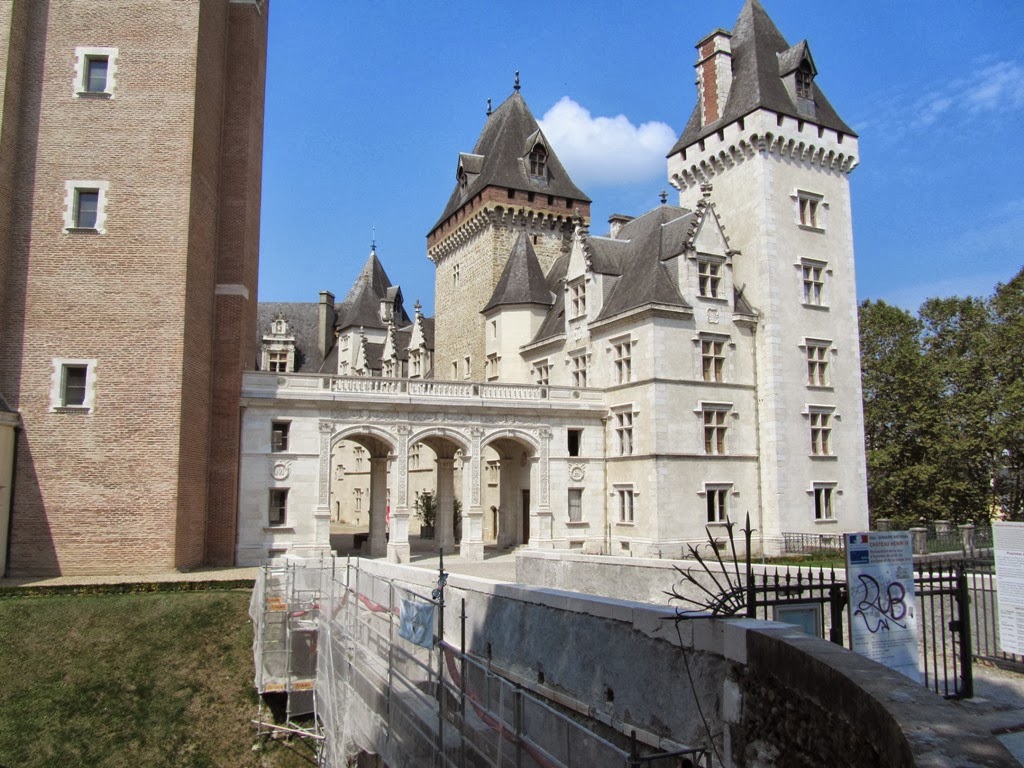 |
| The Chateau at Pau |
Throughout our journey I became increasingly
aware of the great waterways of France. Every village and town, it seemed, had
a river central to its being. This, of course, is true of the vast majority of
settlements – certainly ancient ones - anywhere in the world. But in France it
seems they are heralded and not hidden away or unnoticed. Some of the places we
visited had almost dry river beds with just the merest trickle while others –
as with our friend’s house at Villeneuve-sur- Lot – were great slow moving
waterways. Bridges were invariably decorated with brightly coloured flowers –
again, it seemed to me, a local pride being apparent that is maybe not always
there in England where rivers are just part of the landscape and little thought about until a drought or a
flood. At Lagrasse where we had enjoyed the river we carefully walked across it
on the narrow walkway. A few children and adults were swimming further up
stream and to ensure safety a life guard was on duty – yes, it was all well
thought out and intended to ensure that the river was a valued and used part of the
locality. It was not unusual as we travelled to drive for mile after mile
alongside a river or canal – or sometimes both – and always it seemed they
looked well tended and accessible - not only waterways of importance but also
places to enjoy and to respect. On the day that we arrived in Argens Minervois
we sat in the sun on the banks of the Canal du Midi watching as a succession of
holidaymakers took out their hired canal boats for the first time. We laughed
as one group of holidaymakers emerged slowly from the boat yard in a huge boat
which once they turned onto the main canal lurched from side to side crashing
into one bank and then the other as the “learner driver” learnt how to steer.
At the B&B we were staying at we ate breakfast with a South African couple who were taking a boat
for a week on the Canal to glide through the French countryside in a slow and
stately cruise. I must say, it sounded very appealing – especially as the sun
shone down day after day.
 |
| Anyone for boules in Fouras? |
While we
were in the Minervois region the weather was particularly warm but the heat of
the day was tempered by the cooling mistral wind that affects these regions.
The wind blew gently each day and thinking of it took me back to my geography A
level studies of fifty years ago and reading
of the mistral when I studied the geography of this part of the world. I have
now experienced it. The owner of the B&B where we were staying told us
that it can be particularly cold in winter when the wind blows.
As we drove
and walked around all the places we visited – small and large, rural and urban
- I became slowly aware that something was very different in France. At first I
could not put my finger on it but then half way through the holiday it hit me.
It was the lack of CCTV cameras on show. Here in the UK we cannot miss these
blights on the urban landscape. In some places they seem to be on every street
corner. Our roads and motorways are littered with them watching every movement
and shops and businesses, especially, feel the need for them. As we drove along
the motorways in France we would very occasionally see one but this was an
exception. In the villages and towns I can honestly say that I didn’t spot one
– maybe they just hide them away? Whatever, as the holiday went on, it seemed
to me to be a whole lot more comfortable – it made me wonder if, in fact, the
widespread introduction of video surveillance to the level that we have in the
UK is counter-productive. Does it become self perpetuating as with widening a
motorway - when motorway traffic becomes heavy and an extra lane is constructed
and the natural consequences is that more people use the motorway so yet
another lane has to be built! Are CCTV cameras subject to the same natural law?
 |
| Madam's lovely breakfast table in Fouras |
It seemed to
me that maybe the French have a different take on home security than ourselves –
perhaps more proactive rather than reactive. Walk down any English road like
mine and would be burglars are presented with lots of possible easy options and
clues. They can see if anyone is home since the frontage of the house quite open and
windows often easy to see through. Often houses have driveways that give open
access to the back of the property. Our response to this is to put up security
cameras and security lights rather than simply make it more difficult for the
burglar to get near the place or to know if it is inhabited! Walk down my
street at night and virtually every house (including mine) will light up as the
security light sensors pick up the movement. The French, however, seem more
proactive. At the French B&Bs we
stayed at front gates and drive way were locked – at one place we needed a code
to get in, at another we were given a key. When we stayed with our friends in
Villeneuve-sur-Lot most houses in the road to be completely were surrounded by
fences to keep prying eyes out and making a physical barrier to entry. Fences
are high and keep much of the property private. Windows often remain shuttered
all day so it is impossible to gauge whether there is anyone at home. In other
words burglars weren’t encouraged to give it a try so less need for security
lights or cameras.
Since I returned home I’ve done a little research. The French apparently are in favour of CCTV for its practical use but anxious that they do not become a surveillance society – “We want to avoid the Anglo-Saxon approach” said one French mayor. Cameras are used and are big business in the country – about 400,000 - but this is only about a tenth of the number in England. There is currently a big government initiative planned to increase this, especially in big cities but in a nation where “Liberty” is written into the constitution and inscribed on every French heart they are careful about what they call them. With typical Gallic logic they prefer to call the use of cameras "vidéoprévention" or "vidéotranquillité" (I like that) rather than video surveillance!
 |
| The great Canal du Midi at Argens Minervois |
But France
is not a wonderland. Despite my disparaging remarks at the top of the blog
about the Sussex sea side resort we left behind in England and all the other
(probably unfair) comparisons that I have made. I know that in the big French
cities they battle with very much the same
– and sometimes more complex or threatening - problems that we do in the
UK and the average Frenchman, I am sure, probably moans about France in equal
measure to his British counterpart’s complaints about the UK.As well as
all the wonderful things that stand out about our holiday there were two events
that will be long remembered for the wrong reasons.
On a scorching hot Sunday we drove along the Mediterranean coast – one of the premier routes in France filled with high end places and properties. Late in the afternoon and homeward bound we stopped for a much needed drink and toilet break at a motorway service area. The area was newly constructed and sounded very swish but as we drove we were horrified at the dreadful mess – litter almost ankle deep filed the car park and although the car park was not by any means full vehicles seemed to be scattered everywhere and people milled about or simply lay on the floor in the sun totally oblivious to where they were and the problems they were causing by laying on paths or in parking bays. The vast majority of the people appeared to be of eastern or middle eastern origin – burkas and similar garments filled the shop and the cafe. We trod carefully through the litter and stepped over the reclining bodies, visited the toilet, grabbed a bottle of water and were on our way. There appeared to be no staff intent on clearing up the litter it was simply left. As we eased out of our parking spot plastic cups, coke bottles and sandwich wrappers crunched under my wheels – we were glad to be on the open road. As we pulled away the joys (if there be such a thing) of an M1 service area like Watford Gap or Toddington seemed a long way away and perhaps something to look forward to!
On a scorching hot Sunday we drove along the Mediterranean coast – one of the premier routes in France filled with high end places and properties. Late in the afternoon and homeward bound we stopped for a much needed drink and toilet break at a motorway service area. The area was newly constructed and sounded very swish but as we drove we were horrified at the dreadful mess – litter almost ankle deep filed the car park and although the car park was not by any means full vehicles seemed to be scattered everywhere and people milled about or simply lay on the floor in the sun totally oblivious to where they were and the problems they were causing by laying on paths or in parking bays. The vast majority of the people appeared to be of eastern or middle eastern origin – burkas and similar garments filled the shop and the cafe. We trod carefully through the litter and stepped over the reclining bodies, visited the toilet, grabbed a bottle of water and were on our way. There appeared to be no staff intent on clearing up the litter it was simply left. As we eased out of our parking spot plastic cups, coke bottles and sandwich wrappers crunched under my wheels – we were glad to be on the open road. As we pulled away the joys (if there be such a thing) of an M1 service area like Watford Gap or Toddington seemed a long way away and perhaps something to look forward to!
And the
second event that we will remember with something less than joy? We arrived late one afternoon at our B&B. We
were staying there only one night and it was in a tiny remote village. A car
was parked outside and we knocked on the front door but to no avail. As it was
so remote we sat in the sun waiting. An elderly French man who was digging his
garden next door assured us that there was someone in so we tried again – to no
avail. Time ticked by and by 5.45 we were getting quite concerned - would we have a bed for the night?. The elderly
French lady from the house opposite offered to ring the owner but just as she
offered we spotted a bell on the gate post. We pressed the bell and almost
immediately the shutters were thrown open at a bedroom window and a loud
English voice castigated us for turning up early. The harangue went on for some
minutes, cutting through the silence of the village - and we felt very contrite. “We have to get our sleep” we were told by
the dressing gowned and wild haired harridan who hung out of the window, “It
said on the e-mail I sent not to turn up before 6 o’clock, we have been very
busy.........” And so it went on. We
were clearly in the wrong and for that we apologised profusely – we just hadn’t
noticed the time requirement. By the
time that she had dressed and we were at last unwillingly admitted we felt well
and truly told off. During the evening, as we ate a very pleasant meal we were
reminded several times that she was so busy and that people had to understand
that – it all made one feel as if we were intruding on this lady’s life. On
this occasion the customer was very definitely not right!
 |
| Talmont - feeding the French obsession for sea food |
Since we
have returned home I have looked at comments on Trip Advisor about this place
and many, rightly, speak well of it and its meals – and, as I say, we were very
happy there (but glad we were only staying one night). We would undoubtedly use
the place again if in the area. But in equal measure to the very positive
comments on Trip Advisor were people
(both French and English) who had
had similar experiences to ourselves and who described the owner as rude or
“horrible”. Clearly the lady didn’t learn from her feedback.
The
incident, however, hides a wider commentary - and something that was reinforced
for us on several occasions during our time in France. We stayed throughout in
B&Bs – every one was good or excellent – the ones in Hendaye and Fouras
amongst the best we have stayed in anywhere in the world. We would happily
return to any. But there was a hidden difference. Unbeknown to us until we
actually turned up on the door step (we had pre-booked them by internet) three
of them were run by English people – including the one mentioned in my tale above.
In each of these we felt very much an item of business – we were simply clients
whereas in the French run chambre d’hotes
we were welcome and much appreciated guests in the house. We have experienced this
many times over on previous visits to France. It is not related to cost – indeed the French
owned places we stayed at were on the whole cheaper than their English
counterparts. The breakfasts in the French B&Bs were universally better –
freshly baked bread and croissants, wide selection of (often home-made) jams
etc. - quite simply a feast to be looked forward to. In the English run
establishments although the breakfasts were more than adequate they were
neither a feature of the stay or memorable. Too often it was defrosted stuff from
the freezer, on one occasion slightly stale bread, pre-packed butter, jars of
jam from the local supermarket or packaged croissants or a bowl of
cornflakes. As I say, we would return to
any one with pleasure – all gave us a great holiday – but my lasting thought is
that the English run B&Bs were out
to make a profit but the French wished to welcome us into their home and make our
stay memorable.
 |
| Fouras B&B |
And in the end that is what we “do” in England - we run businesses (was it Napoleon who said we are a nation of shopkeepers?) – profit drives us and we manage our lives through the demands of the balance sheet. Increasingly it seems to me we have sacrificed our heritage, values, culture and in this case our hospitality at the altar of making a fast buck. In England our schools and universities are now driven and judged not by educational philosophy or ethical arguments about what should constitute a good education but by value for money, the needs of the economy and the economic worth to the student; our doctors and hospitals are now forced to prove the economic worth of actions and care rather than make decisions based on need and clinical requirement; when we are involved in some great event – the Olympics or the Royal Jubilee our government defines it in economic terms and what it adds or detracts from the national balance sheet rather than it cultural or national significance. As a nation we have no shame when it comes to taking a moral stance – we will happily sell weapons to anyone no matter what their politics history or policy and justify this by saying "If we don't sell them then someone else will", London is always open to welcome global corporate tax dodgers because it makes the Treasury a fast buck and our present government has no qualms about introducing legislation that actively seeks to disrupt the quality of life for millions in the local community because it saves money.
 |
| Alfred Hitchock in Dinard |
We have blindly fulfilled Margaret Thatcher’s famed maxim “There is no such thing as society”. But "society" is firmly rooted in values, traditions, culture and heritage – I do not mean the “high culture” of the art gallery or the concert hall but the culture of the community whatever and wherever it is and we have, unlike the French, it seems to me torn that up at the accountant and politician’s behest. At an everyday level cheapness and value for money takes precedence over quality and taste – we see it on every High Street with its array of pound shops, we see it in the growth of cheap flights (never mind the quality feel the width!), we see it in the demise of tradition, individual and community values and habits in favour of seven day a week/24 hour shopping and supermarkets or the visit to McDonalds whilst shopping instead of a family Sunday lunch. Politicians of all persuasions talk of schools being “family friendly” when what they actually mean is “ economically friendly and family and destructive” as they encourage and fund the growth of pre and after school and holiday clubs which ensure that children actually spend more and more hours away from the family than in it. This morning I read that the Labour party, as a "family friendly initiative" is promising 25 hours a week of free child care for all 3 & 4 year olds. This might be justified and desirable in economic terms, or to satisfy the personal/professional “fulfilment” of parents. It might even be justified educationally. It might be financially friendly, professionally friendly or educationally friendly but it cannot in anyway be described as "family friendly"- it marginalises family life and its values and practices as all the members of the family are away from each other doing their thing whilst the children are cared for by "responsible others" in some "institution". And so our society races to the bottom and never more so than in these economically blighted times where every item of government policy is not driven by what is right or desirable but what pays.
 |
| How many roads did we drive down like this? |
And that is
why, as I stood on the ferry watching France disappear over the horizon I was
sad – not that the holiday was over but that I was leaving France. “Vive la
France!”


