24 January, 2012

It's Shameful!

I read over the  weekend that the government’s school inspection body OFSTED – doubtless with the hearty support of our bizarre Minister for Schools, Michael Gove – intends to “name and shame” failing schools – specifically those who encourage students to take “easier” subjects at GCSE. There isn't anything  new in this “naming and shaming” policy - successive governments have used it as a threat/punishment/whip with which to beat those involved in public services.

I also read the ongoing tale of the Italian ship’s captain Francesco Schettino  who allegedly sailed his ship onto the rocks off the coast of Italy – and then to add to his shame and misery  allegedly saved his own skin by leaving the ship before his passengers. In doing so he incurred the wrath of the world’s tabloid press and clearly was “shamed”- and has been mockingly given the name “Captain Coward“ by the popular press. 
Captain Schettino - the mob
says he is a coward - but
do they know how they might
behave in similar circumstances? 

It all got me thinking about this “shaming” thing.

I remember when I was about 10 – in the mid 1950s – there was a great  “to do” in the street where I lived. The street was a humble place of tiny terraced houses – workers cottages common in Lancashire mill towns. The people who lived there were, like my parents, humble, perhaps even poor, folk. The family next door had two daughters – both in their late teens - and one night their mother came into our house to have a talk with my mother. There was much whispering behind closed doors. There was a lot of crying from the kitchen where they sat with cups of tea. I pressed my ten year old ear to the kitchen door to try to catch the tit bits of conversation!  It slowly leaked out that one of the daughters (she was about 19) – was “expecting” and not married (we didn’t use such words as “pregnant” in those days! I’m sure that if I had said “Is Stella pregnant?” I would have been told to go and wash my mouth out with soap – but “Is Stella expecting?” would have been ignored and unanswered but acceptable!).  Mrs Dean, the mother, was mortified, ashamed, that her daughter should bring this unforgivable thing upon their respectable family. Slowly, of course,  the news leaked out to the wider street, there was much whispered talk, veiled looks  and comments as the daughter in question walked down the street. A wedding was hurriedly arranged and very slowly the whole thing blew over – but, Mr & Mrs Dean, I remember, seemed to age over night and for me, as a youngster, this event seemed, at the time, to be the most terrible thing that could happen to a family. The family had been shamed – and apart from anything else they were shamed because they knew that everyone else in the street would be looking at them critically and judging them badly. What I  learned was that shaming  only works if the people being shamed subscribe to the same values as those that point the accusatory finger. If Mr & Mrs Dean had not subscribed to the same values as the rest of the street about unmarried pregnancies and all that they implied at the time; if they had simply laughed it off and got on with their life; if they had simply allowed their daughter to have the baby and for it to be welcomed into the home as the child of a single parent – and proudly shown their new grand-child off to the neighbours (as would undoubtedly happen today) - then they would presumably have felt no shame. They would simply have ignored the conventions and mores of their society and got on with their life.

Yep, - having experienced OFSTED it can
sometimes feel like this! 
It seems to me that “shaming” is a two way thing – in order for it to work, those being shamed have to subscribe in some way to the values and beliefs of those doing the shaming. If they don’t, then its effect is limited. And this for me is where it all falls apart – and where the logic and moral foundations of naming and shaming becomes, at least, questionable.

To go back to the examples in the press that I mentioned above. Presumably, OFSTED, in announcing that they are going to “name and shame” these failing schools, hope and desire that the teachers, governors etc. of these schools will be sufficiently mortified  at being held up to ridicule that they will mend their ways. Speaking as an ex-teacher, my experience suggests that this will probably be the case. The vast majority of teachers with whom I have worked are conscientious, hard working and anxious to do a good job – often in the face of quite insurmountable problems. In my experience teachers are largely conventional, they subscribe to the sort of conservative values current in society,  they pay their bills and taxes, they are overwhelmingly honest,  they generally  encourage the children that they teach to be kind, considerate, honest, industrious and the like and as a consequence of this outlook on life they will be shamed and  feel upset, angry and vulnerable when they, themselves, are told that they have let themselves and society down and that they “should be ashamed of  themselves”.    I’m pretty  sure the same would apply with other groups of public servants – nurses, doctors, social workers and the like.

Leaving aside issues like "is shaming and or ridicule an appropriate action" (after all, if a teacher did it to children in his or her class he would pretty soon make the tabloid headlines for his unacceptable  behaviour) or indeed as a reasonable motivator of people  (I’m pretty sure that  behavioural psychologists  would tell us that it is not a particularly good motivator) the issue seems to me to be that the doctrine/policy is applied rather randomly and with random success depending upon who it is meted out to. For example, in the past few years none has been more vilified than bankers and those involved in the City – but this vilification and shaming seems to have had a marked lack of success – the bankers and their like have simply ignored it and gone on as before.  Indeed they have heaped on the shame and ridicule  by brazenly  giving themselves even bigger bonuses – and then laughed all the way to the bank at wider society’s anger.  Is this because the bankers do not have the same value system as teachers? Is it because teachers are more angelic and care more? Do the government know this and so feel that it is an appropriate strategy to use on teachers but not on bankers. Why do the government not publish a list of named and shamed banks and employees who are judged greedy, to have failed in their duties etc .– it’s good enough for teachers  - why not banks?
Fred Goodwin ex-CEO of RBS Bank felt
no shame at his actions or part in the
banking collapse - he metaphorically
 stuck two fingers up to society,
and laughed all the way to the
 bank with his bonuses!

And what about MPs – the debacle a year or two ago about their expenses was pretty conclusive that naming and shaming had little effect – yes, many were punished but few expressed any regret or contrition.

And what about good old Captain Schettino? Clearly he seems to have acted unwisely in respect of his ship but his shaming because he “jumped ship” is another issue. Yes, naval lore says that the captain of any ship goes down with it but in having this expectation (or is it a convention) we place a huge moral load on  ship's captains. Is this something that is written into their job description and that they sign up to when they become a captain.  Or is it simply an expectation that this is what a good captain will do? We  place the same moral expectations upon other groups. For example, we expect that doctors and nurses will tend the patient even when he has a hugely infectious disease which might pass on to them. We expect that our policemen will show bravery  in the face of great danger. If a policemen “ran away” in front of the robber he would soon be “shamed”. And yet we do not expect it of others. None of us, for example, really expect a top class sportsman  or woman to display shame – indeed, all too often they flaunt their shamelessness and they are applauded for it by fans. A year or two ago in the World Cup Finals England scored a disputed “goal” against Germany. The goal was disallowed by the referee who felt that the ball had not crossed the goal line. He gave the best decision he could given the position that he was on the pitch. However, immediately after the game, the German goal keeper Manuel  Neuer, who saw clearly what happened, admitted to the world’s media that the ball had indeed crossed the line and it should have been a goal. But, he confessed, ”I quickly decided to act naturally  as if it hadn’t been a goal to make the referee think the ball hadn’t crossed the line”!  In other words he  cheated. The result, he was hailed as a hero in Germany and his actions perfectly understood by football fans throughout the world. But why did he not run up to the referee and explain that it was indeed a goal - in other words act, honestly and honourably. Clearly, had he done this he would have been ridiculed by much of the footballing world and probably judged as some kind of fool by his fellow players - and yet we expect Captain Schettino to act honourably in the matter of his life, so why not the footballer in the matter of a goal? He saw no shame in admitting that he cheated - it was acceptable. Sporting stories similar to this are legend. And yet, if a school boy walked out of the examination room and immediately confessed to all and sundry that he had cheated then he would immediately be in trouble and be told that he should be “ashamed” of himself!
Manuel Neuer - great footballer -
but by his own admission
a shameless cheat

The point is that in this shaming “thing” we have different expectations for different people. We expect that the ship’s captain will possess and act upon the personal qualities of bravery and selflessness and “go down with his ship” but we do not necessarily expect the same of others. If we did then perhaps the bankers in recent years would have been so ashamed of their actions and the public's view of them that they would have all taken the Japanese option when shamed and committed hara-kiri. But they didn't and we didn't expect it of them - but poor old Captain Schettino was, however, expected to possibly give up his life.Why these differences in expectations? Had the good Captain Schettino not sailed his ships into the rocks off Italy he might have gone through his whole career and never been tested on this personal quality – and he would have been praised as a good man!  

And it seems to me that there is a different aspect to this. Shaming and being shamed assumes that people will act with honesty and integrity. Clearly, the German national goalkeeper, Manuel Neuer fails miserably on this score – he happily admitted his dishonesty and received no admonishment or criticism for his lack of integrity – the ends justified the means.  Suppose, on the other hand, a teacher in a school knew that the head teacher was actively  altering answers on exam scripts or telling pupils what the questions in the exam were going to be. When the cheating was discovered the teacher  confirmed that although he was not in any way involved he knew it was going on. I have absolutely no doubt that he would have been severely reprimanded and shamed for his silence and lack of integrity in  not informing the authorities.  But not so the sportsman, not the banker, not the politician who has cheated on his expenses or been “economical with the truth” or broken some firm  commitment that he gave in order to be elected. Why not? If expectations of integrity are good for some groups why not others? Is there is  an agreed rule or imperative  that says for some groups we have higher expectations of integrity and other personal qualities than others?. Clearly  we expect certain people to have particular skills and professional qualities than enable them to do their job. We expect the sea captain to know all about ships and how to navigate the oceans successfully and safely. We expect the banker to be able to add up, manage the accounts books and make wise decisions about the money that he is entrusted with. We expect the nurse to have the medical and caring skills to make the sick well. We expect the sportsman to have the skills and outlook to be a successful player and team member. But what about these personal qualities of honesty, integrity, bravery, sportsmanship etc. These are personal values and part of the wider society’s value system and are rarely, if ever, referred to in any job specification.
Pointing the finger!

And yet these are the very qualities that shaming relies upon to work and it seems to me that  those who would name and shame, those who would point the finger of ridicule only do so when they know that those they are pointing at are vulnerable and likely to be influenced and frightened by the consequences. That all seems to me to be a bit like the same rationale I have seen on the school playground for forty years – except in that context we call it bullying! It goes like this. Find a victim who is likely to be influenced by your ridicule, point the finger, pour scorn on  her, make fun of him, upset her, make him do your will – yep, it’s the strategy of the bully. The bully doesn’t attack  those who don’t care, who can take the ridicule and walk away - in other words, who have different values. He doesn’t attack those with powerful friends (as have the bankers). He doesn’t pour scorn upon the victim who is physically bigger and stronger  - he picks upon the vulnerable and those that will worry and respond to his bullying. Just as OFSTED are doing with “failing schools”. Just as the tabloid press are doing with the Italian ship’s captain.

I don’t seek to condone the actions of Captain Schettino or to defend a teacher who is failing his or her pupils but if there is a problem with the performance of an employee and their role it seems to me that naming and shaming is a grossly unfair, random, immoral and bullying response used only by those who can think of nothing better to resolve the situation. All those years ago, as our next door neighbour wept in our kitchen at her daughter’s “shamelessness” and the effect it was going to have on her family, she was weeping because of what other people would think and how they would react. And this is where the bully is at his or her most effective – when people care about their self image or the way that they are perceived by their peers. Like the pack of wild dogs, the bullies select their victim from the weakest in the herd and home in. “The Independent” newspaper put it rather well today – its headline on the Schettino  affair was  “ a handy fall guy for a lazy, judgemental media”. Just what I would  say about OFSTED (and I have experienced several very successful OFSTED inspections) and other agencies whose role is to name and shame rather than constructively enquire, advise, support, suggest or professionally improve.
Naming and shaming legitimises
ridicule and breeds hatred. OFSTED
and governments who promote this
policy should themselves be ashamed!

No, for me it all leaves a hugely unsavoury taste in the mouth – and the worrying thing is where does it all end. It’s Captain Schettino and “failing schools” today – who will it be tomorrow? You? Me? My daughter? Your son? Your grand child? Naming and shaming is a  nasty strategy thought up by people who have nothing more to offer –  it legitimises criticism, ridicule and bullying into the  public domain and provides the mob with the justification for  pointing the finger, making fun or  fostering hatred.  It is highly selective – picking only on the vulnerable or those who are easy targets because of their position or values......... and that is exactly what the playground bully does.


18 January, 2012

A Tour de Force

To escape from the hammering, drilling and banging in my house as the builders progress – and most importantly to keep warm (we are without heating at the moment as the plumber fits us a new central heating boiler) - Pat and I went to the cinema this afternoon. We are not regular cinema goers, although Pat would, I know, like to go more frequently so it usually has to be something rather special to attract us.

Of course, these days it’s not like going to the real cinema, with a pretty usherette in a smart uniform (and short skirt!), torch and tray of ice creams. You don’t usually have to queue in the cold outside until the show begins, there’s no Pathe or Movietone News and no “B” movie to excite you. But there you go – it’s progress, they tell me! No, we entered a vast reception area with popcorn stalls McDonalds and numerous other refreshment outlets. You buy a ticket and there are what appear to be dozens of films on at the same time – all in separate cinemas. So we paid our £5.60 each (senior citizen concession), Pat clutched her huge  bag of popcorn (who could eat the stuff?) which  a young man in a baseball cap had  ladled into  a cavernous paper bag.  and we went to the directed area to see “The Iron lady” – the Thatcher film starring Meryl Streep. When we walked in  we were, for a few minutes, the only two sitting there.   Would we view completely alone? But no, as 2 pm approached it slowly filled up – almost universally with senior citizens. I have to confess, when  a couple of younger cinema goers (and by that I mean perhaps 25 year olds) I felt like shouting out “Hey – it’s the middle of the afternoon, shouldn’t you two be at work earning money and paying your  taxes to keep me in my retirement.” You’ll be pleased to know that I didn’t! The audience, as I said, was overwhelmingly retired people – where they all Thatcher fans I mused or where they like me, Thatcher haters anxious to see the old bird sink into dementia.
Meryl Streep & the real thing!

Whatever,  once the film began I was immediately captivated. I have to confess I am a Meryl Streep junkie. From the day I first saw her in “The Deerhunter” and through all the other great roles she has played she has been my absolute favourite – both as an actress and a person. For me all the other Hollywood actresses – whether they be American or British – pale into total insignificance. Oh, how I would love to see Ms Streep take on one of the great Shakespearian roles – perhaps on the Stratford stage! What a treat that would be.

But my idolising of Ms Streep apart this is a real tour de force. By anyone’s standards she is magnificent. I am told that she is in the running for an Oscar – well, that’s as maybe – but I suspect that long after the Oscars have come and gone this portrayal will be remembered as definitive. The accent, the gestures, the patronising voice, the overt stubbornness, the body language, the use of the eyes – I could go on – it is all there. It was almost like Margaret Thatcher was again moving amongst us.

But this was more than mere mimicry. For me the success of Streep’s interpretation was that she evoked in me (and I suspect in others) all the old feelings about Thatcher and the times in which she was Prime Minister.  And – and this is, I believe, is important – the film as a whole and Streep’s acting  provided a window into the hearts and minds of great politicians. The sense of destiny, the loneliness of the job, the notion that “the buck stops here” – and by half way through the film I was not hating Thatcher (as I have done for since the late 70s)  but respecting her.

Now that respect might be shallow – an emotional trick brought on by a good script and fine acting. Perhaps Thatcher was indeed the evil woman I have always thought and Meryl Streep has simply given us all  a sentimental view of an old lady looking back on her life. But I don’t think so. When Margaret Thatcher left front line politics two decades ago no one cheered more loudly than I. But, even then I had a grudging respect – whatever one thought of her, she was the consummate politician, she was a person of substance, she was clear in her views, she was stubborn, her commitment to her causes was quite unquestioned. In an age of mediocrity she stood out. And without question she changed the political landscape of both this country and the wider world. And that, for me is the strength of Meryl Streep’s portrayal of the “Iron Lady” – that is what comes over.

There has been some political criticism in this country of the film.  Douglas Hurd, Thatcher’s Foreign Secretary, in the “New Statesman” a week or  so ago praised the political accuracy of the film and Streep’s  portrayal of Thatcher but questioned the “rightness” of portraying  Thatcher sinking into dementia  whilst she was still alive. I have a certain sympathy with this. The portrayal was brilliantly achieved, but in a sense I got the feeling that it was a bit of creative writing. I’m not aware of who might know what goes on inside Mrs Thatcher’s old mind and to portray it as fact seems a bit of poetic licence. And certainly, I was a little uneasy of this portrayal whilst the woman was still alive.

Having seen the film, whilst I have this sympathy for those who suggest portraying the living Thatcher sinking into dementia is not appropriate, I have to say that for me this is one of the real strengths of the film and of Streep's performance. Forget this is Margaret Thatcher - Streep's portrayal of a frail, confused old lady is truly masterful - again, the eyes and the confusion that lies behind them, the body language, the flashes of the woman that she once was - are all, for me, utterly convincing. This really is an actress on the top of her game made even more resonant because we all know the woman the she is portraying - it is not some long dead personality of whom we only have faded black and white pictures or old memories.  
The wonderful Ms Streep!

We have talk in this country about giving Margaret Thatcher a state funeral when she eventually bows out. No one would shout louder than I against that idea. Indeed, I suspect that Thatcher herself would be the last person to want it. It is perhaps a measure of  her political descendents – Major, Brown Cameron, Blair etc – political midgets all - that this shallow idea should be suggested. No, whatever one’s views on Mrs Torture (as I love to refer to her) she was a great woman and politician.  She was about more than the mawkish extravaganza of a state funeral. She did  not engender universal love and appeal in her years in power – she fostered love and hatred in equal measure and to  arrange a state funeral as a way of saying “thank you” is I believe totally inappropriate. But, she deserves her great place in the political history of the nation and Meryl Streep’s portrayal goes a long, long way to cementing that in place.   

17 January, 2012

The View From The Building Site!

Blogging is taking a bit of a back seat at the moment – not through lack of enthusiasm but rather lack of real opportunity. We are in the middle of a number of major house renovations – new kitchen, downstairs shower room and office. We have  been waiting  for some months for the builders to start and they did so ten days ago, so I am wiring this amid drilling, hammering, piles of bricks and enough dust to make Sahara  dust storm look mediocre! Pat and I are living on one room and we are warned that tonight we may have no heating – the new central heating boiler is being fitted. In this context, blogging has had to take its place in between emptying cupboards, making endless cups of tea for the builders generally surviving in a  waste land!

In truth it is going very well – although cold, the weather has been good and by the end of this week we should be moving away from the demolition and bricklaying stage and more into the cosmetic and construction stage – or so we are told. Actually, we are very fortunate; our builder is a friend who we know well and who makes every effort to make things easy and work with the minimum of disruption to everyday life.

But, whilst all this has been going on there have been a number of things which I have come across and which have made me think – sadly, all rather negative thoughts – and which, in a small way, had a common thread.

The first is something which many will disagree with but is an issue which increasingly saddens me at a number of levels. Over breakfast on Saturday morning I settled down to read my Guardian. Having flicked through the headlines -  as usual pretty depressing stuff – I looked at the Guardian “Family” section. The cover story was entitled “Man about the house” and concerned the role of men in the family  and especially as parents. What saddened me was a report of a comment on Mumsnet: "It has just dawned on me that my husband has absolutely no idea how hard I work looking after three kids under four whilst running my own business. I want to punch the useless twat!" The rights and wrongs of the particular issue (i.e. the role of the man in the house) was not my concern but rather the venom and unpleasant language used by this woman – and the fact that she felt it acceptable and appropriate to express herself in these terms to the whole world. My immediate reaction was well, if she is a business woman I hope that I never do business with her. I quickly followed that up by thinking what on earth is she doing writing on “Mumsnet” – I would have thought that the invective, aggression, venom and foul language in the comment would be a bit of a contradiction with the term “Mum”. But, having got over those initial, male chauvinist pig, knee jerk reactions I felt overwhelmingly sad – what a lot of anger there is in the world, I thought. What poor personal judgement  people show in how they portray themselves. And do they not realise that in making aggressive, unpleasant comments such as that they are displaying their lack of ability to put forward a reasoned and sensible argument of their case. We all know this, of course, we see it on our city streets, on the sports fields, on our TV sets – but to read it in a “family section” of a respected newspaper was not what I expected. The woman concerned probably had a very valid point about her husband – I’m sure that she did – my own feeling was that perhaps she ought to examine her own role and mode of expression. Of course, this is not new – read the posts on any newspaper web site and one will see similar aggressive  unpleasant comments masquerading  as reasoned argument when in fact they are just aggressive and angry outbursts in just the same way that  the drunk on the street or the Premiership footballer might lash out in angry frustration. 
The erudite, bizarre and totally out
 of touch Michael Gove

My second  commentary on the past week’s events is the absolutely appalling and ill considered suggestion by Michael Gove that the nation should give the Queen a new royal yacht to mark her jubilee. Gove is known for his bizarre ideas and his attachment to royalty but in this he has surpassed himself and  seems to show an incredible lack of awareness of ordinary people in these economically austere times. This lack of awareness makes me think that anyone as insensitive and unaware as this really ought not to be holding public office – it reminds me of the some of the more way out candidates of the US Republican Party that we read about in our newspapers.  Gove’s ministerial responsibility is the education of our children and it is a depressing thought that someone as far removed from reality and as insensitive as he is can make decisions that can affect the life and welfare of the young.
US Marines "make a stupid mistake"

And finally, and following my reference to the US Republican party, I was more than a little sad to see over the weekend the picture of four US Marines allegedly urinating on the corpses of Taliban fighters. I wonder what sort of mind would do this? How could anyone commit such an act? What made it even worse was that comments from various bizarre and totally out of touch Republican politicians who seemed to suggest that it was no big deal and within the realms of the acceptable. Rick Perry said the marines involved should be reprimanded but not prosecuted on criminal charge: "Obviously, 18 and 19-year-old kids make stupid mistakes all too often. And that's what's occurred here.” Errr, no - if these young men are capable of making  “mistakes” of this nature then they should not be wearing a uniform that makes them representative of their country. I was rather more cheered by the comment of a senior US army spokesman who posed the question “Have we really reached such a low ebb that we have to run a  course to explain why we do not urinate on dead people?” Sadly the answer to that rhetorical question seems to be "yes".
Rick Perry - the  truly frightening
thing is that, like Michael Gove,
people like him actually wield
influence and might one day
  gain power

And this is the common thread that links all my examples. I’m sure that many will totally disagree  with what I have written but for me it is dispiriting to find that so many people today appear totally unaware of what is acceptable and appropriate. Why would anyone want to advertise the fact that they use foul language and speak of their husband, their life partner, the father of their children in the manner that this woman does? What might the children think if they read it - to hear their mother speak like this and to hear their father described thus? What do the grandparents think? If I read that my daughter had openly described her husband in such terms I would be mortified - what does it say about how I have brought her up? Does no one have any shame? Why would anyone make comments that are so insensitive to many others that they become  offensive? What can society do for young men who, in their eighteen or nineteen years on the planet have not assimilated basic codes of human behaviour and humanity? If they haven't got them by now then when will they? What did their parents think? As the US spokesman said “do we have to run a  course?” 

Implicit in all these examples is the truth that each of the people involved is totally unaware of others and of appropriate action. In the words of a children’s hymn that we used to sing regularly at school:

May they learn from this great story
All the arts of friendliness;
Truthful speech and honest action,
Courage, patience, steadfastness;
How to master self and temper,
How to make their conduct fair;
When to speak and when be silent,
When to do and when forbear.

Put in modern terms – think before speaking or acting. It’s called self control.

Some time ago I read an article aimed at young people applying for jobs or applying for university and amongst the many tips given was “clean up your social networking sites”. In other words make sure that what you write on sites like Facebook or Twitter  (or, in the case of the woman in my  example above, Mumsnet) presents the sort of picture that you want to present about yourself to would be employers. It was good advice. Having acted in recent years as an admissions tutor for people applying for a place on a teacher training course, a quick visit to Facebook would soon present a very different – and perhaps more honest - picture of an applicant than did their application form. It frequently raised the question “Is this the sort of person who possesses the sort of judgement and personal values that we require?”  And that is what I would suggest in the examples I’ve quoted – they’re all about personal judgement, personal values, appropriateness..........perhaps  rather old fashioned ideas in this modern, thrusting, aggressive, transparent,  accountable world in which we live. Politicians, business leaders, shakers and movers of all persuasions never tire of telling us that “accountability” is the thing. We must be “transparent” and open in our actions – well, I’m sure that we would all sign up to that. But the corollary is that if we are “transparent” – and we happily urinate on corpses on camera, if we freely show aggression and use expletives in our internet posts etc., if we make totally insensitive comments as does Michael Gove then we must also be accountable and ultimately judged for our actions and bear the resulting consequences.

08 January, 2012

"Sorry, I'm Not Interested, Thank You"

Last evening our front door bell rang. It was about 6.30 pm on Saturday. We weren’t expecting anyone so I went to the door mildly concerned. I opened the door and a young man stood there in the cold  darkness  – a little unkempt but pleasantly spoken and most apologetic for disturbing me. He was clearly anxious and, I think, nervous. He spoke with uncertainty and a bit of a quiver in his voice, constantly looking around and trying to smile nervously. His first words were, “Oh I hate doing this, but please would you give me a few minutes of your time”. He had a slight stutter and a tremble in his voice. “I’ve just been released a week or two ago from Glen Parva Prison” he said. (Glen Parva is a prison about 30  miles away from where  I live). “I’m trying to make a bit of money and get myself back on my feet”. He reached down and picked up a bag that was at his feet. He was obviously selling items.

At this point embarrassment, anxiety and other concerns kicked in. What should I do – buy something which I didn’t want? Perhaps he was selling stolen goods. Close the door? Tell him to “Clear Off”. Offer him money or other sustenance? Be a good Samaritan? Ring the police? Offer him  advice on how he should sort his life out?  In the end I hurriedly, and with some embarrassment and much shame, mumbled “Sorry, I’m not interested, thank you” and I closed the porch  door.  As I did so he apologised for disturbing me and closed his bag and sadly trooped away. I watched him go down the drive to the next house, shoulders hunched looking, it seemed to me, dejected.

Now, he may have  been crook or a con-man. He maybe was just out to make a few easy pounds without actually working for his living. He may have been exactly what he said and in dire need of some kind of help to get a foot on the ladder or to put food in his belly on a cold dark night. I don’t know. I’m sure that those people who know about these things would have strongly advised me not to give him money and in that sense say that I acted correctly. I would like to think that if he was what he said then there are good systems in place to help a person like him to “get back on their feet” – and that all he needed to do was to access them. If he wasn’t what he said and that he had merely hit upon an easy way to make a few pounds from naive people like me then I would like to think that in  a small way I disabused him of this belief by not buying anything.

But whatever he was, whatever his motives or his needs, it left me with an unpleasant feeling about myself and how I reacted.

For years I have stood in front of children and led school assemblies. I have told these thousands of youngsters about great acts of kindness and bravery.  I have told Bible stories and legends where people selflessly gave. I know all the words of the Good Samaritan story. I have told the tale many times of the Roman soldier who cut his cape in half to give to the poor beggar and so incurred the wrath and persecution of his commanders. I have told the story many times of Jean Valjean who, on his release from prison in “Les Miserables”,  is taken in by the kindly Bishop and then forgiven by him for stealing the Bishop's silver. The list is endless, I have explained to children why these people acted in the way we did and why we should do the same.

And yet when the opportunity arises on my own front doorstep I turned away.

When the door shut and the man disappeared into the night, picking his way between my two cars that were parked on the drive; when I returned to the warmth of my sitting room to my TV and my computer; when I picked up my newspaper and continued reading of the world’s events, this little interruption into my cosy world still chipped away at the back of my mind. I sadly (and probably naively) thought what it must "cost" a person in this wealthy day and age to knock on the front door of a stranger and confess you are an ex-prisoner in need.  I had an overwhelming desire to jump up, run after him and push a few pounds into his hand.

I didn’t. Should I have done? The few pounds would have meant little to me – not that I am rich, but I will happily spend a few pounds on a trivial treat or a few pints of beer. But the few pounds might have made a huge difference to him. As I sat there pondering this, I wondered whether by running after him and squashing money into his hand I would have been acting correctly. It would certainly have eased my conscience – but is doing “good” just about easing our conscience? I’m afraid I’m not clever enough to argue the ethics and morals of such a case – all I do know is that in the many stories that I told children over the years people like the Good Samaritan didn’t seem to worry about “conscience” or whether what they were doing was wise or sensible or appropriate – they simply did it because they perceived it as “right”.

Like many people I occasionally subscribe to disaster appeals or to appeals for specific needs. My wife and I sent a few pounds to the Salvation Army Christmas Appeal a few weeks ago. We had a lovely letter of thanks back – which made us feel good – but as is so often true in today’s world money seems the answer to everything. It is easy to send a few pounds, to sign the direct debit mandate or tap in our credit card pin and to believe that we are acting like Good Samaritans. And, of course, we are - charities are grateful for our help and we hope they will use the money wisely. And, indeed, for the ordinary person it takes away the “messiness” of dealing with these unpleasant things – the homeless, the old, the sick, the refugee from war and the like – we can send our few pounds to a major charity in the belief that the experts know best, will know how to use the money effectively and will ensure that only the really deserving are helped. That is all true, but I can’t escape from the worry that the Good Samaritan and his like didn’t simply whip out their credit card or worry that they might get a bit messy in dealing with and helping these unfortunates – they simply acted because they saw it as the “right” thing to do.

Politicians of every hue proclaim that in their various ways they are going to help those in need – and indeed, I’m sure that they are serious in their intentions. For as many years as I care to remember I have believed profoundly in social justice, equality, opportunity and all the other causes and solutions to making the lot of ordinary people and those at most risk in our and other societies easier. I can quote the great social reformers and make a water tight argument for why and how we should act,  improve society and help the most vulnerable. And yet, and yet, when  a man knocks on my door and explains that he is struggling a bit and trying to “get himself on his feet” I close the door in his face – when to have listened or helped might have been the “right” thing to do.

Perhaps had I given him time or money I might later that evening have walked past the village pub and seen him drinking my few pounds - and then felt very foolish at my naive action.  But I think that I could have lived more comfortably with that – foolish and costly perhaps but ultimately done for the right reasons and reflecting my decision to think the best of someone and to try to help.

As I said above, I’m sure that those with experience would tell me that I did the “right thing” by turning him away – but it sure as hell didn’t and doesn’t feel that way.  As I sit in my cosy warm house, surrounded by my possessions and my long held and cherished  academic/intellectual beliefs about making society a better place it makes me realise that when it came to the crunch of perhaps helping someone I didn’t quite measure up. Just like in the Good Samaritan I was one who walked past.

30 December, 2011

"You didn't go downstairs on Christmas Eve, did you Grampy!"

Christmas is all but over – the big day has come and gone and although my front room still has candles and tinsel, it is all starting to look a little bit tired and sad! Yes, we still have New Year;  yes, we still have the rest of the twelve days of Christmas  to go but the January sales are with us, the world is moving on.
Every year it is the same – so much anticipation, so much prior preparation and hard work, so much potential stress. The TV adverts show us the idyllic Christmas of huge roast turkey, smiling families, happy children, peace and contentment throughout the world – and we so want to live up to the expectations. And then it’s over so quickly!
Christmas is great - you get just what
 you've always wanted!
Was it meant to be like this? Was it part of the deal on the first Christmas when Jesus was born? I think not. But if, indeed, there was a first Christmas with shepherds and magi and angels; if Mary & Joseph existed; if a baby, the Son of God, was born in a  stable adjoining an inn – then was the deal that we celebrated this event in the way we do with rushes to the January sales, the latest computer consoles and i-phones, an over indulgence of food and drink, by jetting off to the sun via Heathrow or by  watching again a much repeated “family film” as we sit, droopy eyed, in our new sweaters, our bellies bloated and heads slightly hazy from  too much wine.
It all sounds a bit doubtful to me – but the thing is we all do it in our various ways. And why? Because it is Christmas! We want it to be the “best one ever” and anyway, “it’s only for the kids”.
So what has my Christmas been like? What, twelve months down the line, will I remember of these past few days?
It didn’t start at all auspiciously. Early last week I went down with a dreadful cold which slowly took its toll -  a non-stop cough and wheezy chest meant that lying down to sleep was impossible. For several nights I slept not a wink and, so, felt dreadful next morning. We managed to entertain one or two friends for coffee and a glass of sherry, we got the last minute shopping done and the car cleaned (a “must do” for Christmas!) and by Friday afternoon the shining car was packed with presents, food and drink to take to our daughter Kate’s in Manchester. We were to spend Christmas there with her and her family, plus our son John and his family. He would make the trip from Reading to Manchester on Christmas Eve as would we from Nottingham.  Unfortunately that night my cold got worse and in the end at 2 a.m. in the morning we found ourselves in Accident and Emergency at our local hospital. It was not the cold that was the problem but the fact that my dodgy heart was beginning to show its hand and we feared a build up of fluid on the chest. As always, the  A & E dept was overworked but kindly and hard working. I slowly progressed through the system and at just after 4.30 a.m. following heart traces, blood tests and e-rays found myself given the all clear but with the much appreciated rider  “With your heart condition, Mr Beale, come straight back if you have any worries”. We are, in this country very, very lucky.
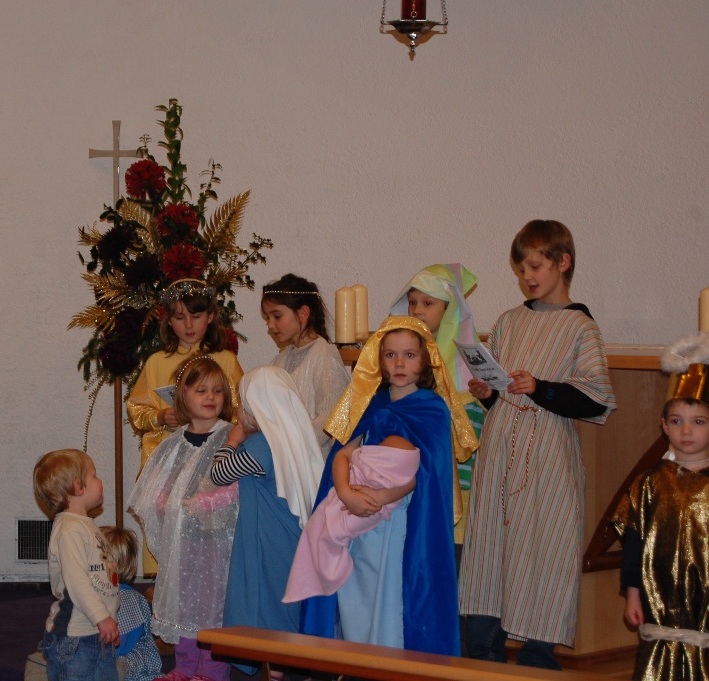
Waiting for our star parts as
Mary & the Angel!
So that will be one of the things that I will remember twelve months hence from this Christmas - A&E on Christmas Eve morning.. But there are a couple of others from the same night. As I  lay on the A&E trolley, waiting to be wheeled to have my x-ray completed, a young woman lay close by. She was fast asleep and a nurse approached her and kindly said “Open your eyes, Rosie, wake up”. There was no response and it took the nurse a minute or two to establish some kind of communication. When she did so she said ”Rosie, you are going home, we’re getting  taxi for you” She walked the young woman around the area, trying to get her attention and wakefulness. “You’ve drunk too much and taken  too many pills...........we’ve spoken to your mum........but she can’t pick you up because she’s drunk too much and taken some pills too...........I’ll get you a drink of coffee”. The nurse went off to get the coffee and as I was wheeled away for my x-ray the Rosie sat quietly sobbing on a chair. It’s Christmas.
The tableau is growing
And the second event? At 4.30 a.m. as I stood outside A&E in the cold  waiting for Pat to pick me up a young man stood arguing with his mother.  The lady, caring, anxious and upset - tears streaming down her face -  was trying to calm him down. His face was a mass of blood, rough bandages had been coiled around his mouth and nose. As they argued these slipped down to reveal a dreadful cut from nose to lips, exposing his teeth and gums behind. His face had clearly been sliced by a knife of some kind. Blood ran down his chin and onto his shirt. The lady pleaded with him to return into A&E where they could attend to his injuries – he roared that he wasn’t going back in but was going to find the culprits and exact vengeance. He was clearly very drunk – swearing at his mother and becoming increasingly agitated and aggressive. He stormed away from his mother and approached me – “You got a lighter mate?” he demanded. “Sorry I don’t smoke” I replied – inwardly I groaned at the prospect of seeing him trying to hold a cigarette in those bleeding, gaping lips. His mother ran up, mumbled an apology to me and grasped his arm, again pleading for him to come into the hospital. I strode back inside to seek safety and warmth until my wife arrived. Inside the door the security man advised “Steer clear of him.....he’s gonna cause trouble”. And standing there with the guard was a nurse who confirmed he did indeed have problems – “He needs maxillofacial surgery – and  urgently”. When Pat arrived with the car to pick me up the man was still standing swearing at his mother, she begging and pleading with him, the blood continuing to spread. And as we drove away I wondered what his mother must have been thinking –  just a few years ago he would have been a little boy excitedly looking forward to unwrapping the presents that she had wrapped for him  for Christmas Day? What must she think now as, the night before Christmas, he swears at her in public, uses every form of foul language and blood spurts from his face and he threatens a terrible revenge on his attackers? Where did it all go wrong for him and her?
Opening presents is great
And so to Manchester. Tired (having been at A & E for most of the night) we arrived to be with our family – eleven of us. We had a wonderful time – lovely meals together, the five grandchildren playing and laughing together, Christmas presents, too much food and although we had a drink or two nothing in excess. But what will I remember?
Well, certainly, all of the things that I mention above but especially our trip to the local church on Christmas Eve afternoon to join in the nativity service. We always feel welcome there – a full church, the usual humorous and warm welcome from Fr Clarke and the expected songs and carols to accompany the great words of the Christmas story and the building of the nativity tableau as children excitedly and noisily  take their places as shepherds, kings, sheep, Mary, Joseph and angels. We’ve all seen it hundreds of times before – we know the words, we can predict that the shepherds will wear tea towels on their heads, we can be almost certain of the songs we will sing..............and yet, year after year people all over the world will turn up to see something they have all seen before. It’s the ultimate “repeat show”. And we loved it! It's Christmas!
What other image will stick in my mind twelve months hence?
I like Christmas
On Christmas Eve I could not sleep – no, I wasn’t waiting for Santa – my cold had become worse and I could not stop coughing as I lay in bed. So, at about 2 a.m. in order not to disturb my wife who was fast asleep I crept downstairs, my duvet under my arm, to see if I could grab an hour or two’s sleep sitting in the arm chair. The light from the street light showed me that Santa indeed had been – the floor at the base of the tree was piled high with presents! Next morning at breakfast I commented to my granddaughters, Sophie and Ellie, that I had come downstairs to sleep. A look of horror crossed their faces – “Grampy, you didn't go downstairs in the middle of the night did you? Had Santa been? Did you see him? What if you disturbed him?” I suddenly felt that I was being accused of acting very rashly and putting the whole of Christmas in jeopardy by possibly interrupting Santa delivering his gifts -  the girls  clearly thought that I had not thought this through properly and they were going to let me know it!
And on Christmas Day much unwrapping of presents and a lovely Christmas lunch together. As lunch time approached it all reminded me of Dickens’ wonderful description of Christmas at the Cratchit’s in a Christmas Carol: “Such a bustle ensued......Mrs Cratchit made the gravy (ready beforehand in a little saucepan) hissing hot; Master Peter mashed the potatoes with incredible vigour; Miss Belinda sweetened up the apple-sauce; Martha dusted the hot plates; Bob took Tiny Tim beside him in a tiny corner at the table; the two young Cratchits set chairs for everybody, not forgetting themselves, and mounting guard upon their posts, crammed spoons into their mouths, lest they should shriek for goose before their turn came to be helped. At last the dishes were set on, and grace was said. It was succeeded by a breathless pause, as Mrs Cratchit, looking slowly all along the carving-knife, prepared to plunge it in the breast; but when she did, and when the long expected gush of stuffing issued forth, one murmur of delight arose all round the board, and even Tiny Tim, excited by the two young Cratchits, beat on the table with the handle of his knife, and feebly cried Hurrah.
And so do we!
There never was such a goose. Bob said he didn't believe there ever was such a goose cooked. Its tenderness and flavour, size and cheapness, were the themes of universal admiration. Eked out by apple-sauce and mashed potatoes, it was a sufficient dinner for the whole family; indeed, as Mrs Cratchit said with great delight (surveying one small atom of a bone upon the dish), they hadn't ate it all at last. Yet everyone had had enough, and the youngest Cratchits in particular, were steeped in sage and onion to the eyebrows. But now, the plates being changed by Miss Belinda, Mrs Cratchit left the room alone -- too nervous to bear witnesses -- to take the pudding up and bring it in.”
Everyone waitng to tuck in!
And yes, just as did the Cratchits, after we had all eaten our fill and congratulated my daughter on her preparations and cookery skills we left the table to relax – much as Dickens’ described it 150 years ago: “At last the dinner was all done, the cloth was cleared, the hearth swept, and the fire made up. The compound in the jug being tasted, and considered perfect, apples and oranges were put upon the table, and a shovel-full of chestnuts on the fire. Then all the Cratchit family drew round the hearth, in what Bob Cratchit called a circle, meaning half a one; and at Bob Cratchit's elbow stood the family display of glass. Two tumblers, and a custard-cup without a handle.” We, too, all sat together, the children watching a TV programme whilst they grasped one of their presents, the adults in various stages of conversation, nodding or TV watching.  And scattered around little piles of presents – testaments to the day!
And, just like the Cratchits, we all gathered around......
If Dickens had looked down on us (and probably millions of others like us) I think he would have recognised the similarities between what he saw in  my daughter’s lounge on Christmas Day and what he had written about all those years ago in “A Christmas Carol”. I wonder what he would have thought? A far cry this from the Cratchit’s poor house – but of course as we all know the spirits ensured that their lot was improved by Scrooge when he became a “new man”. Would Dickens have approved of the huge amounts of money that we spend on Christmas each year, would he have approved of the vast numbers of presents that my grandchildren each received. As a Victorian gentleman I think not. And would he have approved of our visit to church and the nativity play – he would certainly have approved of the church visit but the informal nature of it, the way that children were encouraged to take part and dress up? There was no thought here that children should be “seen and not heard” as was the belief in Dickens’ day. – that might have been too much even for the great social reformer Dickens. It might not have been the sort of church service that he recognised! And finally, what would he have thought of my Christmas experiences in A&E – in one way he would have found it wonderful that ordinary folk can be treated for their illnesses - he would have thought that one of his great social dreams had indeed become reality. But what of Rosie, the girl suffering from an hangover and possible drug use? What of the young man with the gaping lip and blooded face? Well, he would certainly have recognised the seamier side of life – violence, drink and drugs were very much part of his age – but would it have saddened and confused him to see this in the age in which we live where poverty of the scale prevalent in Victorian Britain is totally unknown. Would it have confused him or indeed worried him when he saw and heard the way that the young man treated his mother who was trying to help him? Would he have thought that despite the wonderful hospital facilities and care there that we have are still very serious problems in our society – that increased wealth has not always made for a perfect society. I think that he could have used a few of his very carefully chosen words to express his feelings.
Christmas!


20 December, 2011

A FOOTBALLING GHOST FROM THE PAST (WITH APOLOGIES TO SCROOGE)

When Charles Dickens wrote his great tale of Christmas, “A Christmas  Carol” he restated and established many of the Christmas conventions and traditions that we still put to the test each year. The tale  of Ebenezer Scrooge, probably more than any other book anywhere in the world, has established our Christmas. I could write a whole  blog on this theme but will resist that and select just one small aspect.
Scrooge
When Scrooge is visited by the “Ghost of Christmas Past” he is forced, by the spectre, to remember the many happy Christmases of his own past and the kind, jolly people that he knew then. And this is what we all do at Christmas – we tell our children and grandchildren of Christmases when we were small, we remember long lost friends and relations and Christmases that we have enjoyed, we send cards to remind ourselves and our neighbours, friends and relations of our friendship and warm thoughts about them at Christmas time.
And so I have been doing in the last few days – with a rather unexpected result!
Before I begin this I must say to all that this is not particularly about Christmas – that is merely its starting point. And, I would add I’m writing it and it appeals to me because I like little coincidences and the nice symmetries of life. Those of you who are, like Ebenezer Scrooge, of  a harder hearted disposition might dismiss the next few hundred words as (to use Scrooge’s much used phrase) “Humbug!” But to all of you – wherever you might be on the planet  I would, like little Tiny Tim, in Dickens’ story, to  say “A Merry Christmas to you One and All – and God bless Us, Everyone”.
Being passed over the crowd
On Sunday I was writing my weekly article for the football programme that I produce for my local team – Arnold Town. It had a Christmas theme and I was recalling games that I had watched  on past Christmases. I wrote of my own memories of going to big games at Christmas as a child.  Each week of the football season I went to Deepdale to watch Preston North End. This was the mid-fifties and I would (like all the other kids) be passed over the heads of the thousands of spectators so that I could sit on the cinder track right at the side of the pitch. At the end of the game I would wait till my dad or uncle came to find me.
But Christmas games were different. Always Boxing Day local derbies – against Blackpool or Burnley or Blackburn with vast crowds and there would be a family outing – my dad, my  uncle, my dad’s mate and me. And, we would stand in the crowd – I was rarely big enough to see anything except the back of the bloke in front! But I loved it – I was with the men, I could hear the banter and the jokes from the blokes standing around me – and I knew that after the game we would all go home to a family party at my uncle Joe's where the men would all have a bit too much to drink! They would sing slightly rude songs, there would be presents, and if I was lucky, a few silver coins would be pressed into my hands from slightly tipsy Aunts and Uncles.  At half time in the match my uncle Joe would always take a flask of coffee out of his overcoat. One plastic cup which would be shared around. And, out of the other pocket would come his little bottle of rum, which he would pour into the coffee – “To keep out the cold” he would say. I hated it – revolting stuff, but this was growing up time and part of what you do when you go to a match as a man – and I loved it! It was why I would stand and see little of the game – and drink something revolting - it made me feel grown up! Such is the power of football and Christmas!
Little boys standing on the edge
 of the pitch at Deepdale as Tom Finney
takes a corner. I must be on
there somewhere!
But that was at Christmas – other weeks of the year, as I said above, I watched like all the other thousands of kids from the edge of the pitch – sitting on the cinder track that ran round the perimeter – so close to the players that they occasionally crashed into you as they ran or slid off the pitch. If the ball bounced off the pitch there would be a mad scramble of little boys all wanting to retrieve it to throw back to our footballing heroes. I can remember many such days and games – and a few stand out – one in particular, for an incident that happened only four or five feet from where I was sitting. I didn’t think too much of it at the time but in the days and months and years afterwards it became one of football’s legendary events. And, as I researched footballing history for my programme notes the other day it came back, like Scrooge’s ghost,  to touch me in the most unexpected of ways.
Derek Dooley
You see, on a damp and cold February Saturday in 1953 I was sitting on the cinder track at Deepdale watching the game between Preston and Sheffield Wednesday. I was eight years old. It was a big game and mid way through  the Sheffield Centre Forward, the great and feared Derek Dooley ran in towards the Preston Goalkeeper George Thompson. They both lunged for the ball – right in front of my eyes, only a few feet away – and there was a crack that was, it was later said, heard all around the stadium. I can certainly vouch for that – everyone in the ground knew that one of the players had a serious injury. Thompson staggered to his feet but Dooley lay still – his right leg badly broken in two places. Ambulance men ran onto the pitch and Dooley was carted away to the Preston hospital where he was treated. Unfortunately, the treatment didn’t go well. As he was preparing to leave hospital the following Monday a nurse noticed that there was no reaction in his toes when touched. When the pot was removed it was found that a small scratch on the back of his leg had become infected. Gangrene had set in and it was decided to amputate his leg. It was thought at the time that a chemical from the white touchline marking had got into his injury. They were the touchline markings right on front of where I had sat!
Derek Dooley and his wife Sylvia
leave Preston hospital for home after
his "accident".
Derek Dooley died in March 2008 aged 78. Of course in those days footballers were poorly paid and the loss of his leg meant his career was over. But, he  overcame the trauma of the  amputation to become the club's manager, and was later chairman of their rivals Sheffield United. The way Dooley triumphed over adversity made him the most respected icon of his football-mad home city, and his administrative skills earned him an MBE in 2003. Aggressive on the field, he became renowned off it for his modesty and integrity; the United manager Dave Bassett reckoned him "a man you could trust your life with".
Deprived of his livelihood at 23, Dooley displayed a complete lack of bitterness or self-pity. Indeed, the only time he showed resentment was when Wednesday sacked him as manager on Christmas Eve 1973. He would not watch a game at Hillsborough for 19 years; when eventually he returned, for a Sheffield derby, the entire crowd rose to give him a standing ovation.
Derek Dooley's statue at Bramall Lane
- home of Sheffield United
On his death, both Sheffield Wednesday and Sheffield United opened their own books of condolence the following day. United announced  that they would name their new youth academy after him and that  a statue of Dooley would be commissioned. 
But, you might be asking, that’s all very interesting but why are you blogging about an obscure event sixty years ago which probably has  a pretty limited appeal in terms of interest – except to football nuts! Well, that is true, but as I researched  my Arnold Town programme I discovered something else – that, rather like Scrooge was touched by the spectres who visited him in Dickens’ great tale, there brushed against me something that brought that event back to my mind and (yes, I do mean this) set the hairs on the back of my neck tingling!
I was searching Google images for a photo of the great crowds who used to attend matches. I put in “Preston North End”, found a number of suitable pictures and then, following  a link, suddenly a picture of Dooley and that fateful day in 1953 popped up onto my screen. “Look”, I said to my wife, “I was there then”.
But then, as the link continued, another photograph with a face I recognise almost as my own! It was my good friend Brian Bradley – a man I had been sitting beside in a football meeting only three or four days before and who I have known and respected for many years. Brian is a Sheffield man – a Yorkshire man – gritty, no-nonsense, sincere,  a droll sense of humour, kind, thoughtful, modest and oozing integrity. Just as was said of Dooley,” He is a man you could trust your life with!” I would say the same thing about Brian. He has given his whole life to football at every level and I know him, and have known him for years,  because  of our mutual interest in local sport and football and because  we both sit in the Committee than runs the Under 19 Football in the North Midlands.
 So, Brian’s face leapt out at me from the thousands of Google images in front of me. Why?
My friend Brian (centre) receiving
his award.
Because, last year Brian was awarded the  “Derek Dooley Award”.  Sheffield & Hallamshire FA and Sheffield City Council  celebrated and recognised the outstanding dedication and achievements of Brian to  the grassroots football community in the area. The Derek Dooley Award  is  specially commissioned  to recognise and honour the outstanding contribution made by Derek Dooley to both the professional sides from Sheffield playing today, and for the grassroots game as a whole - and my friend Brian has been a deserved recipient.
Brian Bradley  has dedicated his whole live to the game at a local level starting out as a player, then a referee and referees assessor before moving into the administration side of the game. And he is still doing it – with huge commitment, humour and expertise - passing his vast experience in to the next generation.
When I sat with Brian last week, I knew nothing of this – he hasn’t boasted of it – he wouldn't. But I somehow  had  a link with that day all those years ago, when I sat, as  a little boy, on the cinder track at Preston, saw the dreadful injury to one of the footballing greats  and never dreamed that over half a century later I would sit, regularly, with a man who has followed on the tradition set up by Dooley. In those days I didn't even know where Sheffield was and never dreamed that sixty years later I would be friends and a colleague of someone who subsequently had a direct link with the man who lay badly injured on the grass in front of me!
Last year Brian wrote an obituary for a footballing friend who had died after a long illness. He wrote of the man “he can be best summed up by saying that today’s players are yesterday's youngsters and today’s youngsters are tomorrow's players, and they all have one thing in common, they are all playing because of Tom's determination and dedication to the club he loved so much." That comment could equally be made of Derek Dooley and Brian Bradley.

At our meeting last week – the last before the Christmas break – Brian arrived with two packets of mince pies – “to celebrate Christmas” he announced. We all had a laugh at his expense and said things like “No expense spared” and “This doesn’t sound like a Yorkshire man”! (For readers in far off places across the globe, Yorkshire men are known in this country for being very careful with money!). In a way a real Ebenezer Scrooge moment – the tight fisted Yorkshire man turns up just before Christmas with Christmas mince pies for everyone! I like that!
"God Bless us everyone"
said Tiny Tim
So, yes, when I saw the connection between the event that I witnessed as a child, when I thought of all the history of it  that I knew so well and then  realised that in a very tiny way I was involved because of my friendship with Brian – then yes, the hairs on my neck bristled a little bit! It put the whole thing in a new context and made it extra meaningful. And that, of course, is what happened to Scrooge in Dickens’ tale – the ghostly visions opened up a new world for him and he became a new man. And when I next see my friend Brian, after Christmas, I will be delighted to tell him of my little connection with his award – and like Scrooge when he woke on Christmas morning after his ghostly visits, I will feel a bit of a warm glow at that association.

Now, as I said above, there might be those of you out there who are of the Scrooge disposition and might just say "Bah Humbug" to what, in the end, is just a bit of a coincidence  - that I went to a football match half a century ago and now know a man who has got an award! But to you I would say these are the little events and occurrences  that perhaps set us off from the animal kingdom - we respond emotionally to situations, we notice quirky little things like this, we think about our past and how it affects our present and future - in short, it is, I believe, one of the characteristics of being a person. To use a musical analogy it is why a piece of music can make us weep or feel pride or feel huge excitement - when after all, be it Mozart or Madonnna, it is in the end only an assembling of notes and sounds and rhythms. It does so because, as human beings, we are stirred by these deep emotional instincts and feelings which in turn are often related closely to our past and its good times and bad times, its happy events and sad, notions of right and wrong or good and bad, the people we have met and been close to, events that have changed our lives  and so on. Animals and robots know no such considerations - but we are humans and we have these feelings. A week or two ago my wife and I went to a concert to see the "Bootleg Beatles" - a wonderful evening of pure 60s nostalgia. And as we listened to the music and watched the group perform it transported me back to the sights, sounds,smells, feelings and emotions of the period - and yet, in the final analysis, it was only a few notes arranged in a particular way and in a particular rhythm. This is part of the human condition and which  separates us from animals or robots. We have feelings. And it is what the ghosts taught the hard hearted Scrooge - a man who until his Christmas Eve visitors - was known for having no feelings.  In the end, my little discovered coincidence   gave me a new take on something that I remember from my childhood - those days of going to watch my team, of being part of a huge crowd, of witnessing an event which made the newspapers and then sixty years later knowing a man who also has a small part in this jig saw made me feel good, it gave the memories and extra dimension .

So, to those of you who would say "Bah Humbug" I will simply repeat the final words from "A Christmas Carol".........."Scrooge was better than his word. He did it all and infinitely more......he became as good a friend, as good a master, and as good a man, as that good old city knew........." Perhaps that is what  happened to the great Derek Dooley after his dreadful accident on that fateful day in 1953 - it transformed him and he became a new person so respected and loved in his native City. And that in turn has touched me via my friendship with my colleague Brian Bradley.........I am a very tiny part of that jig saw of events that began in my home town almost sixty years ago.

"And so, as Tiny Tim observed, God bless Us, Everyone”.