15 July, 2011

Wooden Ships And Iron Men?

The older I get the more I realise (and this is confirmed by my wife!) that I am becoming my father. Increasingly I find myself thinking his thoughts, using his phrases,  sitting as he used to sit, seeing the world through his eyes and each morning, as I look at myself in the mirror as I shave, I realise that it is his face that stares back! At one time I would have been horrified by this prospect but now it seems perfectly natural and reasonable – at least to me - and in many ways I am quietly pleased. My father, although a humble man and someone with whom I did not develop a close relationship with until later in life, was, I believe, someone to look up to. I once read that it is the destiny or responsibility of every son to be better than his father. I don't know if that is true but I do know that if I can be the sort of man my Dad was then I will be satisfied.
Dad and me in the 
mid fifties

My father died about five years ago, my mother having died two or three years earlier. I have always regretted that I did not have the close father/son relationship with him that some enjoy. He was a long distance lorry driver and often away for much of the week and on top of that when he was at home there were frequent rows about money which coloured my childhood, which still haunt me and sadly made relationships difficult within the family. The opportunities for Dad and I to do things together were limited and for me that was a great sadness; although I loved my mother, even at my young age, I was aware that she was a difficult woman and that my Dad couldn't really win - whatever he did. We did, however, occasionally go to the cinema – him and me. I would have liked my mother to have come as well but she wasn't one for the cinema so it was usually just us two. As the years have passed those cinema trips with Dad have become more important to me and if one of these old films is repeated on TV I'm a sucker for it  -  it takes me back to the darkened cinema,  to the  heavily  made up usherette ( a real woman!) selling ice creams, to fish and chips on the way home and to that shared couple of hours with my Dad.

On at the local 'Flea Pit!'. Little did I know that 
over 50 years later I would be reading the story 
and still be 'hooked'!
This was in the mid fifties and the term ‘cinema’ is probably a bit over the top – we actually went to one of the several 'flea pits' that were to be found in the narrow streets near where we lived in Preston, Lancashire. I can still remember , and almost smell them today: 'The Guild', 'The Queen’s', 'The Plaza', 'The Carlton' – all within a short walking distance of our little terraced house. And we saw films like 'Paleface', 'Genevieve', 'Robin Hood', 'Davy Crockett', 'The Robe', 'The Ten Commandments', '20,000 Leagues Under the Sea', 'Son of Paleface' , 'A Kid for  Two Farthings', 'The Cockleshell Heroes', 'King of the Khyber Rifles', 'The Dam Busters', 'Shane', 'High Noon', .......the list goes on. And today, I'm still a sucker for these – what I call real films, not the rubbish that fills our screens today – films with real heroes, likeable people and where the 'good guys' are good and the 'bad guys' get their due punishment! Many would say they are 'naff', twee, old fashioned. That may well be the case – they certainly don’t contain the real violence or seamy side of life portrayed in modern films – but they do speak of a gentler life and honourable action – something to aspire to and make you feel good. For a youngster they were portraying worthwhile values – albeit a bit twee. I would argue this is much more savoury than the values portrayed to the young in modern films. Who cannot empathise with the ultimate hero -Shane - a man who portrays all the best in human nature. A man of few words: quiet, unassuming, dignified. No Clint Eastwood figure this. I defy anyone not to empathise with the feelings of  Shane as as he stoically and unflinchingly takes the abuse from the Ryker gang and doesn't rise to their bait. And no-one could not breath a sigh of relief as he faces down the psychopathic gunslinger Jack Wilson and eventually kills him? Who cannot feel anxious and want to help Gary Cooper as Marshal Will Kane in "High Noon" as he desperately tries to enlist the help of other town folk to face the dreaded Miller gang? I refuse to believe that anyone cannot be moved by the story of young Joe as he looks after sickly little goat he has bought believing  that it is a unicorn in 'A Kid for Two Farthings'. Even as I write this I can still feel the anger and anxiety as I watched Sam, the honest, hard working young man in the film, wrestle with the dreaded and evil  'Python Macklin' (played by the huge wrestler Primo Carnera)  whilst the crowd bay and Sam’s girl friend Sonia (played by Diana Dors) averts her eyes from the punishment that Sam was receiving! I can still hear my Dad that evening leaning over in the darkened Queens's cinema in Tunbridge Street - three or four minutes walk from my home - and whispering 'That's Primo Carnera, Tony - he's a nasty, big headed, 'bu**er'. 
The Queen's where dad and I saw many films including  'A kid for two farthings'.
It had been a cinema since the Great War but by the mid-sixties changed from being
 a family cinema to one showing "X" rated films and renamed itself the Continental.
It is now a Punjabi Temple  reflecting the make up of the local inhabitants

I have often reflected that it is by such quietly whispered words or casual conversations over the tea table that children learn right and wrong, or learn of the things that their parents  aspire to and expect of them: in short they learn to be grown up. My Dad's words that night in the darkened cinema have remained with me - I can still hear him today sixty years later; I didn't think of it in these terms but looking back they told me of things that I should value and that my Dad valued - fairness, honesty, thought for the underdog, of not being a bully and of not being big headed. And, his words did it in a far more effective way than a lecture or telling off would ever have done.  Maybe I'm  reminiscing through rose coloured glasses but I can still, too, remember the quiet kindly wisdom and wonderful voice of David Kossoff playing Mr Kandinsky, the Jewish tailor, as he  talked to little Joe about life and death when Joe’s 'unicorn' finally died -  as we all knew it would. I knew that Mr Kandinsky was everything that one should be, unlike the thoroughly unpleasant "Python" and  I knew it was so because the film told me and more important my Dad did.  It was, like the rest of those cinema trips with Dad, one of those growing up things - hours that were few but still today, much treasured!


What a hero!
I mention all this by way of introduction. My daughter was aware of my love of old films and knew that I had especially enjoyed, all those years ago, seeing 'The Cockleshell Heroes'.  (also see my blog: ‘Balance Sheet or Basic Humanity’). I was about ten at the time. And this year my daughter bought me, for my birthday, a copy of the book (by Quentin Rees) retelling the story of the Cockleshell Heroes. This is  not a novel -  but a tightly researched and hugely detailed biographical account of the military operation and the people involved. I am not much of a military man and abhor all war but on this occasion was engrossed.

The greatest western
 ever made - say I!
For those not familiar with the story, it took place in December 1942. The war was raging and  Hitler dominated Europe. Churchill and the top military took the decision that it would be helpful to mount 'raids' on European targets – partly to inflict damage on the enemy’s war effort  but equally importantly to keep the Germans at 'full stretch' – to 'tie up' valuable soldiers in guarding activities and the like – in this way they would not be available at 'the front'. One of the raids planned was the one which has become known as 'The Cockleshell Heroes'  - an attempt by twelve men in small kayaks (cockles) to paddle up the river Gironde estuary  in occupied France (about 90 miles) and plant mines on the German ships docked in the harbour at Bordeaux. The idea was first thought of and planned in its minutest detail by 'Blondie Hasler'. The operation’s correct name was Operation Frankton and was first put forward in September 1942. Hasler conceived the raid, put the idea to Lord Mountbatten and Churchill and then having received the go-ahead was adamant that he should take part – even though it was accepted that survival was unlikely.

The book of the film - I can
remember buying it after
 I'd seen the film
In the  autumn of 1942 preparations began. What I found fascinating about the story was the huge and meticulous attention to detail in the preparations and at the same time what we would view today as an amateurish, Heath Robinson approach. Hasler was totally responsible. He designed everything himself – the 'cockles', the lifting apparatus that would lift the fully laden little boats from the submarine into the sea, the calculations of rations and items that they could carry with them, the storage racks in the submarine that would hold the cockles in place as they journeyed to the dropping off point off the Gironde estuary. He made hugely detailed little drawings of all the equipment and maps - no computers for him! He selected the men for the mission – ordinary men who had volunteered. Men, who before the war had been bus drivers and the like but had 'joined up' or been conscripted at the outbreak of war. These were not highly trained professional soldier commandos and Hasler had to devise their training, teach them simple French phrases to give them a chance should they survive the raid and be in a position to escape through France, build their stamina for a hugely physically demanding task and teach them basic seamanship so that they could safely navigate the treacherous estuary and keep together as they paddled in complete darkness. He had to decide who would paddle with who in each canoe – each boat had two men with rations, mines and all the other equipment required – it was crucial that the loss of a canoe would not jeopardise the whole mission so the logistics of the whole a operation and  the manning of each canoe was critical. He had  to factor in the weight of each man, the particular skills he had, the ability of the two men to 'get on together'  these were all   crucial to the operation’s success - and it all had to be done in  a matter of weeks. Some of the men had never paddled before and so the training and stamina building in the highlands of Scotland was intensive - all under Hasler's direction.  And on top of all that, he had to do it without telling the men what they were going to do – none of them knew what the mission was until the submarine had  left port and was below the waves en route to the Gironde.
Blondie Hasler

I was also humbled to read of the men on the mission. Ordinary men who simply volunteered for  'a hazardous mission' as it was called. Young men  from very ordinary backgrounds – some of them no more than boys not long out of school. They put their complete trust in Hasler – even when he told them that the chances of a safe return were pretty slim and gave them the opportunity to drop out. None of them did drop out. One of the men, Eric Fisher,  had been a complete non-swimmer when he volunteered for the mission and had to be taught! Unfortunately as his canoe was being winched, in the dark,  out of the submarine it was damaged and could not be used. He and his fellow paddler were therefore not able to go on the mission – as he stood on  the submarine deck watching his comrades paddle off into the darkness it is recorded that he broke down and sobbed uncontrollably so distressed was he at missing out on the venture. In the event, his swimming lessons bore fruit – he became an underwater frogman! Eric, a humble print machine minder in civilian life survived the war but took part in several highly dangerous operations and then returned to his former occupation - minding printing machines. All very matter of fact!   
Hasler and Sparks in their cockle

There were a number of other touching stories – copies of the last letters that the men wrote home – Hasler insisted that they did this although at the stage they wrote them they did not know what the mission was. The letters were handed to the submarine commander for delivery  as the  men left the submarine. One man's letters  in particular  stand out – those written by 20 year old Robert Ewart. He wrote to his young girl friend Heather. In his rather old fashioned, looped handwriting he  told Heather that if he didn't return she should “........not take it too hard, you have your life to live, think of me as a good friend and keep your chin up, some lucky fellow will find you who has more sense than I do and who can get you what you deserve........I’ll say cheerio and God be with you. Thanking you and your mother from the bottom of my heart.” Robert also wrote to his family. ‘Dear Mum, Dad and Brothers..........As you know I volunteered for a certain job which I trust you will learn about at a later period. I've enjoyed every minute of it and hope it will help to end the war and make it a decent and better world...........I’ll be like a bad penny and turn up; so please don’t upset yourself over my safety. My heart will be with you always, you are the best parents one could have. Anyway, Mum, you can always say you had a son in the most senior service, and though I say it myself, I might be 'one of twelve heroes'. No matter how hard I try I don't see many young soldiers of today writing such  mature, unassuming and sensitive letters - but perhaps I'm wrong - I hope so.
Robert Ewart
Bill Sparks
Both letters are much longer than I have quoted but humbling in the matter of fact way they are expressed and  in the use of language from a very ordinary young man. Both gave me food for thought of the differences with today – these young men just accepted their danger as part and parcel of life. It’s worth noting that Robert’s wish for his girl friend didn't come true. Robert was caught by the Germans and executed in a wood at 3 o'clock in the morning on December the 11th 1942. He had been interrogated but gave no clues as to the mission in order that the rest of his comrades should be protected. Heather was only fifteen years old and shortly after Robert’s execution German radio announced that several British commandos 'have been slaughtered in France'. This was reported in the Portsmouth newspaper and Heather read it. She immediately became ill, suspecting that one was Robert, although she had no knowledge of where he was or what he was doing. She was ill  in bed by Christmas. In January 1943 Robert’s parents were officially informed that he was missing and presumed dead. When Heather learned of this she plummeted further into despair and over the next few months she simply declined. Eventually she caught tuberculosis and died later in 1943 – almost a classic case of a 'broken heart'.
Part of Robert Ewart's letter to Heather
My birthday gift

The operation was ultimately successful – but at  a cost. Of the twelve men who had been involved six were caught and executed,  two were lost and believed drowned in the Gironde estuary, two did not take part because of the damaged canoe – and both survived the war – and two, Hasler and Bill Sparks survived, escaped through France to Spain and returned safely home. It was a high price to pay – but Churchill felt it a worthwhile price – he often said that he believed the damage caused to the ships in  Bordeaux harbour plus the inconvenience that it caused to the German military machine probably shortened the war by about six months.

As I said above, I am not a military man and have reached the stage where Hollywood type war films and the posturing of modern politicians offends me – this is, it seems to me, the glorification of war. But reading the book and thinking back to the film that I watched as a ten year old all those years ago reminded me of the higher values that these soldiers seemed to have. I am not naive – war has always been terrible, violent and unpleasant. People behave in ways they would not normally do in peace time. But it seems to me that the sort of quiet values that were portrayed in the films of the era – 'A Kid for Two Farthings', 'Shane', 'High Noon', 'King of the Khyber Rifles', 'Genevieve', 'The Dam Busters' and the rest  spoke of a way of behaving, a set of values  and an attitude to life that we have perhaps lost. And, it seems a lot like the sort of quiet values, dignity, manners, respect, empathy with others, common humanity, maturity, the will not to give in when the going gets tough, pride and bravery that were displayed by the men of Operation Frankton – the Cockleshell Heroes. 


Mr Nasty - Python
Macklin - I really
hated him!

 As I have mentioned in a previous blog ('Coming to a street near you.......a shrieking orgy of fake tan, false lashes, fights, booze....' ) I found  a photograph last year in the newspaper  showing  an American GI -  but it could equally have been a British Squaddie -  in Iraq sitting, tired and exhausted. I found the photograph offensive and spoke volumes about how our attitudes have changed. On each finger of his hands was tattooed ‘F**K YOU’ – it saddened me to see a 'professional' soldier, not an unwilling conscript, proud to display this. I find it equally or perhaps even more offensive that his superiors permitted him to display this vulgarity and that we as a society accept that it is "alright". I don't somehow see  Robert Ewart or Bill Sparks, or Eric Fisher being proud to display the same motto - nor do I think Hasler would have allowed them to do so. I don’t think that Gary Cooper, as he played the brave marshal in 'High Noon', or Alan Ladd as he stood up for what was right in 'Shane' would have portrayed this image. I can, however, in my mind’s eye, picture brave Marshal Kane hero of 'High Noon' writing the sort of letter to his young wife before he went out to face the Miller gang  that Robert Ewart wrote to his girl friend before he set off in his little 'cockle' - never to return. In my mind’s eye I can picture the brave Sam in 'A Kid for Two Farthings', as he climbed into the wrestling ring knowing he was going to be savagely beaten by Python Macklin, being just the sort of young man that Blondie Hasler would have been looking for to be part of his 'hazardous mission'  – and Sam would have joined it without a thought! I can believe that the sort of words and quiet reasoning that the injured Shane, after the gunfight with Jack Wilson, used to young Joey when he explained  to the boy  about how he should grow up straight and tall and look after his Ma and Pa were just the sort of words that Hasler and Sparks would have used when they modestly talked about their adventures on their return home. They didn’t see it as bravery  - just a job to be done in a dignified, quiet, unassuming, mature and professional way - just like Shane. The film heroes and the real life heroes represented the best that we can aspire to. They put their own safety and life on hold while they attended to these greater matters. They had a quiet acceptance of what they had to do and how they had to do it.  They were the perfect role models - not at all like the role models we present to the young today - foul mouthed and often violent sports stars driven by money; shallow celebrities; films where violence is the focus rather than honest deed and honourable action. 

But I loved him - Marshal  Kane
explains to his young wife that a
man's gotta do what a man's
gotta do!
Bobby Jones - loved and respected
 for the life he lead - and he was
also a fairly good golfer!
So, yes, I might be naive. I’m certainly a sucker for the old films. But I think maybe we have lost something – we are so clever today, there are many things we can be proud of and have gained. But there are also many things perhaps we have lost – and many of these are the stuff of the 'Cockleshell Heroes' and the films of the time. My worry is that if our films and media today do not portray these basic human values to the young. If our 'heroes' – sports stars, celebrities, politicians etc -  portray values  and a way of life that does not give young people something worthwhile to aspire to then where else will they get it?

In that context  I am reminded of two quotes one from my Dad and one from journalist Alistair Cooke. In one of his 'Letters from America' (March 2002 – to commemorate the birth of the American golfer Bobby Jones) Cooke said 'Bobby Jones was not only the best player in the world, probably the best there has ever been, but the most attractive sports hero of the day. Even by people who knew no golf, he was idolized on both sides of the Atlantic for his god-given combination of flashing good looks, wry humour and unflagging modesty. He became, and remained until the day of his death, the First Gentleman of Golf'. I have no interest in golf or golfers but it seems to me that what Cooke was describing was the sort of hero and celebrity that we have lost. It is perhaps relevant to also mention that Jones, at the height of his fame, was diagnosed with an incurable and progressive wasting disease causing paralysis. Jones’ only comments on this were:  'Well now, let's not talk about it. We play the ball, you know, as it lies'. And to his golfing friends: 'I don’t think I will be playing with you boys for some time'. Alistair Cooke described Jones as '...kind and genial, without affectation to friends and strangers; and always looking out for the shy one in the corner.' Cooke made the point well – Jones was loved, admired and respected firstly for his qualities as a human being and only secondly for his golfing prowess – people wanted to be like him  because of the virtues he displayed not for his stardom -  a very far cry, perhaps from how we perceive our heroes today. No matter how much I try I cannot see the same verdict being passed on Wayne Rooney or a thousand other professional sportsman - that they were loved for their virtues as human beings.

Shane - the ultimate hero - explains to
little Joey about the nature of heroism!

In fact, going back to my earlier points – Jones, it seems to me, represented the sort of values and behaviours epitomised by Shane, Marshal Kane, Blondie Hasler, Robert Ewart, Mr Kandinsky, Bill Sparks and the rest – be they real or fictional. As I noted above, in the film 'Shane' a conversation is held  between Shane and Joey, the young boy in the story. Joey, who sees Shane as the brave hero, pleads with Shane to stay and look after him and his family. But Shane points out that he, Joey, can be the hero and increasingly care for and look out for his Ma and Pa. Anyone, says Shane, can learn to shoot a gun, ride as horse and enjoy an exciting life but that doesn't make him a hero. A few years later the same sort of conversation takes place in another of my favourite films - "The Magnificent Seven" - a youthful Charles Bronson, one of the "Magnificent Seven"  smacks the bottom of a young Mexican boy when the boy says that his farmer father is a coward because he only pulls a plough and doesn't know how to shoot a gun. Bronson tells the boy that his father carries his bravery - the responsibility for his wife and family - like a millstone around his neck and it is slowly pulling him into the earth - "that's real bravery" says Bronson.  This might seem like sentimental Hollywood  drivel – indeed it is – but the point is, I believe, well made. It is also the stuff of the Cockleshell Heroes. I can just imagine Robert Ewart, had he lived and married Heather, saying what Shane said to Joey to his own son or grandson.

The harbour as Hasler and Sparks
left it in December 1942 -
iron ships laid low by iron men
in their little wooden cockles
Hasler and Sparks return in happier
 times to Bordeaux to see again the
harbour where they
reeked such damage 

And the other quote – the one from my Dad? Much briefer, but one he used often and which I now find myself, as I become older and gaze at my dad's face looking back at me in the shaving mirror, increasingly thinking, if not saying (but I'm sure that will come!): “We used to have wooden ships and iron men – now we have iron ships and wooden men!” – I think that sums up well the heroes of yesteryear when compared with today! And I think it has a sweet irony - Hasler and Sparks and the rest of those heroes who didn't return, those men of iron, paddled their little wooden framed ships - their cockles - and caused much destruction of the mighty iron warships of the German navy - true wooden ships and iron men. Dad was right all along!


13 July, 2011

Musings on Musings - or, ramblings revisited!

The outpouring of news, comment, opinion and shocking revelation relating to News International , The News of the World, Rupert Murdoch and Rebekah Brooks and the rest has filled our air waves and newspapers for the past fortnight. In fact ever since I wrote my little play 'Eton Mess' and put it on the blog site, the phone, so to speak, has never stopped ringing! Perhaps I’m being 'hacked'! I can’t really believe that my little dramatic farce and my blog can really be totally responsible for the tumbling of the mighty Murdoch empire – but in the end, perhaps it was really, Inspector Morse behind the scenes quietly doing his job and exposing the wrong doings of the Oxford Set and all who mix with them! Whatever, from a few days after my blog appeared the exposures have been coming thick and fast! It has made me think where do we go next? Should I write another scent to my play and see if that illicits more exposure!

But the events of the last couple of weeks has also made me muse a little more on one or two of the other blogs that I have posed in recent weeks.

Some weeks ago – just after the royal wedding - I commented on the 'Mrs Malaprops of Fashion'. I commented on the dress code of the 'movers and shakers' of society, the royal family, celebrities and the like at the wedding and at social events like Royal Ascot. A couple of things have come along since then! Firstly, my daughter and family had a day out at the races – a work’s staff treat. Towards the end of the day I had a text from her. They had greatly enjoyed the event, won a few pounds with one or two bets and the grandchildren had enjoyed seeing the horses. A good day out. But, my daughter explained, she now knew that my blog had been correct when she had seen the fashion sense of the 'in crowd'. In fact, she put it far better than I – she knew now, she said, why the horses wear blinkers – 'it would be too frightening for the poor animals to see the made up trollops in the fashionable enclosures'!

And continuing this line of thought, I noticed, a week or two ago that Princess Beatrice, that priestess of high fashion and good breeding (she of the famous royal wedding 'hat') has been awarded her degree - a 2:i from Goldsmiths in London. The Princess has studied history and the history of ideas. Beatrice said: "I have had the most amazing university experience. Goldsmiths College is a wonderful place to study. I am so lucky to have had the support of the incredible tutors and staff. I am so excited about my results. I wish everyone graduating this year congratulations as well. It is amazing"

Well, no shortage of hyperbole there! As I read this erudite review of university life and success I was minded of Tony Judt’s famous comment: 'in the western tradition, how well you expressed a position corresponded closely to the credibility of your argument. Rhetorical styles might vary .... but it was never a matter of indifference: poor expression belied poor thought. Confused words suggested, at best, confused ideas........There is now a glib "popular" articulacy based upon shoddy prose and quality of argument and when words lose their integrity so do the ideas they express.' I may be wrong, but I would have hoped that someone who has studied the history of ideas - presumably this includes areas such as philosophy and the like - to degree level, would be able to go beyond 'popular articulacy' - especially if one is a princess of the realm!

I know I might be accused of being a grumpy old man, a curmudgeon, but I find it rather sad and worrying that in this day and age a young woman who is at the pinnacle of our ‘system’, has had the best private education that money can buy, is a member of a family that notionally, at least, govern us and whose every move and utterance is the subject of interest and debate in the media – both at home and in the wider world – cannot express herself rather more eloquently than this. Why was it ‘amazing’ and ’wonderful’. What characteristics did these ‘incredible’ tutors display? This is the expression and hyperbole of the of the street and the night club - facile, superficial and trivial. We should expect more.

Mind you, having said that I read this morning that Beatrice’s sister, Eugenie is in even more trouble! Newspapers today report that: ‘Party loving Princess Eugenie needs to take a leaf out of her sensible sister’s book after disappointing results in her English Literature, History of Art and Politics end-of-year exams at Newcastle University. “They were a fairly mixed bag,” said a friend. “Some grades were quite low and she’ll really have to cut the all-night partying if she wants to get a 2:1 like Beatrice.”

If the top royals lack a certain erudition and see partying as the way forward then I suppose there is small chance for us lesser mortals.

I thought of Beatrice and Eugenie when I watched a fly on the wall TV documentary last week about work in an A & E department. As well as the usual stories of critically injured people and the like there was a depressing piece showing four very silly and immature university students - four girls. As I watched I felt Beatrice and Eugenie would have fitted in well. I also thought of the blog that I wrote in June about a ' Coming to a street near you - a shrieking orgy of fake tan, false eye lashes, fights and booze'. The girls turned up at the department late at night having been to a fancy dress party – dressed as red Indians. Two of them had fallen off a bar on which they had been dancing (as you do!). They were clearly under the influence of drink, although not drunk. None were seriously injured. For the next few hours they proceeded to cause chaos in the department – dressing up in hospital items, complaining, being generally unhelpful, giggling, being rude to staff. How on earth the staff contained their composure was completely beyond me. But they did – through gritted teeth they did what they had to do and ensured that the girls were medically sound. That, of course, was right and proper – but for me I wanted to ask will a very large bill be sent to their parents? Will their university take action? I wondered if, when the girls saw the film, they would cringe with embarrassment? I suspect not, but not to do so belies, I believe, a weakness in our current system – not only of providing health care but of also how we bring up our children and what we expect of them.

04 July, 2011

Balance Sheet or Basic Humanity? Ethics or Economics? - Our Warped Value System.

When I was about 19 I first read John Steinbeck’s "Grapes of Wrath" – a book that at the time and still today, after almost half a century and many readings, continues to have the power make my anger burn bright. The overwhelmingly powerful, poignant and sad tale of the Joad family’s pathetic struggle to survive in America of the Great Depression culminates with Rose of Sharon – the teenage daughter - who is severely malnourished and has just given birth to a stillborn child – breastfeeding a stranger who is too sick from starvation to eat solid food. I can still remember the feelings of initial confusion,  then horror and finally raging anger when I first read this. It came as a bolt from the blue and with no shadow of doubt became one of the formative elements of my life . Of course, society has "moved on" since the Great Depression of the 1930s and it is to be hoped that scenes such as those depicted in Steinbeck’s novel could not be repeated today. But, even in these 'enlightened' times there is still a resonance.

I am not clever enough to understand all the messages from Steinbeck’s tale but for me much of it seems to be about the struggle of the individual to survive against the powerful economic forces that were at work in America at that time. The Joad family, like thousands of others, were simply trying to survive and make a better, more dignified  life, but drought, economic hardship, the collusion between corporate interests, lack of rights and the spiral of financial havoc wreaked by Wall Street  brought them to their knees. In that context, there is indeed a resonance with today.

In the end the Joad’s were beaten by the forces of economics – the balance sheet. Their humanity was, in the final analysis, "screwed" by Wall Street’s  power and mistakes. I have thought about this story on one or two occasions in the past week or two and especially today when I read of the unveiling, in London, of a statue to Ronald Reagan – a man whose policies with no shadow of doubt (and faithfully emulated in London by Margaret Thatcher) repeated over again the mistakes that lead to the great crash in the early 30s. – making some hugely wealthy and many millions more much poorer. Reagan's and Thatcher's "economics", famously encapsulated in Thatcher's immortal justification "you can't buck the market" was the root cause in both the USA and the UK of inequality spiralling to an all time high and a  situation  where our government (and the US government) are forced (and seem to find it acceptable) to pour endless millions into the banks who brought about our modern day  "depression".  But  at the same time they are unwilling to pour the same resources into other aspects of our national life – the Health Service, the pensions of those who care for us, care of the elderly, our schools and the like. Only a few days ago our Prime Minister was adamant that the current public sector pensions were "unaffordable" – the balance sheet rules. Over the past months and year or so in the  USA a bitter dispute has raged against the President's health care proposals - how can this be that large swathes the greatest and most wealthy power on earth finds it unacceptable to ensure basic health and security for all its people? There is a strange and frightening ethical code at work here.

Someone to look
up to? I don't think so.
Now, again, I am not clever enough to begin to understand the economics of all this. Perhaps, indeed,  there is some immutable law which dictates that all our decisions, morals, ethics and beliefs should be subjugated to the needs of the balance sheet and big business. Perhaps in the end GDP is God – although I suspect that Jesus, Buddha, and Mohammed (and other great religious or moral leaders) might have a thing or two to say about that! But, it seems to me that if, indeed, this is the case, then for the good of society in general and all its individuals in particular, we need to re-assess our sense of values in order that society and its individuals are protected from the financial imperative that would govern all our beliefs and actions. Not to do so brings the world of the Joad’s a step nearer for all of us – it brings a return of the Dickensian workhouse and an ethical code based upon winner takes all. If, on the other hand, there is no immutable law which demands that all must be subjugated to economic requirements then we have, as a society, the opportunity to make choices about what we believe, what we value, who we reward and the like.

At this point I could move in many directions. I could discuss the issues and implied values associated with the current public sector union dispute over their pensions. I could consider the mass redundancies just announced by Lloyd's Bank – an act which has, apparently delighted the City to the degree that the stock market immediately moved up a few points. What a strange society we do live in when the putting of thousands on the economic and possibly social scrap heap "delights city investors" – perhaps the age of Dickens is already here. It is doubly ironic when one considers that our own government actually own 41% of the shares in the Lloyd'sgroup! Or, for example, I could perhaps muse on the recommendations of the Dilnot  Commission  into the care of the elderly. But no, attractive though each of these is interesting and important,  I will consider something else.
Statue of the
Good Samaritan

Despite the dreadful end to Steinbeck’s tale there was, within that ending, hope. I said above that the Joad's had their humanity 'screwed' by Wall Street - this is perhaps no quite the case - for despite all their suffering and loss of dignity they still struggled on and did their best. When Rose of Sharon takes the starving stranger to her breast she is perhaps symbolising some form of "regrowth" - a will to survive despite any obstacle. She is also displaying perhaps the very essence of humanity – caring for another. And for me this is essential, because in the final analysis, as human beings, this is what we must be about – caring. Take that facet out of our lives and we are nothing. Throughout the animal kingdom we see simple caring - the swan with her cygnets, the gorilla picking fleas from the fur of its young, the family life of the pride of lions with mothers playing with their cubs and teaching them the skills of the hunt, the cow licking the new born calf.....the list is endless. Are we so different? I hope not, for if we are then the human race is on its way out.  Caring would seem to me to be one of those values that transcends all others. The balance sheet and economics may well have a vital place in the world – but in the final analysis they are as nothing when the chips are down. No matter what your wealth or position when you are injured or desperately ill you will turn to those who will care for you -  you will drive to A & E or  wait desperately for the ambulance to arrive. When the world has crumbled and your savings are gone – as it had for the Joads – all you have is the comfort and care and love and support of others to help you. Economics and the balance sheet will not hep the survivor of a plane crash who is  lost in the desert - it is the kindness of a stranger who gives him  water that is critical.  In those circumstances his wealth and balance sheet count for nothing. The Parable of the Good Samaritan made the point better than I; economics and banks and balanced budgets did not help  the man who "journeyed from Jerusalem  to Jericho".  It was the care of the Samaritan that was important. The Samaritan, in taking the injured man to the innkeeper, did not say "Here's some money to take care of him, but don't overspend, make sure that you are efficient, don't spend more than I've given you, here's my mobile number so make sure you get my authorisation before buying anything, make sure that you reclaim the VAT on any items that you buy and ensure that I receive this VAT repayment......oh, and above all make sure that you only pay your employees the minimum wage or less - I don't want to be paying top whack for their services". No, he said  'Take care of him. Whatever you spend beyond that, I will repay you when I return.' - no sign of the balance sheet there! The Samaritan would have got short shrift in 21st century Britain or America. George Osborne and Sarah Palin would have soon rubbished him - they could not even begin to understand what he was getting at. 
Doing the work that we won't do.

My friend and fellow blogger, Betty Kidd, recently wrote a blog which she entitled "Unsung Heroes" (http://bettykidd.blogspot.com/)  in which she made exactly this point – that the people who are the real heroes are those who care for us and provide the services that are important in life.

So, how bizarre – and indeed distressing – it was to see a ten foot statue of ex-American president Ronald Reagan unveiled in London today. Our own Foreign Secretary William Hague attended and proudly proclaimed that it "is a great honour for me, personally, to take part in a ceremony for a man who changed the political landscape at the time I first became involved in it." Well, Reagan certainly changed the landscape – but with Margaret Thatcher  as his "henchwoman" many would argue "not for the better". It was Reagan and Thatcher’s policies of free markets and deregulation that ultimately brought about the financial time bombs that exploded  three years ago and which are now being paid  for by the people of  Greece, Lloyd's employees, nurses, hospital cleaners and the like. A repeat of the 1930’s fiasco.

Why a heroic statue of Reagan should decorate our capital is beyond me. It is of the same level of obscenity as the statue of Bomber Harris a man responsible for the fire bombing of cities like Dresden. It might be argued by some perverted minds that it was a military and economic imperative but that does not mean it should also be celebrated. We do, indeed, seem to have a strange  value code  for deciding who are our heroes, what we aspire to  and what indeed our values are.
Bill Sparks

By digression, this thought about our warped value system crossed my mind over the weekend and, in a strange way, is related to the unveiling of the Reagan statue. I have just finished reading an account  of the Second World War mission often called "The Cockleshell Heroes" – more on this in my next blog! But sufficient to say that as I reached the end of the account I mused again on our strange set of values. The mission was an attempt (successful) to attack German shipping docked in the French port of Bordeaux in 1942. Churchill estimated that the success of the mission cut short the war by at least six months. It was a daring plan in which twelve marines would paddle kayaks up the River Gironde estuary – a trip of some 90 miles – having been launched from a submarine. They would travel by night and hide by day. It was incredibly dangerous and each man knew there was little chance of safe return. If they did manage it then they were on their own – to escape in any way they could – ideally via Spain. In the end only two returned safely – the rest being executed by the Germans or dying in the attempt.

As those who have read my blogs before will know, I am no military man – in my view all things military show up the cant and hypocrisy of our (and other) nations.  But, to get back to the Cockleshell Heroes, one of the two to return was Bill Sparks -  a humble man -  a corporal in the Royal Marines, a cockney. Bill had volunteered for this "hazardous mission" and luckily returned  home safely. He was awarded the DSM for his heroic efforts. All well and good. Unfortunately at the end of the war his services were no longer required – he became a bus driver, a labourer, and ice cream vendor, a  bus inspector. Occasionally he was asked to return to France where he was hailed as a hero – but not in his own country. After his death his council house in Essex was presented with a 'blue plaque' to commemorate his residence.We sure know how to reward and value our heroes in this country don't we!  In his early sixties ill health forced him to take retirement and soon after the government in its wisdom decided to cut his invalidity pension by £1000. Despite his protests  "nothing could be done". In the end he was forced to sell his medals – luckily (if that is the right word) the purchaser was the Royal Marine Museum who "allowed" Bill to "borrow" them when he took part in veterans’ parades or represented the marines at some military event. Bill was understandably very bitter. To paraphrase the title of a recent Hollywood blockbuster – "No Country for Old Heroes". No statue or pension for Bill. But, hey, don't dwell on the past, clearly Ronald Reagan is a hero – he has a statue to prove it. This morning's Guardian headlined the event by saying "politicians gather to catch a little of Reagan's stardust" - perhaps that was a Freudian slip identifying the reality what our society values and worships today - "stardust". If it is true then these politicians and indeed the Guardian should hang their heads in shame.  Bill Sparks on the other hand wasn't really into "stardust", he   was just a man who volunteered to give up his life and then was forgotten and denied a few pounds in old age. Reagan’s contribution to humanity was that he  almost single headedly destroyed the financial and ethical security of the world -  and he  is now  hailed a hero and has  a statue. Mmmmm........a strange set of values.
Perhaps the sort of statue
we need more of

But back to my first paragraph and the "Grapes of Wrath". Last week my wife and I were watching a couple of hospital "fly on the wall" documentary programmes on TV. Amongst the many sad, happy, sometimes frightening sights two stood out. The first was a young hospital worker describing how her motivation for getting up each morning, knowing that during the day she will face the death of people brought into A & E, she will need to comfort people, take away their pain, comfort relatives and the like, was that she was indeed going to help people during the day.  It’s those basic human instincts again – caring  and loving  and comforting – what Rose of Sharon displays at the end of Steinbeck’s great work. The second was even more pertinent and poignant in my book. A nurse in an intensive care unit for babies who had been born many weeks  or months premature. It would be nice to think that in these circumstances  modern technology  and the love of the parents of the new born child when combined with the expertise and hard work of medical staff ensures a happy outcome.  In reality it is often very different and one problem is that often these new born babies are the babies of single mothers who may have other children at home – so it is not always possible for mum to be available at the hospital for the many weeks or months that some of these tiny babies need to be cared for. There may be many moral, social and practical issues here but in the final analysis the nurse in question, very close to tears, explained how she and her colleagues had to try to give the babies what they most needed  - "cuddles" – surrogate motherhood, because there was no one else there to do it. Rose of Sharon again.

As I said above, when the chips are down it’s not money and technology and economics and balance sheets and Ronald Reagan or George Osborne that will save us – it’s care and love and comfort.

I don’t subscribe to the notion that all nurses or firemen or teachers or carers are heroes or angels – no group or profession can claim that. But everyday people like them do the jobs that we would rather not or that others do not have the time for. The care of the elderly, for example, is a problem to our modern society. People are living longer, families are often separated by many hundreds of miles and as a result care homes and all that go with them are a feature of our lives. Whatever the rights or wrongs or economics of all this we ever more demand that others – the care home worker, the health visitor, the hospital porter, the policeman, the teacher, the foster parent, the social worker, the street cleaner and the like – do the things that we cannot or do  not wish to be bothered with – because we are so busy pursuing our own careers and attending to our own needs. These people who day after day "get us off the hook" for our obligations are, it seems to me, the real heroes.
A statue celebrating
a real hero

Walk through London and you will see great statues reminding us of the great and the good – and sadly the not so good. Bizarrely, pop star Michael Jackson stands outside Fulham Football Club – this would seem to me to be the ultimate affront to what is supposed to be a cultured society - very much on a par with ancient Rome erecting a statue of Caligula. We now have Ronald Reagan. How about a statue of the princesses Beatrice and Eugenie for their contribution to the wealth of the fashion industry – real heroes those girls! Or what about a statue of Rupert Murdoch – he’d fit in well, after all, with his cynical and manipulative use of the media, no-one has had as much influence on democracy as he in recent years. These and others would all be good people to aspire to. “Look at that statue of Bomber Harris, Johnny” a young mother could say to her son. “Grow up like him and you’ll be able to kill thousands”.

But seriously, how about a few statues and some recognition of the people who really matter, who display the basic characteristics of humanity – care and love. Not glamorous or rich or powerful – just ordinary people who do the jobs that need to be done and upon who we rely day after day. Why can’t every street corner, every village centre, every shopping precinct  celebrate the life and contribution of those who really matter - not Ed Miliband or Alan Sugar. Not Prince Charles or Sir Alex Ferguson. Not Kate Middleton or Victoria Beckham. Not the accountant or the entrepreneur. Not the politician or the millionaire. Not the admiral or the  general.   Perhaps a statue of Rose of Sharon might be a timely reminder of what are ultimately the important things in life. And if not that, a nurse, a hospital porter, a mother, a policeman, a fireman, a care worker – whatever. Perhaps that might restore our value system a little, give these people some kind of recognition and remind our children of what is important to value and aspire to - and most important remind ourselves of what it is (or should be) to be human.    


03 July, 2011

‘I went down the Perimo on my bike last night, Sir.........’

The sun is shining and the first BBQ of the year beckons (late this year) – so I have fought of the temptation to produce another rant type blog! That may well appear in the next few days – there is much to make me angry! But for today, pleasanter things.
My first classroom - near to the 'Depot'!
I began my  teaching career in the village where I now live some 43 years ago. In those days of the late sixties the world seemed a much simpler place – and, certainly, schools and teaching were  very different  propositions to what they are today. My first class – it was an all boys junior school housed in the original 1870 'Board School' building on the Village Green -  had 43 ten year olds in it. There was a huge range of ability – from some outstandingly bright boys (I still have absolutely no doubts it was, in terms of ability, the brightest class I ever taught) to boys who really struggled. Many of the boys were from very old established village families, others the sons of professional people – especially lecturers at the near-by teacher training college. It was just the same picture at the village’s Junior Girls’ School where my wife to be also started her teaching career. Quite a few of those children that we taught are still village residents and now middle aged themselves – one of them is our painter and decorator another is the village builder. I suppose all villages are like this.

The 'Perimo' 

When I began teaching in the September of 1968 I quickly began to learn the 'language' of the boys. They played on the 'rec' (short for 'recreation ground'), They went down 'the lines' – the railway track that lead to the recently redundant village railway station – closed under the Beeching  axe  of the 60s . They went to 'fifty steps' – a bridge over the railway line that had fifty steps – 25 on each side – and lead to an area of woodlands and streams – a great adventure playground. It took me many weeks to work out and find out about these places  to understand what they were telling me when I asked what they had done over the weekend. But of all the places one that figured largest was 'the depot' and 'the perimeter'. – or 'perimo' as they called it.  Many of the boys had parents who worked at 'the depot' and the encircling 'perimeter road' was where they would ride their bikes at high speed -  a private road around 'the depot' where there was generally little traffic.
Inside the Depot

From the air
The 'Depot' lay on the edge of the village -  a huge area but, in fact, not very obvious. From the main road pretty invisible because of high trees  and accessible only via the 'perimeter' a road with a private road sign. The long, perfectly straight road was a military road and along its side ran the fence of the depot – high and topped with barbed wire. Very intimidating. Inside could be glimpsed rambling buildings, aircraft type hangars and the like. A set of double gates were always closed with men on guard. Whenever one walked past nothing seemed to be happening. No-one ever prevented the use by the public of the private perimeter road but the depot itself always looked slightly daunting and mysterious. Obviously people worked there – many of the boys' parents did -   but it was rare to see anyone inside apart for the security staff on the gate. The depot itself covered a vast area – to walk all the way round the perimeter road was a walk of several miles – it was an ideal place for someone to learn to drive – dead straight and with no other traffic and it was not unusual to see any number of learner drivers taking their first jerking drives along the road!
Government  'sale' adverts
 But once every few weeks the Depot – and indeed the village came to life. I  noticed this when I had been teaching about a month. The school lay on the road which lead to the Depot and one day I suddenly realised that this normally quiet toad was very busy – lorries, vans, cars and the like constantly rumbled past my classroom. This went on for several days and then all returned to quietness again. In the morning they were going in the direction of the depot and later in the day came back. What was going on? Of course, the boys soon told me – the Depot was having a sale! As the lorries and trucks rumbled past in the late afternoon it was very obvious – military equipment – army jeeps, great camouflaged items of unknown use and who knows what else was lying in the back of vans and lorries. The depot was an Ordinance Depot and had been so since the early years of the 2nd World War. Residents of the village had had no idea of the government plans - they were kept secret - but in December 1940 the plans were not secret anymore and an area south of the village  was levelled off & destroyed forever. Initially between 60,000 & 100,000 people were employed in the building process. Over 200 buildings were erected along with roads, paths & a branch line to Ruddington railway station. The local people could only speculate exactly what the site was going to be used for but consequences of war could not be ignored & acceptance set in for what was going to be a permanent fixture for nearly 41 years.
'Wanna buy a lorry?'

The site was divided into two parts, one used as the munitions factory & the other used to store supplies. Both areas were separated by fencing which also ran around the perimeter of the site. With its two underground reservoirs, a heating plant, a sewage plant, several generators  a telephone exchange two canteens, a surgery, a laundry, a bakery and a mortuary the depot was almost completely self sufficient. . The whole site employed several thousand people and  was under tight security with security staff working 24 hours a day, seven days a week.
Inside the depot today - the
Rushcliffe Country Park
At the end of the war the site was decommissioned and from that date used for auctioning redundant ex-military vehicles & equipment. It finally closed in 1983.  The auctions were known nationally & were held every eight weeks. Each auction lasted about a week & were so popular that they were advertised in the national press & dealers came from all over the country. It was often said  that you could buy anything from a tank to 50 million razor blades – all ex-government stock!
needs no explaining!
After the site closed the area seemed to lay redundant. I well remember this period – we had recently come to live in the village and had a dog and two small children. It was a popular walk with the dog to go round the perimeter – still surrounded by the high wire fence but to all intents and purposes unused. A kind of ghostly relic. And perhaps because of the air of mystery it was not unusual for stories to begin to circulate. At the height of the cold war when demonstrations such as those at Greenham Common were taking place there was a local concern as to exactly what the government might be ‘hiding’ at the depot. Although to all intents and purposes closed and derelict – was it? Or were cruise missiles and the like being stored there? All perhaps fanciful but none the less of local concern and myths circulated. Indeed, even when the site was eventually demolished there was the lingering suspicion that something nasty might still be lurking in the underground storage facilities! 
The 'Perimo' today and the
railway crossing where
Thomas the Tank Engine chugs
 each weekend!
What was less fanciful occurred in 1984 just after the depot finally closed its doors. This was the period of the miners’ strike against the Thatcher government and Nottinghamshire was a focal point in the dispute. Although Ruddington itself was not a mining village and was some way from those villages, which are largely in north Nottinghamshire, the depot was used to provide a base for the large numbers of police who were drafted into the area. I well remember at that time going for our regular Friday night drink in one of the local village pubs – usually a  quiet event – but for the period of the strike the village pubs were inundated with policemen from all over the country – especially the Met in London. Loud, aggressive, high on testosterone and alcohol. Loudly proclaiming how much money they were making 'on overtime' with the dispute and how they were going to knock sense into the miners the day afterwards. It was for me a bit of a turning point – I had until then been pretty 'middle of the road' but it suddenly made me realise that overall politics, politicians, the police and government are a pretty nasty combination.
The children's playground

But then in the early 90’s all changed. The decision was at last taken to dispose of the old Depot and to turn the whole area into a country park – the Rushcliffe Country Park. Work began in 1989 and the park was finally completed in 1993 at a cost of £3.5 million. It is a vast  open parkland  space covering approximately 210 acres.  The old Depot buildings were reduced to rubble and the rubble used to landscape the site. Almost 140,000 trees were planted & a 70,000 cu. metre lake created. Some areas were raised to provide a sense of rolling countryside. Several miles of paths, a car park, a railway heritage centre a wooded area, a children’s playground, a study centre, wood sculptures, a habitat to encourage a range of wildlife and a near-by business park.

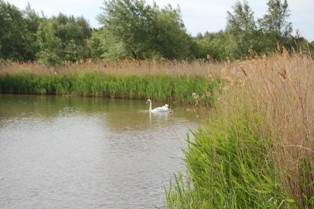
The swan family - rulers of the lake
The lake which is, I suppose the centre piece of the Park, is a haven for wild life – huge carp lurk beneath its surface and fishing is strictly forbidden. The edges are filled with a vast selection of ducks, moor hens and other water fowl. In the middle of the lake are tiny 'islands' where it is common to see birds sitting. On one of these a cormorant is often clearly visible standing like a statue, his wings outstretched as he dries them in the sun. Occasionally a heron might be spotted also standing perfectly still waiting for some movement on the surface heralding the sign of a small fish dinner! A family of swans have made the lake their home for many years and each year new families of cygnets are guided up and down the lake. They are clearly 'the rulers' of the lake - monarchs of all they survey. Indeed one of the memories that we have concerns the swans. We were walking around the lake on day when a dog jumped into the water. He swam out towards the swans and would take no notice of his owners’ calls to return. As he got nearer the swans the pen shepherded the cygnets away but the cob turned to face the dog who was by now well out of his depth. The cob did nothing until the dog approached. The poor dog was by now tired and, I guess, completely disorientated and the swan calmly swam up to him and forced the dog’s head under water - clearly intent on drowning this threat to his family. Crowds on the bank watched in horror. The dog’s owners were, of course, distraught. As the dog bobbed to the surface the cob backed off. Again the dog approached – low in the water, clearly exhausted and again it was forced under by the swan. When it emerged again the dog - I think by pure chance – found itself facing away from the swans and began to paddle in the opposite direction. Fortunately this was in the direction of the bank and the horrified owners. It was several minutes later before a very bedraggled dog, clearly exhausted and distressed, shambled up onto the bank. Its owners quickly put on its lead! Many parts of the Park are 'lead free' areas – around the lake is not one of them and the owners should have known better. I suspect they would not make the same error again.
In the bleak mid winter -
the frozen lake
 
The Country Park has, without a doubt, changed the face of the village. Instead of the forbidding old Depot we have a bright, 'useful' and enjoyable Country Park from which not only villagers benefit  but also people from a very wide area. Special events are regularly held – charity marathons and the like – indeed as I walked to my newsagents this morning the village was filled with road signs directing visitors to a 'special event' being held at the Park – a 'Rush4health Day'  to promote a healthy life style within the  Rushcliffe area. As I sit in my back garden this afternoon writing this blog I can vaguely hear in the distance an announcer speaking through a loud speaker to the people at the 'Rush4health Day' and every few minutes I can hear the sound of a steam train chugging along blowing its whistle – clearly the visitors are enjoying 'Thomas the Tank Engine' at the Heritage Railway! Many hundreds, perhaps thousands will be enjoying a day out.
Below the waters
huge carp lurk

The railway line and sidings
in the old depot - still in use by
 the Heritage Railway
It is easy to criticise government and local authorities such as Nottinghamshire County Council – indeed, I do it with great regularity and increasing venom. But in this case, Notts County Council, Rushcliffe Borough Council and the village’s own Parish Council have much to be proud of. But above all this the staff who work the country park are superb  -  it is rare for my wife and I not to make some comment as we walk around about some new wood sculpture, some thoughtful planting, the way that different areas of the park have a different 'feel'. Indeed this morning, as we walked we commented that a piece of fencing that had lain unfinished for a few days had been nicely finished off.  A new path had been laid and the fencing was obviously the last piece of the 'jig saw' – and this morning it was complete – and this is one of the joys – the Park is so well maintained by its staff, many of whom are volunteers.

One of the wonderful wood sculptures
For me one of the 'beauties' of the Park is that it is uncommercialised. There is a small refreshment kiosk near the children’s playground which seems to be open at the weekend and where an ice cream or a cup of tea can be purchased but there are no burger bars or gift shops or amusement arcades and the like – it is simply a place to come and enjoy for what it is.    In some areas you might be in some remote part of the countryside miles from anywhere and surrounded by tall grasses, but within a few minutes’ walk you might see a great stretch of open  parkland in front of you filled with Sunday afternoon visitors many of whom have brought garden chairs and a picnic! The list is endless – and that is probably its reason for success – there is something for everyone. A young family can come to enjoy the playground, look at the swans, play football on the grass and it doesn’t cost a thing unless they decide to splash out and buy  an ice cream. Equally, the dog walker can enjoy a quiet stroll and the serious walker has plenty of opportunities to stretch his or her limbs and stride out all day if they wish. For my wife and I, we can set off from our home and have  a 'short walk' around what we call 'the bottom path' and cover about a mile and a half and be back home for coffee in half an hour – as we did this morning. Or, if we are feeling fit we can go 'round the loop' and past the lake and over the railways lines –and come back rather exhausted having covered about three miles. Or, if we are feeling supremely fit (not so often these days!) we can go down the railway lines as well and this will mean a walk of about four miles by the time we get home. And we can do it in high summer or on Christmas Day – all for free! So much more useful and less intimidating than the old, ghostly 'Depot' – and in my book certainly much more use to mankind than a munitions dump! A few weeks ago we walked through the Park and over the railway bridge. We gazed down on the lines and sidings. In the distance were the railway sheds and the rolling stock, now used and maintained by the Heritage Railway Trust and manned by local enthusiasts. This branch line had been built to service the original war time Depot and it suddenly made me realise how easy it would have been for the military to transport anything in or out of the Depot without anyone knowing both during and after the war. The cynic and conspiracy theorist in me reflected on how little we know of what might go on under our very noses. Perhaps cruise missiles did indeed lay stored under the Depot - I wonder if they were all removed!
And another
Who would think you were only
 minutes from a busy village centre

A few years ago the local history society (http://www.ruddington-history.org.uk)  produced a wonderful book called 'From Bombs to Butterflies' to tell the story of the Depot and the Park – fascinating reading and a fascinating glimpse into local history and the place that a small Nottinghamshire village had in the war effort.